
Quick Answer
The Getty Center in Los Angeles holds over 160 illuminated medieval manuscripts with world-class conservation facilities that reveal hidden content in manuscript illuminations. Combined with the Huntington Library, Manly P. Hall's Philosophical Research Society, and UCLA's rare book collections, Los Angeles offers one of the richest environments for studying the intersection of medieval manuscript art, alchemy, and consciousness traditions.
Key Takeaways
- The Getty holds 160+ illuminated manuscripts spanning the 9th to 16th centuries, anchored by the 1983 Ludwig Collection acquisition that made it a world-class repository
- Medieval manuscripts contain encoded alchemical symbolism hidden within religious imagery, with bestiaries, Books of Hours, and scientific texts carrying dual-layer meaning
- Getty Conservation Institute analysis of mineral pigments (lapis lazuli, gold leaf, cinnabar, malachite) connects manuscript art directly to crystal healing and alchemical traditions
- Los Angeles uniquely combines major manuscript collections (Getty, Huntington), esoteric institutions (Philosophical Research Society), and university rare book holdings (UCLA, USC)
- Multispectral imaging at the Getty reveals hidden content beneath manuscript surfaces, potentially uncovering deliberately concealed alchemical instructions
Table of Contents
- The Getty's Medieval Manuscript Collection
- The Ludwig Collection Acquisition
- Alchemy Encoded in Medieval Illuminations
- Bestiaries and Alchemical Animal Symbolism
- Mineral Pigments and Crystal Connections
- Getty Conservation Institute and Hidden Content
- Los Angeles as Esoteric Research Hub
- Manly P. Hall and the Philosophical Research Society
- Visiting the Getty for Manuscript Research
- Frequently Asked Questions
The Getty Center's Medieval Manuscript Collection
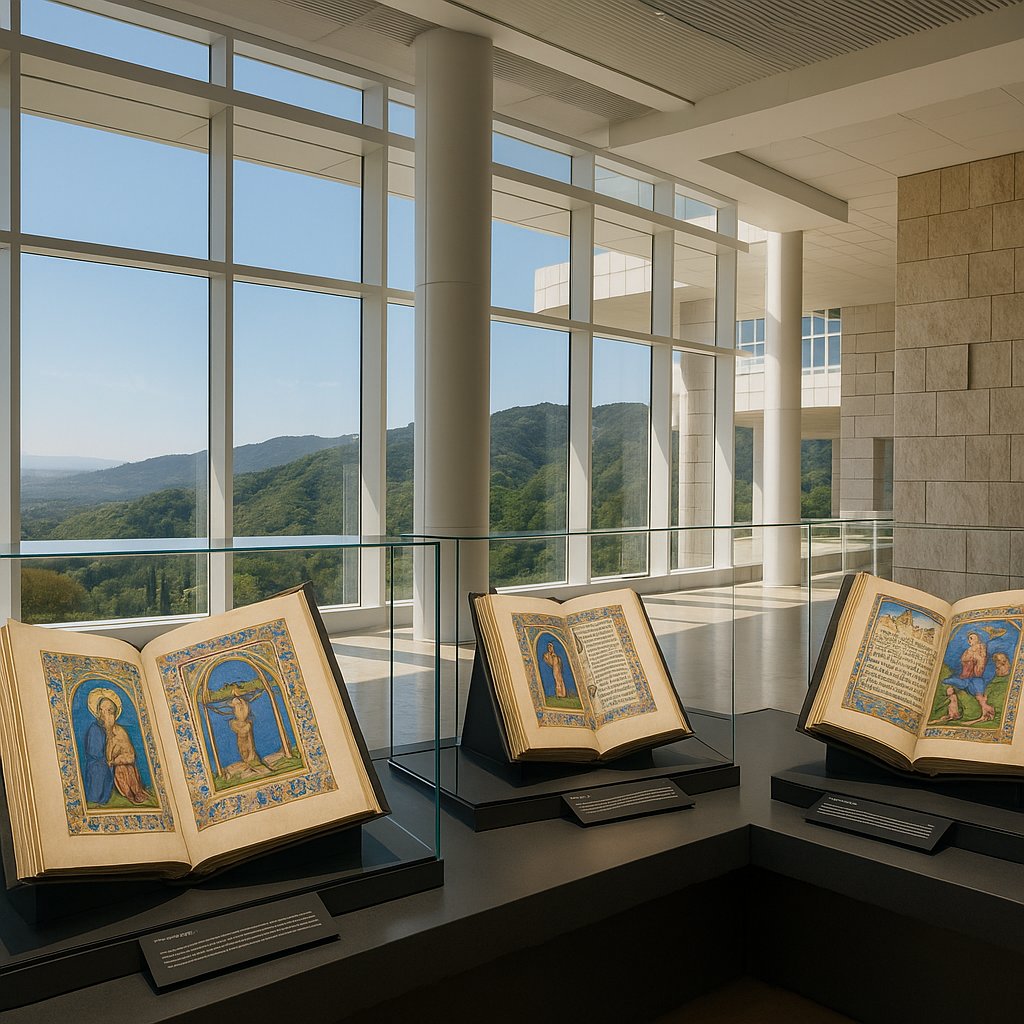
The J. Paul Getty Museum at the Getty Center in Brentwood, Los Angeles, holds one of the most important collections of illuminated manuscripts in North America. With over 160 complete manuscripts and thousands of individual leaves dating from the 9th to 16th centuries, the collection rivals those of major European institutions in quality if not quantity. What distinguishes the Getty's holdings is the consistently exceptional calibre of its acquisitions, each manuscript representing the finest work of its period and region.
The collection spans the full geographic and chronological range of Western manuscript illumination. French manuscripts, produced by the workshops that defined the art form during its golden age (13th-15th centuries), form a significant portion. Flemish manuscripts from Bruges, Ghent, and other centres of the Burgundian Netherlands represent the tradition's technical and artistic peak. German, Italian, English, and Spanish manuscripts provide comparative breadth. The earliest items date to the Carolingian and Ottonian periods (9th-11th centuries), when manuscript production was centred in monastery scriptoria and served as the primary vehicle for preserving and transmitting classical and sacred knowledge.
Among the Getty's most treasured manuscripts is the Stammheim Missal, a monumental liturgical manuscript produced around 1170 in Hildesheim, Germany. Its full-page miniatures display a synthesis of Byzantine and Romanesque artistic traditions, with gold backgrounds that transform each page into a luminous field. The Canon Tables of the Stammheim Missal use architectural frameworks that some scholars have connected to sacred geometric principles underlying both church architecture and alchemical laboratory design.
The Vidal Mayor, a 14th-century Aragonese legal manuscript, demonstrates how even secular texts could carry spiritual and symbolic dimensions. Its illuminations depict scenes of justice, governance, and human interaction that, when read through an alchemical lens, describe the process of refining crude matter (base human behaviour) into golden conduct (perfected social order). This parallel between social refinement and material transmutation was a consistent theme in medieval thought.
The Ludwig Collection: A significant Acquisition
The defining moment in the Getty's manuscript history came in 1983 when the museum acquired a major portion of the Ludwig Collection. Peter and Irene Ludwig, based in Aachen, Germany, had assembled one of the most important private collections of illuminated manuscripts formed in the 20th century. Their collection was renowned not just for individual masterpieces but for its comprehensive representation of European manuscript traditions.
The Ludwig acquisition transformed the Getty from a museum with some notable manuscript holdings into one of the world's premier manuscript repositories virtually overnight. The collection brought extraordinary examples from every major European school of illumination. German manuscripts from the Ottonian, Romanesque, and Gothic periods. Flemish manuscripts from the great Bruges and Ghent workshops. Italian manuscripts spanning the duecento through the high Renaissance. French manuscripts from the court workshops of Paris, Bourges, and Tours.
For researchers interested in alchemical connections, the Ludwig manuscripts are particularly valuable because of their chronological depth. The collection includes manuscripts from periods when alchemy was practiced openly (pre-13th century), periods when it was driven underground by ecclesiastical opposition (13th-15th centuries), and periods when it resurfaced in modified forms during the Renaissance (15th-16th centuries). This span allows researchers to trace how alchemical symbolism was encoded, concealed, and revealed across the tradition's most active centuries.
The Getty's decision to make the Ludwig manuscripts widely accessible through exhibition, publication, and digitization reflects a commitment to public scholarship that serves both academic researchers and interested visitors. Many Ludwig manuscripts have been published in detailed facsimile editions with scholarly commentary, and the Getty's online catalogue provides high-resolution images accessible from anywhere in the world.
Alchemy Encoded in Medieval Manuscript Illuminations
To understand why medieval manuscripts matter for alchemy research, it is necessary to understand the conditions under which alchemical knowledge was produced and transmitted. From the 13th century onward, the Catholic Church increasingly viewed alchemy with suspicion. Pope John XXII's 1317 decree Spondent quas non exhibent specifically condemned alchemical practice and the fraudulent production of gold. The Inquisition could prosecute alchemists for heresy, particularly when their work suggested theological positions at odds with Church doctrine.
This persecution forced alchemists to develop sophisticated methods for encoding their knowledge within forms the Church would not merely tolerate but actively commission and celebrate: religious manuscripts. The very institution that threatened alchemists also produced, consumed, and preserved the manuscripts in which alchemical knowledge could be hidden. The irony was functional: church libraries became the safest repositories for concealed alchemical teachings.
The encoding operated at multiple levels. At the most basic level, alchemical symbols were inserted into decorative borders and marginal illustrations where they could pass as ornament. More sophisticated encoding mapped alchemical stages onto biblical narratives. The most advanced encoding used the material properties of the manuscript itself (specific pigments, gold application techniques, proportional relationships in page layout) as carriers of technical alchemical information.
A Crucifixion scene, for example, could simultaneously serve as a devotional image and an alchemical diagram. The cross represented the furnace (Latin "crux" and "crucible" share etymological roots). Christ's death and burial represented the nigredo (putrefaction of matter). The three days in the tomb represented the period of transformation. The Resurrection represented the rubedo, the final stage producing the perfected stone. This layered reading did not diminish the religious meaning. For the alchemist, the spiritual and material processes were parallel expressions of the same universal transformation.
Medieval Bestiaries and Alchemical Animal Symbolism
Bestiaries, those beautifully illustrated catalogues of animals both real and fantastical, represent one of the richest sources of encoded alchemical symbolism in the medieval manuscript tradition. The Getty holds several important bestiaries, and understanding their alchemical dimension opens a layer of meaning that purely zoological or moralizing readings miss.
The pelican, one of the most frequently depicted bestiary animals, appears piercing its own breast to feed its young with its blood. The standard moralizing interpretation reads this as a symbol of Christ's self-sacrifice. The alchemical reading identifies the pelican with the philosopher's stone in its final stage: the perfected stone must dissolve itself (sacrifice its form) to produce the elixir of life (the blood that nourishes). This process, known as "multiplication," involves dissolving the completed stone and using the resulting liquid to transmute larger quantities of base metal. The pelican's blood feeding new life directly depicts this multiplicative process.
The phoenix rising from flames represented the rubedo, the final reddening stage of the Great Work. The bird's death in fire corresponded to the calcination (burning) of the alchemical material at extreme temperatures. Its rebirth from the ashes depicted the emergence of the purified substance in its perfected red form. The phoenix's unique nature (only one exists at any time, perpetually dying and being reborn) mirrored the alchemist's understanding that the stone is produced through a single, non-repeatable process of destruction and regeneration.
The salamander, depicted living within flames without being consumed, represented materials capable of withstanding the extreme temperatures of alchemical calcination. The unicorn, whose horn could purify poisoned water, represented mercury (quicksilver), which medieval alchemists believed purified base metals through its solvent properties. The ouroboros (serpent eating its own tail), while not typically a bestiary animal, appeared in manuscript margins and represented the cyclical, self-consuming nature of the alchemical process.
The green lion devouring the sun, another common manuscript motif, depicted the dissolution of gold in aqua regia (a mixture of nitric and hydrochloric acids). The lion's green colour identified it with vitriol (sulfuric acid, green in its copper-containing form), while the sun universally represented gold. This image, appearing in manuscripts across centuries, encoded a specific laboratory procedure within a symbolic form comprehensible only to those who knew the code.
Mineral Pigments: The Material Connection to Crystal and ORMUS Traditions
Every illuminated manuscript is, in a literal sense, a mineral artefact. The colours that still glow after five hundred or more years are ground stone, metal, and mineral, the same materials used in crystal healing, energy work, and ORMUS practices. The Getty Conservation Institute's extensive pigment analysis has documented these materials with scientific precision, providing a bridge between art history and mineral science.
Ultramarine, the most precious medieval blue, was ground from lapis lazuli imported from the mines of Badakhshan in northeastern Afghanistan. The journey along the Silk Road to European workshops took months and made the pigment more expensive than gold by weight. Manuscript artists reserved ultramarine for the most sacred elements: the Virgin's robe, the heavens, divine visions. In crystal traditions, lapis lazuli activates the third eye and throat chakras, supporting truth, intuition, and spiritual sight. The medieval use of this stone specifically for depicting spiritual vision may reflect an intuitive understanding of these properties.
Gold leaf connected manuscript art directly to the alchemical tradition and to modern ORMUS research. Beaten to approximately 0.1 micrometres (roughly 500 atoms thick), gold leaf exists at the boundary between bulk metal and atomic-scale material. At this thickness, gold becomes translucent and exhibits quantum surface effects different from bulk metal. The Getty's manuscripts display gold leaf in two primary techniques: flat gilding (gold applied to a smooth surface) and raised gilding (gold applied over gesso mounds to create three-dimensional relief). The raised technique creates small regions where the gold is even thinner than the standard leaf, potentially approaching the monoatomic scale at its thinnest points.
Vermillion (cinnabar, mercury sulfide) provided the vivid reds that define many Getty manuscripts. Cinnabar was one of the most important substances in both Chinese and European alchemical traditions. When heated, cinnabar releases liquid mercury, a process that medieval alchemists considered the first step in the Great Work. Every red initial, every rubric (the word itself comes from Latin "rubrica," red earth), connected the manuscript to this alchemical tradition. Carnelian and other red stones share this association with vitality, transformation, and the fire element.
Malachite and azurite, both copper carbonate minerals, provided green and blue pigments respectively. These minerals, commonly found in crystal healing collections (malachite for heart chakra work, azurite for third eye activation), ground easily into fine powder and produced stable, beautiful colours. Green aventurine and other green stones share copper's association with the heart centre and the colour green's alchemical connection to the vegetable kingdom and growth processes.
The Getty Conservation Institute: Revealing Hidden Manuscript Content
The Getty Conservation Institute (GCI), housed at the same hilltop campus as the museum, brings scientific methodology to manuscript study in ways that can reveal content medieval artists deliberately concealed. For alchemical manuscript research, these technologies offer the possibility of uncovering encoded knowledge that has been invisible for centuries.
Multispectral imaging captures manuscript pages under wavelengths ranging from ultraviolet through visible light to infrared. Each wavelength reveals different information. Ultraviolet fluorescence can distinguish between pigments that appear identical to the naked eye, revealing where artists used different materials despite producing similar visual effects. Infrared reflectography penetrates dark pigments to show underdrawings, the artist's preliminary sketches beneath the finished painting. These underdrawings sometimes contain content (geometric constructions, proportional guidelines, symbolic sketches) absent from the finished surface.
X-ray fluorescence (XRF) spectroscopy identifies the elemental composition of pigments by directing X-rays at the manuscript surface and analyzing the fluorescent X-rays emitted by each element present. This non-destructive technique can determine whether a blue area contains lapis lazuli (identified by the presence of sulfur) or azurite (identified by copper) without removing any material from the manuscript. For alchemical manuscripts, XRF can identify materials deliberately mixed into pigments, potentially revealing alchemical recipes encoded in the pigment formulations themselves.
Raman spectroscopy determines the molecular structure of materials by analyzing how they scatter laser light. This technique can distinguish between different crystal forms of the same chemical compound, identifying whether a mineral pigment was processed in specific ways that might have alchemical significance. The combination of XRF (what elements are present) and Raman spectroscopy (what molecular structures those elements form) provides a comprehensive chemical portrait of each pigment application.
These technologies have already produced surprising discoveries in non-alchemical manuscript research, including hidden texts, erased passages, and previously invisible illustrations beneath repainted surfaces. Applied systematically to manuscripts with suspected alchemical content, they could potentially reveal a layer of encoded knowledge that has waited centuries for the technology to detect it.
Los Angeles as an Esoteric Research Hub
Los Angeles might seem an unlikely centre for medieval manuscript and esoteric research, but the city's combination of world-class collections, academic institutions, and alternative spiritual communities creates a research environment with few parallels.
The Getty Center anchors the academic end of this ecosystem. Its manuscript collection, conservation facilities, research library, and public programming provide rigorous scholarly infrastructure. The Getty Research Institute, a separate entity from the museum housed on the same campus, maintains additional library and archival resources relevant to the history of art, culture, and ideas, including material on the history of science and alchemy.
The Huntington Library, Art Museum, and Botanical Gardens in nearby San Marino houses over 400,000 rare books and 11 million manuscript items. Founded by railroad magnate Henry Huntington, the collection includes significant holdings in early science, natural philosophy, and the occult sciences. The Huntington's Burndy Library, acquired in 2006, specializes in the history of science and technology, with strong alchemical representation. Researchers can access these materials through the Huntington's reading room with a valid research credential.
UCLA's William Andrews Clark Memorial Library, located in the West Adams district, focuses on 17th and 18th-century English civilization and includes significant holdings in early modern natural philosophy, which encompasses the later alchemical tradition. UCLA's main library Special Collections adds further depth in medieval and Renaissance studies. The USC Libraries contribute additional rare book holdings relevant to esoteric research.
The Philosophical Research Society, founded by Manly P. Hall in 1934, provides a resource that no other American city can match: a dedicated institution for esoteric scholarship with its own library, lecture programme, and research tradition spanning nine decades.
Manly P. Hall and the Philosophical Research Society
Manly Palmer Hall (1901-1990) stands as one of the most prolific and influential writers on esoteric traditions in the 20th century. Born in Peterborough, Ontario, he moved to Los Angeles as a young man and delivered his first public lecture at age 18. By 27, he had completed his magnum opus: "The Secret Teachings of All Ages" (1928), a lavishly illustrated encyclopedia of symbolism, mythology, philosophy, and esoteric tradition that remains in print nearly a century later.
Hall's treatment of alchemy in "The Secret Teachings" is particularly relevant to our subject. He devoted extensive chapters to alchemical symbolism, manuscript traditions, and the relationship between material transformation and spiritual development. His analysis of alchemical manuscripts, including detailed descriptions of the Aurora Consurgens, the Splendor Solis, and the Mutus Liber (the "Silent Book," an alchemical text composed entirely of images), provided generations of readers with access to manuscript traditions that would otherwise require visiting European rare book rooms.
In 1934, Hall founded the Philosophical Research Society (PRS) at its current location in the Los Feliz neighbourhood of Los Angeles. The institution houses a library of approximately 50,000 volumes covering comparative religion, philosophy, psychology, and esoteric studies, including rare alchemical texts and manuscript reproductions. The PRS continues to offer public lectures, study groups, and library access, maintaining Hall's vision of making esoteric knowledge accessible to serious students regardless of academic credentials.
For researchers combining Getty manuscript study with broader esoteric investigation, the PRS library provides complementary resources. Where the Getty offers original medieval manuscripts with cutting-edge conservation analysis, the PRS offers the interpretive framework for understanding those manuscripts' esoteric dimensions. A research visit incorporating both institutions accesses the material evidence and the interpretive tradition simultaneously.
Visiting the Getty Center for Manuscript Research
The Getty Center occupies a striking campus designed by architect Richard Meier atop a hill in the Santa Monica Mountains, offering panoramic views from downtown Los Angeles to the Pacific Ocean. The physical setting, with its natural light, stone surfaces, and carefully designed gardens, creates an environment well suited to contemplative study.
General access. Admission to the Getty Center is free. Parking (currently $20) is the primary cost for visitors arriving by car. The Getty Tram transports visitors from the parking structure to the hilltop campus. Public transit access is available via the Metro Expo Line to the Bundy station, with a shuttle connection. The museum is open Tuesday through Sunday. The Manuscripts Gallery displays rotating selections from the collection, with new manuscripts installed regularly.
Research access. Scholars requiring access to manuscripts not currently on display can apply through the Getty's Department of Manuscripts. A brief research statement describing your project is typically required. The reading room provides supervised access with appropriate handling protocols (pencil only, no direct contact with painted surfaces, support cradles for bound manuscripts). Conservation staff may be available for consultation about technical aspects of specific manuscripts.
Digital resources. The Getty's online catalogue and digital image collections provide substantial access to manuscript images without requiring an in-person visit. High-resolution images of many manuscripts are available through the museum's website, with zoom capability that reveals details difficult to see even in person. For preliminary research or distance researchers, these digital resources are invaluable.
A complete LA manuscript research circuit might include the Getty Center (morning, for medieval manuscripts and the Manuscripts Gallery), the Getty Villa in Pacific Palisades (afternoon, for antiquities providing alchemical origins context), the Huntington Library in San Marino (a separate day, requiring advance reservations), and the Philosophical Research Society in Los Feliz (open select hours, check schedule). This circuit provides access to materials spanning from ancient Egyptian mineral work through medieval European alchemy to modern esoteric interpretation, all within the Los Angeles metropolitan area.
The experience of viewing illuminated manuscripts in the Getty's carefully controlled lighting, where gold leaf catches and redirects light exactly as medieval artists intended, provides something that no reproduction can capture: a direct encounter with objects that were themselves conceived as vehicles for consciousness transformation. The mineral pigments ground from sacred stones, the gold beaten to atomic thinness, the encoded symbolism concealing and preserving forbidden knowledge, all converge in manuscripts that function simultaneously as art objects, historical documents, and tools for an inner work that continues today through practices including ORMUS research and consciousness exploration.
Art and Beauty in the Middle Ages by Eco, Umberto
View on AmazonAffiliate link, your purchase supports Thalira at no extra cost.
Frequently Asked Questions
What medieval manuscripts does the Getty Center have?
The Getty Museum holds one of the most important collections of illuminated manuscripts in North America, with over 160 complete manuscripts and thousands of individual leaves dating from the 9th to 16th centuries. The collection's strength lies in its exceptional quality rather than sheer volume. Highlights include the Stammheim Missal (German, circa 1170), the Vidal Mayor (a medieval legal text with remarkable illuminations), the Rudolf von Ems World Chronicle, and numerous Books of Hours from French, Flemish, and Italian workshops. The Getty acquired major portions of the Ludwig Collection in 1983, instantly establishing it among the world's premier manuscript repositories. The conservation and digital imaging facilities at the Getty are among the most advanced globally, producing high-resolution images that reveal details invisible to the naked eye.
How do Getty manuscripts connect to alchemical traditions?
While the Getty's collection focuses primarily on devotional and secular manuscripts rather than explicitly alchemical texts, many of its holdings contain encoded alchemical symbolism within their illuminations. Medieval manuscript artists frequently embedded alchemical knowledge within religious imagery to avoid Inquisition persecution. The Getty's bestiaries contain animal symbolism with dual alchemical meanings: the pelican feeding its young with its own blood represents the philosopher's stone, the phoenix represents transmutation through fire, and the ouroboros represents the cyclical nature of the Great Work. The Getty's scientific manuscripts, including astronomical and medical texts, intersect with alchemical theory because medieval science, medicine, and alchemy shared a unified worldview. The mineral pigments used in the illuminations themselves (lapis lazuli, gold leaf, cinnabar, malachite) create a material connection between manuscript art and alchemical practice.
What mineral pigments were used in the Getty's illuminated manuscripts?
The Getty Conservation Institute has conducted extensive scientific analysis of medieval pigments, identifying materials that connect manuscript art directly to mineral and crystal traditions. Ultramarine blue was ground from lapis lazuli imported from Afghanistan along the Silk Road, the same stone used in third eye and throat chakra crystal work. Gold leaf was beaten from pure gold to approximately 0.1 micrometres thickness. Vermillion was ground from cinnabar (mercury sulfide), a primary material of both Chinese and European alchemical practice. Azurite and malachite (both copper carbonates) provided blue and green respectively, both being minerals used in crystal healing traditions. Lead white, orpiment (arsenic trisulfide for yellow), and carbon black completed the basic palette. The Getty's technical analysis of these pigments has contributed significantly to understanding medieval manuscript production as a form of applied mineral science.
What makes Los Angeles significant for esoteric manuscript research?
Los Angeles offers a unique combination of manuscript resources, esoteric institutions, and research facilities. The Getty Center and Getty Villa together hold major manuscript collections with world-class conservation facilities. The Huntington Library in nearby San Marino houses over 400,000 rare books and manuscripts including alchemical material. UCLA's William Andrews Clark Memorial Library holds Renaissance-era printed texts on alchemy and natural philosophy. The Philosophical Research Society (PRS), founded by Manly P. Hall in 1934, maintains a library of esoteric texts including alchemical manuscripts and rare printed works. The UCLA Library's Special Collections and the USC Libraries add further research depth. Los Angeles's position as a centre for spiritual exploration and alternative thought creates a cultural context that supports esoteric manuscript research in ways that more conventional academic environments sometimes do not.
Who was Manly P. Hall and what is the Philosophical Research Society?
Manly Palmer Hall (1901-1990) was a Canadian-born author, lecturer, and mystic who became one of the 20th century's most influential writers on esoteric traditions. His magnum opus, 'The Secret Teachings of All Ages' (1928), written when he was just 27, remains the most comprehensive single-volume encyclopedia of esoteric symbolism, including extensive treatment of alchemical manuscripts and their hidden meanings. Hall founded the Philosophical Research Society (PRS) in 1934 in the Los Feliz neighbourhood of Los Angeles, creating a library, lecture hall, and research centre dedicated to comparative religion, philosophy, and esoteric studies. The PRS library contains rare alchemical texts, manuscript reproductions, and Hall's personal research collection. The institution continues to operate today, offering lectures, courses, and library access.
How does the Getty Conservation Institute study medieval manuscripts?
The Getty Conservation Institute (GCI) employs some of the most advanced analytical techniques available for studying medieval manuscripts. X-ray fluorescence (XRF) spectroscopy identifies elemental composition of pigments without physically sampling the material. Raman spectroscopy determines molecular structure of pigments and binding media. Multispectral imaging captures manuscript pages under different wavelengths of light, revealing underdrawings, erased text, and pigment layers invisible to the naked eye. Infrared reflectography penetrates dark pigments to show the artist's original drawing beneath painted surfaces. These techniques have revealed that many medieval manuscripts contain multiple layers of work, with preliminary sketches, corrections, and hidden content beneath the visible surface. For alchemical manuscripts, these technologies can potentially reveal encoded content deliberately concealed beneath decorative painting.
Can visitors see medieval manuscripts at the Getty Center?
Yes, the Getty Center displays medieval manuscripts in rotating exhibitions in its Manuscripts Gallery. Because illuminated manuscripts are light-sensitive, individual pages are displayed for limited periods and then rotated to prevent fading. This means each visit may present different manuscripts and different pages than previous visits. The Getty also hosts special exhibitions focused on specific themes or collections. General admission to the Getty Center is free (parking is charged). The Getty Villa in Malibu, which focuses on antiquities, occasionally displays manuscripts from the earliest periods of the collection. The Getty's digital resources provide high-resolution images of many manuscripts online, allowing detailed study before or after visiting in person. Research access to manuscripts not on display can be arranged through the Department of Manuscripts.
What is the Ludwig Collection and why does it matter?
The Ludwig Collection, assembled by Peter and Irene Ludwig of Aachen, Germany, was one of the most important private collections of illuminated manuscripts formed in the 20th century. The Getty acquired a major portion of this collection in 1983, transforming its manuscript holdings from a modest presence to a world-class collection virtually overnight. The Ludwig manuscripts include extraordinary examples from every major European school of illumination, with particular strengths in German, Flemish, and Italian manuscripts from the 12th through 16th centuries. The acquisition was significant not just for the quality of individual items but for the collection's comprehensiveness, providing the Getty with a representative survey of medieval illumination that supports comparative research across regions, periods, and artistic traditions.
How do medieval bestiaries encode alchemical knowledge?
Medieval bestiaries (illustrated books of animals) functioned as dual-purpose texts: surface-level natural history and moral instruction, with deeper alchemical meanings accessible to initiated readers. The pelican, depicted tearing open its own breast to feed its young with its blood, represented the philosopher's stone sacrificing its form to create the elixir of life, the alchemical concept of solve et coagula (dissolve and coagulate). The phoenix rising from flames depicted the final stage of transmutation (rubedo), where the material is destroyed by fire only to be reborn as the perfected stone. The salamander surviving fire represented materials that withstand calcination. The unicorn, whose horn purified poisoned water, represented mercury (quicksilver), which purifies base metals in alchemical processes. The Getty holds several important bestiaries whose animal illustrations contain these layered alchemical readings.
What is the connection between the Getty and ORMUS research?
The Getty's connection to ORMUS research is indirect but substantive, operating through three channels. First, the Getty's medieval manuscripts document the alchemical tradition that sought the philosopher's stone, a substance described in terms remarkably similar to monatomic gold (a white or red powder with transmutative, healing, and consciousness-enhancing properties). Second, the Getty Conservation Institute's pigment analysis reveals how medieval artists used the same minerals (gold, lapis lazuli, cinnabar) that feature in both alchemical and ORMUS practices. Third, the Getty's position in Los Angeles, near the Philosophical Research Society and multiple university research programs, places it within an ecosystem of esoteric scholarship that includes ORMUS research. For practitioners, studying alchemical manuscripts at the Getty provides historical depth for understanding the tradition that modern ORMUS research continues.
Sources and References
- Kren, T. and McKendrick, S. (2003). Illuminating the Renaissance: The Triumph of Flemish Manuscript Painting in Europe. Getty Publications.
- Hall, M.P. (1928). The Secret Teachings of All Ages. Philosophical Research Society. Chapters on alchemy and manuscript symbolism.
- Obrist, B. (2003). Visualization in Medieval Alchemy. HYLE: International Journal for Philosophy of Chemistry, 9(2), 131-170.
- Bucklow, S. (2009). The Alchemy of Paint: Art, Science and Secrets from the Middle Ages. Marion Boyars.
- Abraham, L. (1998). A Dictionary of Alchemical Imagery. Cambridge University Press.
- Principe, L.M. (2013). The Secrets of Alchemy. University of Chicago Press.
- Getty Conservation Institute. (2020). Technical Studies of Illuminated Manuscripts: Methodologies and Case Studies. Getty Publications.
- von Franz, M.-L. (1980). Alchemy: An Introduction to the Symbolism and the Psychology. Inner City Books.