
Quick Answer
The Morgan Library and Museum in Manhattan houses over 1,360 medieval and Renaissance manuscripts, many containing encoded alchemical symbolism within their illuminations. Founded by J.P. Morgan, the collection includes scientific manuscripts covering alchemy, astronomy, and medicine, with mineral pigments like lapis lazuli and gold leaf connecting manuscript art directly to crystal healing and ORMUS traditions.
Key Takeaways
- The Morgan Library holds 1,360+ medieval manuscripts, assembled by J.P. Morgan, the greatest collector of his century, with specific reference holdings covering alchemy, astrology, and medieval science
- Medieval alchemists encoded consciousness teachings within religious manuscripts to avoid Inquisition persecution, making Books of Hours and bestiaries carriers of hidden alchemical knowledge
- Manuscript pigments connect directly to crystal healing: ultramarine from lapis lazuli, gold leaf from beaten gold, vermillion from cinnabar, and malachite green from copper carbonate
- The Aurora Consurgens and Splendor Solis represent the pinnacle of alchemical manuscript illustration, depicting the stages of the Great Work through symbolic imagery still studied by ORMUS researchers
- NYC offers unmatched manuscript research access through the Morgan, Columbia's Butler Library, the NYPL, the Met's Cloisters, and the New York Academy of Medicine
Table of Contents
- The Morgan Library's Medieval Collection
- Pierpont Morgan: The Collector Behind the Collection
- Great Alchemical Manuscripts of the Medieval World
- How Alchemists Hid Teachings in Manuscript Art
- Mineral Pigments: Where Manuscript Art Meets Crystal Healing
- Gold Leaf as Spiritual Technology
- The Philosopher's Stone and Modern ORMUS
- NYC's Complete Manuscript Research Circuit
- Practical Guide to Researching at the Morgan
- Frequently Asked Questions
The Morgan Library's Medieval Manuscript Collection
The Morgan Library and Museum at 225 Madison Avenue in midtown Manhattan holds one of the world's most significant collections of medieval and Renaissance manuscripts. Spanning approximately ten centuries of Western illumination, the collection comprises over 1,100 manuscripts in its core holdings, with additional collections (Glazier, Heineman, Buhler, Stillman, and Wightman) adding more than 200 additional items. The total exceeds 1,360 manuscripts, a concentration of medieval material rivalled only by the British Library, the Bibliotheque nationale de France, and the Vatican Library.
The collection's scope extends well beyond the devotional manuscripts for which it is best known. While Books of Hours, psalters, and bibles form the numerical majority, the Morgan holds scientific manuscripts dealing with astronomy, medicine, agriculture, hunting, warfare, and, significantly for our purposes, alchemy. The library's reference collection development policy explicitly includes works on "the calendar, astrology, alchemy, zoology, medicine, and early globes and mapmaking," confirming the institution's ongoing commitment to acquiring material in these esoteric fields.
The geographic diversity of the collection is extraordinary. French manuscripts form the largest national group, followed by Italian, English, German, Flemish, Dutch, and Spanish holdings. Armenian, Syriac, Coptic, Ethiopian, Arabic, Persian, and Indian manuscripts provide non-Western perspectives. This breadth is significant for alchemical research because alchemy was fundamentally a cross-cultural practice, flowing from Egyptian and Arabic origins through Byzantine channels into medieval European laboratories. A collection spanning all these traditions allows researchers to trace alchemical ideas across the cultural boundaries that carried them.
Among the Morgan's most celebrated holdings are the ninth-century bejewelled Lindau Gospels (with their extraordinary metalwork cover containing gold, precious stones, and pearls arranged in patterns some scholars associate with sacred geometry), the tenth-century Beatus Apocalypse commentary (whose vivid illustrations of cosmic transformation parallel alchemical stage imagery), the Hours of Catherine of Cleves (one of the most lavishly illuminated manuscripts ever created), and the Farnese Hours (containing some of the finest Renaissance miniature painting in existence).
Pierpont Morgan: The Collector Behind the Collection
John Pierpont Morgan (1837-1913) was not merely a wealthy man who bought things. He was, by virtually universal scholarly assessment, the greatest collector of his century, and his collecting was driven by instincts that went deeper than investment or prestige. Understanding Morgan's motivations illuminates why his collection contains the material it does.
Morgan's father, Junius Spencer Morgan, was a London-based banker who exposed his son to European art and culture from childhood. The younger Morgan developed an eye for quality that became legendary. He did not collect comprehensively or systematically as institutions do. He collected passionately and personally, gravitating toward objects that combined exceptional craftsmanship with deep historical significance. His library, commissioned in 1902 and completed in 1906 by architect Charles McKim, was designed specifically to house "the collections closest to his heart": autograph manuscripts, rare books and bindings, old master drawings, Mesopotamian cylinder seals, papyri, and medieval illuminated manuscripts.
Morgan's most important bulk acquisition came in 1902 when he purchased 110 illuminated manuscripts from the collection of Richard Bennett. This single purchase included 29 manuscripts that had previously belonged to William Morris, the Arts and Crafts movement leader who was himself deeply interested in medieval craft traditions and their connection to spiritual practice. Morris's interest in medieval manuscripts was not purely aesthetic. He saw in them evidence of a unified creative consciousness that industrial modernity had fragmented, an understanding that connects to the alchemical worldview of transforming base conditions into golden ones.
Morgan's collecting extended to Mesopotamian cylinder seals and Egyptian antiquities, both fields with direct connections to the origins of alchemy. Mesopotamian seals depicted celestial alignments and divine-human interactions that prefigured alchemical cosmology. Egyptian artefacts from the periods when temple alchemy flourished at sites like Serabit el-Khadim gave Morgan's collection an unusually deep timeline for tracing the alchemical tradition from its origins through its medieval flowering.
Great Alchemical Manuscripts of the Medieval World
While the Morgan's specific alchemical holdings merit research attention, understanding the broader tradition of alchemical manuscript production provides essential context. Several manuscripts represent the highest achievements of combining visual art with encoded spiritual and chemical knowledge.
The Aurora Consurgens (Rising Dawn), created around 1410, stands as one of the most important alchemical manuscripts in existence. Once wrongly attributed to Thomas Aquinas (a misattribution that itself reveals how closely alchemy and mainstream theology intertwined in the medieval mind), the text is actually a commentary on "The Silvery Water" (al-Ma al-Waraqi), a classic of 10th-century Islamic alchemy written by Ibn Umayl. The Aurora Consurgens is famous for its richly illuminated illustrations that depict alchemical processes through human and animal figures alongside masterfully rendered transparent glass vessels.
The manuscript's symbolic language is densely layered. The coupling of sun and moon represents the unification of opposite principles: female and male, passive and active, cold and hot, moist and dry. This cosmological motif symbolizes the generation of all things through the union of complementary forces, a concept central to both alchemy and consciousness research. An eagle and a dragon represent mercury in its volatile and solidified states respectively. An illustration of Mercury decapitating the sun and moon beside a vase filled with silver and gold flowers encodes the process of dissolving metallic gold and silver to release their spiritual essence.
The Splendor Solis (The Shining Sun), produced in the 1530s, is widely considered the most magnificent alchemical manuscript ever created. Drawing heavily on the Aurora Consurgens, it contains 22 elaborate miniature paintings depicting the stages of the alchemical Great Work with extraordinary artistic skill. The peacock with its iridescent feathers symbolizes the cauda pavonis (peacock's tail), the stage when the dark contents of the alchemical vessel suddenly display rainbow colours, indicating that the fixed principles are beginning to separate and transform. The Splendor Solis exists in approximately 20 copies, with the finest held by the British Library and the Berlin State Library.
The Rosarium Philosophorum (Rose Garden of the Philosophers), first printed in 1550 but based on earlier manuscript sources, presents the alchemical process through a famous sequence of images showing a king and queen meeting, disrobing, joining in union, dying together in a shared grave, and being reborn as a unified hermaphrodite figure. This imagery influenced Carl Jung's psychological interpretation of alchemy, which understood the process as a metaphor for individuation, the integration of conscious and unconscious aspects of the psyche. Jung's 1946 work "The Psychology of the Transference" used the Rosarium images as the structural framework for understanding therapeutic relationships.
The Ripley Scrolls, dating from the late 15th century and attributed to English alchemist George Ripley, present the entire alchemical process on continuous scrolls up to six metres long. The scroll format itself carries meaning: the work unfolds as a continuous process, not a series of discrete steps. Multiple copies survive in various collections, and their imagery of serpents, dragons, fountains, and crowned figures encodes both laboratory procedures and consciousness transformation practices.
How Medieval Alchemists Encoded Teachings in Manuscript Art
Medieval alchemists operated under constant threat. The Church viewed alchemy with suspicion, and several papal bulls (including John XXII's 1317 decree Spondent quas non exhibent) explicitly condemned alchemical practice. The Inquisition could and did prosecute alchemists for heresy, particularly when their work touched on creating the philosopher's stone (seen as usurping divine creative power) or when their writings suggested unorthodox theology. This threat forced alchemists to develop sophisticated encoding techniques that concealed forbidden knowledge within forms the Church would accept.
The primary technique was symbolic embedding within religious imagery. A crucifixion scene might depict the cross as a furnace, with the body on the cross representing the "death" stage (nigredo) of the alchemical process. The resurrection naturally represented the rubedo, the final reddening stage that produced the philosopher's stone. By mapping alchemical stages onto the most sacred Christian narrative, alchemists created manuscripts that could be read devotionally by the uninitiated and alchemically by those who held the key.
Colour sequences served as another encoding layer. Medieval manuscripts used specific pigment progressions that tracked alchemical stages. A manuscript that moved from dark imagery (black ink, deep blues) through white and silver tones to red and gold was simultaneously beautiful as art and instructional as an alchemical process map. The stages ran: nigredo (blackening, putrefaction, depicted through darkness and death imagery), albedo (whitening, purification, depicted through silver, moonlight, and washing), citrinitas (yellowing, sometimes omitted in later traditions), and rubedo (reddening, completion, depicted through red, gold, and sunrise).
Bestiary imagery carried alchemical meaning through established symbolic codes. The pelican, depicted feeding its young with blood from its own breast, represented the philosopher's stone dissolving itself to create the elixir of life. The phoenix rising from flames depicted the final stage of transformation, where the material "dies" in fire only to be reborn as the stone. The ouroboros (serpent eating its own tail) represented the cyclical nature of the alchemical process. The green lion devouring the sun depicted the dissolution of gold in acid (the "green lion" being vitriol, or sulfuric acid).
Geometric patterns in manuscript borders encoded proportional relationships. The ratios used in decorative borders sometimes specified the proportions of ingredients in alchemical recipes, with the height-to-width ratios of framing elements corresponding to weight ratios of mercury, sulfur, and salt in laboratory preparations. A skilled alchemist examining a manuscript's decorative programme could extract procedural information invisible to an untrained eye.
Mineral Pigments: Where Manuscript Art Meets Crystal Healing
The creation of a medieval illuminated manuscript was, in a very literal sense, an alchemical act. The pigments used to create the brilliant colours that still glow after centuries were ground from the same minerals used in crystal healing, energy work, and consciousness practice. Understanding these materials reveals a material connection between manuscript art and spiritual traditions that extends far beyond metaphor.
Ultramarine, the most expensive and prestigious blue pigment in the medieval palette, was ground from lapis lazuli. This semi-precious stone, imported primarily from mines in Badakhshan (modern Afghanistan) along the Silk Road, commanded prices exceeding those of gold. The grinding and purification process required days of careful work to separate the blue mineral (lazurite) from its grey host rock. In crystal healing traditions, lapis lazuli is associated with the third eye chakra, truth-speaking, and spiritual insight. Its use in manuscripts depicting divine visions, heavenly scenes, and moments of spiritual revelation suggests medieval artists intuitively understood the connection between the stone's spiritual properties and its visual application.
Gold leaf, applied through the gilding process, used real gold beaten to approximately 0.1 micrometres thickness. At this extreme thinness, roughly 500 atoms across, gold begins exhibiting quantum properties distinct from bulk metal: it becomes translucent, transmits green or purple light, and its surface atoms behave differently from interior atoms. Medieval gilders spoke of "releasing the spirit of gold" through the beating process, language that directly parallels ORMUS practitioners' descriptions of transforming metallic gold into its monoatomic, high-spin state. The burnishing process, where the applied gold leaf is polished with an agate stone, uses friction to create the brilliant reflective surface that made medieval manuscripts seem to generate their own light.
Vermillion, the vivid red pigment used for important initials and rubrics (from the Latin "rubrica," meaning red earth), was ground from cinnabar (mercury sulfide, HgS). Cinnabar was the primary material of Chinese alchemical practice and one of the most important substances in the Western alchemical tradition. Mercury, released from cinnabar through heating, was considered one of the three prime principles of alchemy (alongside sulfur and salt). Every time a medieval scribe wrote a red initial, they were literally handling alchemical material.
Malachite provided green pigment from the same copper carbonate mineral used in heart chakra crystal work. Azurite, another copper carbonate mineral, produced a deep blue that preceded ultramarine for affordability. Green aventurine and other green stones share copper's association with the heart centre and growth energy, connecting the manuscript's green imagery to traditions of heart-centred spiritual development.
Orpiment (arsenic trisulfide) produced a brilliant yellow associated with gold and solar energy. Realgar (arsenic disulfide) created orange-red tones. Both arsenic minerals were known to be toxic, and their careful handling by manuscript artists parallels the alchemist's careful handling of dangerous laboratory materials. The willingness to work with poisonous substances to create beauty and encode knowledge reflects the alchemical principle that transformation requires encountering and mastering dangerous forces.
Gold Leaf as Spiritual Technology
The use of gold in medieval manuscripts merits special attention because it connects manuscript illumination directly to the ORMUS and monatomic gold traditions. Gold was not merely decorative in medieval manuscripts. It was understood as carrying spiritual properties that enhanced the manuscript's function as a tool for contemplation and consciousness development.
The medieval gilding process involved several stages, each with both practical and symbolic dimensions. First, a ground layer (bole) of red or yellow clay was applied where gold would appear. This preparatory layer, typically made from Armenian bole (a red iron oxide clay), provided both adhesion and a warm undertone that intensified the gold's visual warmth. The choice of red clay beneath gold echoes the alchemical principle that the rubedo (reddening) provides the foundation for the final golden stage.
The gold itself was prepared by goldsmiths who specialized in beating metal into leaf form. Starting with a small nugget, the beater progressively flattened the gold between sheets of animal membrane (goldbeater's skin), eventually producing sheets so thin that light passed through them. This mechanical processing reduced gold from a three-dimensional metallic mass to a two-dimensional film where quantum surface effects began to dominate. The alchemical language used by goldsmiths described this as "liberating" the gold from its material heaviness, a description that parallels David Hudson's descriptions of gold transitioning from metallic to monoatomic states.
Applied to the manuscript page and burnished with an agate or animal tooth, the gold leaf created surfaces that reflected and scattered light in ways that changed with the viewer's angle and the ambient illumination. In candlelit medieval churches and monasteries, where these manuscripts were primarily used, the gold surfaces would catch and redirect candlelight, creating a living, moving illumination that responded to the reader's movements and the flickering light. This interactive luminosity transformed reading from passive reception to active engagement, a form of consciousness practice embedded in the physical object.
The theological justification for using gold was that it represented divine light, the uncreated light of God's presence. But this justification may have encoded a more specific understanding: that gold, particularly gold processed to extreme thinness, exhibited properties that genuinely affected the consciousness of those who contemplated it. The enormous expense of gold illumination (a single manuscript could require more gold than a craftsman earned in years) suggests the effect was considered valuable enough to justify extraordinary investment.
The Philosopher's Stone and Modern ORMUS Research
The ultimate goal of medieval alchemy, the philosopher's stone, provides the clearest connection between manuscript traditions and modern ORMUS research. Understanding what medieval alchemists actually described, as opposed to popular caricatures of the tradition, reveals striking parallels to contemporary monatomic element research.
The philosopher's stone was consistently described as a powder, not a stone. Depending on the stage of its preparation, it appeared as a white powder (the white stone, associated with silver and the albedo stage) or a red powder (the red stone, associated with gold and the rubedo stage). Both descriptions match monatomic gold's appearance at different preparation stages. ORMUS precipitate in its initial form is white. When processed through additional heating stages, it can take on reddish tones.
The stone's three traditional powers, transmutation of base metals into gold, curing of all diseases (the universal medicine or panacea), and granting of spiritual illumination, map onto three categories of effects reported by modern ORMUS practitioners. While the literal transmutation of lead to gold remains unconfirmed, the health-supporting and consciousness-enhancing properties of monoatomic preparations are consistently reported by practitioners worldwide.
The alchemical Great Work, the process of creating the philosopher's stone, followed a defined sequence of stages that medieval manuscripts illustrated extensively. The nigredo (blackening) involved putrefaction and dissolution of the starting material. The albedo (whitening) involved purification and washing. The rubedo (reddening) involved the final fixation and multiplication of the stone. This sequence parallels ORMUS wet-method extraction remarkably: the starting material (seawater or mineral water) undergoes pH adjustment (dissolution), the resulting precipitate is washed repeatedly (purification), and the final concentrate is sometimes subjected to additional processing.
For those interested in experiencing the substance that medieval alchemists may have been pursuing, Aultra Monatomic Gold provides a laboratory-tested monoatomic gold preparation. The NOVA Dead Sea Salt ORMUS uses mineral-rich source material similar to what alchemical traditions describe as ideal starting material for the Great Work.
NYC's Complete Manuscript Research Circuit
New York City offers researchers an unmatched concentration of medieval manuscript resources. A dedicated research visit combining multiple institutions provides access to material that collectively spans the entire history of the alchemical manuscript tradition.
The Morgan Library and Museum (225 Madison Avenue) anchors any manuscript research itinerary. Beyond its permanent collection, the Morgan mounts rotating exhibitions that frequently feature medieval manuscripts. The Reading Room provides supervised access to materials not on public display, available to qualified researchers by application through the Morgan's website. The CORSAIR online catalogue allows preliminary searching before visiting.
The Metropolitan Museum of Art and its medieval branch, The Cloisters (Fort Tryon Park, Washington Heights), house important manuscript holdings within their Medieval Art and Medieval Hall galleries. The Cloisters' setting within a reconstructed medieval monastery creates an environment that contextualizes manuscript study within the spiritual architecture that originally housed these works. The Unicorn Tapestries at the Cloisters, while not manuscripts, contain densely layered alchemical symbolism in their depiction of the capture, death, and resurrection of the unicorn (a well-known alchemical symbol for mercury and the philosopher's stone).
Columbia University's Butler Library and Rare Book and Manuscript Library hold medieval scientific texts including alchemical material within their Special Collections. Columbia's strong programs in medieval studies and history of science create an academic context for manuscript research that the museum collections complement.
The New York Public Library (Fifth Avenue at 42nd Street) holds manuscript material in its Berg Collection and Manuscripts and Archives Division. The NYPL's vast printed book collection also includes early printed alchemical texts (incunabula) from the 15th and 16th centuries, bridging the gap between manuscript and print traditions of alchemical knowledge transmission.
The New York Academy of Medicine (1216 Fifth Avenue) maintains a rare book room with historical medical and alchemical texts. Medieval medicine and alchemy were deeply intertwined, with many physicians practicing alchemy and many alchemists producing medicines. The Academy's collection illuminates this intersection in ways that art museum collections typically do not.
Practical Guide to Researching at the Morgan
For those planning to research alchemical and esoteric themes in the Morgan's collection, several practical considerations will help maximize the experience.
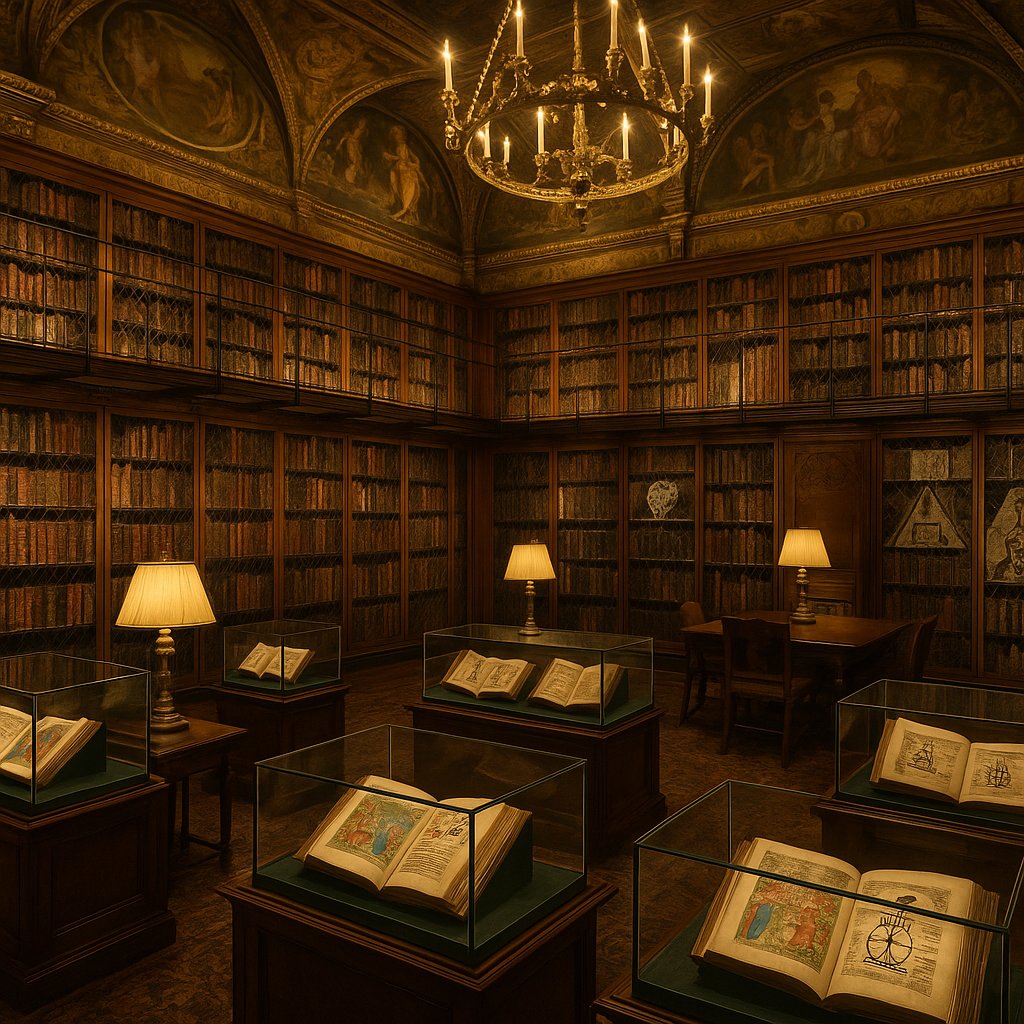
General visits. The Morgan is open Tuesday through Sunday with varying hours (check themorgan.org for current schedule). General admission provides access to all current exhibitions. The permanent installation of Pierpont Morgan's original library room, with its three tiers of bookshelves, Renaissance ceiling, and massive fireplace, is itself worth the visit as an example of how a collector created a sacred space for contemplating his holdings.
Research access. Researchers seeking to examine specific manuscripts can apply for Reading Room access through the Morgan's website. Applications require identifying yourself and briefly describing your research interest. Approval typically takes a few business days. Reading Room rules include pencil-only note-taking (no pens near manuscripts), no food or drink, and careful handling protocols for fragile materials. Photography policies vary and should be confirmed in advance.
Online resources. The Morgan's CORSAIR catalogue (corsair.themorgan.org) provides searchable access to collection records and, in many cases, high-resolution digital images of manuscript pages. For preliminary research, the Images from Medieval and Renaissance Manuscripts (ICA) database provides additional visual access. These digital resources allow focused preparation before an in-person visit.
Complementary reading. Before visiting, familiarize yourself with the key alchemical manuscripts discussed above (Aurora Consurgens, Splendor Solis, Rosarium Philosophorum) through published facsimile editions available at many academic libraries. Understanding the visual vocabulary of alchemical illustration before encountering medieval manuscripts in person allows recognition of encoded content that might otherwise pass unnoticed. Lyndy Abraham's "A Dictionary of Alchemical Imagery" (Cambridge, 1998) provides an essential reference for decoding symbolic content.
The experience of viewing medieval manuscripts in person, of seeing the gold leaf catch light and the lapis lazuli ultramarine glow with a depth no reproduction captures, provides something that digital images and printed reproductions cannot: a direct encounter with objects that were themselves conceived as tools for consciousness transformation. The alchemists who created these works understood that their art functioned on levels beyond the intellectual, engaging the viewer's consciousness through the material properties of gold, minerals, and meticulously crafted visual symbolism in ways that seven centuries have not diminished.
The Secrets of Alchemy by Principe, Lawrence M.
View on AmazonAffiliate link, your purchase supports Thalira at no extra cost.
Frequently Asked Questions
What alchemical manuscripts does the Morgan Library hold?
The Morgan Library and Museum houses over 1,360 medieval and Renaissance manuscripts, with its reference collection specifically covering alchemy alongside astrology, zoology, and medicine. While the Morgan's primary strengths are in devotional manuscripts (Books of Hours, psalters, bibles), several holdings contain alchemical symbolism embedded within ostensibly religious texts. Medieval alchemists frequently encoded their teachings within religious manuscripts to avoid persecution, making many Books of Hours and bestiaries carriers of dual-layer meaning. The Morgan's collection of scientific manuscripts dealing with astronomy and medicine also contains material touching alchemical theory, as medieval science, medicine, and alchemy were deeply intertwined disciplines rather than separate fields.
Who was Pierpont Morgan and why did he collect medieval manuscripts?
John Pierpont Morgan (1837-1913) was the most powerful American financier of his era and is acknowledged as the greatest collector of his century. Within approximately twenty years before his death, he assembled vast collections spanning antiquities, paintings, sculptures, and decorative objects. However, the building he commissioned in 1902 (completed 1906) was designed specifically to house the collections closest to his heart: autograph manuscripts, rare books, old master drawings, and medieval manuscripts. His most significant bulk purchase came in 1902 when he acquired 110 illuminated manuscripts from the Richard Bennett collection, including 29 manuscripts previously owned by William Morris. Morgan's collection has more than doubled since his death to over 1,360 items.
What is the Aurora Consurgens and why does it matter for alchemy?
The Aurora Consurgens (Rising Dawn) is a 15th-century alchemical treatise famous for its richly illuminated illustrations. Created around 1410 and once wrongly attributed to St. Thomas Aquinas, it is actually a commentary on 'The Silvery Water,' a classic of 10th-century Islamic alchemy by Ibn Umayl. The manuscript's illustrations use human and animal figures alongside transparent glass vessels to depict alchemical stages of transformation. Key symbolic elements include the coupling of sun and moon (representing the unification of opposites: male/female, active/passive, hot/cold), Mercury decapitating the sun and moon, and eagles and dragons representing volatile and solidified mercury. The Aurora Consurgens directly influenced the later Splendor Solis, considered the most magnificent alchemical manuscript ever produced.
How did medieval alchemists hide teachings in manuscript illustrations?
Medieval alchemists developed a sophisticated visual code system to encode forbidden knowledge within seemingly innocent religious manuscripts. Techniques included embedding alchemical symbols within biblical scenes (a serpent on a cross representing mercury sublimation, not just the bronze serpent of Numbers), using colour sequences that mapped to alchemical stages (black for nigredo/putrefaction, white for albedo/purification, red for rubedo/completion), and placing geometric patterns in manuscript borders that encoded proportional relationships used in laboratory work. Animals in bestiaries carried double meanings: the pelican feeding its young with its own blood represented the philosopher's stone dissolving to create the elixir, and the phoenix rising from flames depicted the final stage of transmutation. This encoding protected alchemists from Inquisition charges of heresy while preserving their knowledge for initiated readers.
What is the Splendor Solis and what do its illustrations depict?
The Splendor Solis (The Shining Sun) is widely considered the most magnificent alchemical manuscript ever produced. Created in the 1530s and drawing heavily on the earlier Aurora Consurgens, it contains 22 elaborate miniature paintings depicting the stages of the alchemical Great Work. Each illustration uses rich symbolism: humans, birds, and animals represent particular stages of the transformation process. The peacock with its iridescent feathers symbolizes the cauda pavonis (peacock's tail), the stage when black contents suddenly turn rainbow-coloured. Other images depict the king dissolving in water (dissolution of gold), the hermaphrodite (union of opposites), and the red king emerging triumphant (completion of the philosopher's stone). The manuscript exists in approximately 20 copies, with the finest held by the British Library and the Berlin State Library.
What pigments in medieval manuscripts connect to crystal healing?
Medieval manuscript illumination used mineral pigments with direct connections to crystals used in spiritual practice. Ultramarine blue was ground from lapis lazuli, the same stone associated with third eye activation and truth-speaking in crystal healing traditions. Gold leaf, applied through a process called gilding, used real gold beaten to extreme thinness, connecting to monatomic gold and ORMUS traditions. Vermillion came from cinnabar (mercury sulfide), the primary material of Chinese alchemical practice. Malachite provided green pigment from the same copper carbonate mineral used for heart chakra work. Azurite (another copper mineral) produced deep blue. Orpiment and realgar (arsenic sulfides) produced yellow and orange. These mineral pigments meant that creating an illuminated manuscript was literally an alchemical process, transforming raw minerals into vehicles for spiritual knowledge.
Where else in New York can you research alchemical manuscripts?
New York City offers exceptional resources for alchemical manuscript research beyond the Morgan Library. Columbia University's Butler Library and Rare Book and Manuscript Library hold medieval scientific texts including alchemical material within their Special Collections. The New York Public Library's Berg Collection and Manuscripts and Archives Division contain relevant holdings. The Metropolitan Museum of Art's Department of Medieval Art and the Cloisters (their medieval branch in Fort Tryon Park) display illuminated manuscripts with alchemical symbolism. The New York Academy of Medicine's rare book room holds historical medical and alchemical texts. The Grolier Club, America's oldest bibliophilic society, occasionally exhibits alchemical material. NYU's Institute for the Study of the Ancient World provides academic context for Hellenistic and Arabic alchemical traditions that preceded medieval European alchemy.
How does the philosopher's stone tradition connect to ORMUS?
The philosopher's stone, the ultimate goal of medieval alchemy, was described not as a literal stone but as a white or red powder with the power to transmute base metals into gold, cure all diseases, and grant spiritual illumination. These descriptions closely parallel modern ORMUS research: monatomic gold in its dried form is a fine white powder, David Hudson documented unusual properties including apparent superconductivity, and practitioners report consciousness-enhancing effects. Medieval alchemists described their Great Work as transforming crude matter through stages (nigredo, albedo, rubedo) to produce the 'stone,' just as ORMUS practitioners transform metallic gold or mineral-rich water through chemical processes to produce monoatomic elements. The continuity of description across seven centuries suggests either a continuous tradition of working with the same materials or independent rediscovery of the same phenomena.
Can you visit the Morgan Library to see alchemical manuscripts?
Yes, the Morgan Library and Museum at 225 Madison Avenue in Manhattan is open to the public. General admission provides access to rotating exhibitions that frequently include medieval manuscripts. To view specific manuscripts not currently on display, researchers can apply for access to the Reading Room through the Morgan's website. Applications require a brief statement of research purpose and are typically approved within a few days. The Morgan's CORSAIR online catalogue allows searching the collection before visiting. Photography policies vary by exhibition. The Morgan also offers guided tours, lectures, and educational programs that sometimes address alchemical and esoteric themes within their medieval holdings. Combining a Morgan visit with the Metropolitan Museum's medieval galleries and the Cloisters creates a comprehensive day of medieval manuscript exploration.
What is the connection between gold leaf in manuscripts and monatomic gold?
Gold leaf used in medieval manuscript illumination was beaten to approximately 0.1 micrometres thickness, roughly 500 atoms across. At this extreme thinness, gold begins exhibiting quantum properties different from bulk metal: it becomes translucent, appears green or purple rather than gold-coloured when light passes through it, and its surface atoms behave differently from interior atoms. Some researchers note that the mechanical beating process used to create gold leaf could theoretically produce monoatomic gold at the leaf's thinnest points, where individual atoms become separated from the metallic lattice structure. Medieval gilders described their craft using language remarkably similar to alchemical transformation, speaking of 'releasing the spirit of gold' through beating and burnishing. The spiritual significance attributed to gold-illuminated manuscripts may reflect an intuitive understanding of gold's unusual properties at the atomic scale.
Sources and References
- Voelkle, W.M. and L'Engle, S. (1998). Illuminated Manuscripts: Treasures of the Pierpont Morgan Library. Abbeville Press.
- Abraham, L. (1998). A Dictionary of Alchemical Imagery. Cambridge University Press.
- Obrist, B. (2003). Visualization in Medieval Alchemy. HYLE: International Journal for Philosophy of Chemistry, 9(2), 131-170.
- Jung, C.G. (1968). Psychology and Alchemy. Collected Works, Vol. 12. Princeton University Press.
- Principe, L.M. (2013). The Secrets of Alchemy. University of Chicago Press.
- von Franz, M.-L. (1966). Aurora Consurgens: A Document Attributed to Thomas Aquinas on the Problem of Opposites in Alchemy. Pantheon Books.
- Hudson, D. (1995). Non-Metallic, Monoatomic Forms of Transitional Elements. Patent application and lecture series.
- Bucklow, S. (2009). The Alchemy of Paint: Art, Science and Secrets from the Middle Ages. Marion Boyars.