Thalira
Hermetic Synthesis: The Complete Esoteric Course
Hermetic Synthesis: The Complete Esoteric Course
Couldn't load pickup availability
The Kybalion Is Not Hermetics. This Is.
220-page printable PDF course - plus optional audio narration.
The Kybalion was a deliberate simplification. William Walker Atkinson, writing as Three Initiates, gave the world a 7-principle skeleton and stopped there. He knew the quick-answer seekers would take it, call themselves students of Hermeticism, and move on.
The actual system, the full science, he buried across over 100 books written under a dozen pen names over three decades. Yogi Ramacharaka. Theron Q. Dumont. William Walker Atkinson. The same mind. The same architecture. Deliberately fragmented.
No single Atkinson book contains the full system. That was not accidental. This course is the synthesis he never published.
Cross-Referenced Against the Hermetic Canon
Every principle in this course has been verified against the primary Hermetic texts. Not to prove Atkinson right, but to show where his synthesis draws from, where it diverges, and where it extends a tradition reaching back 2,000 years.
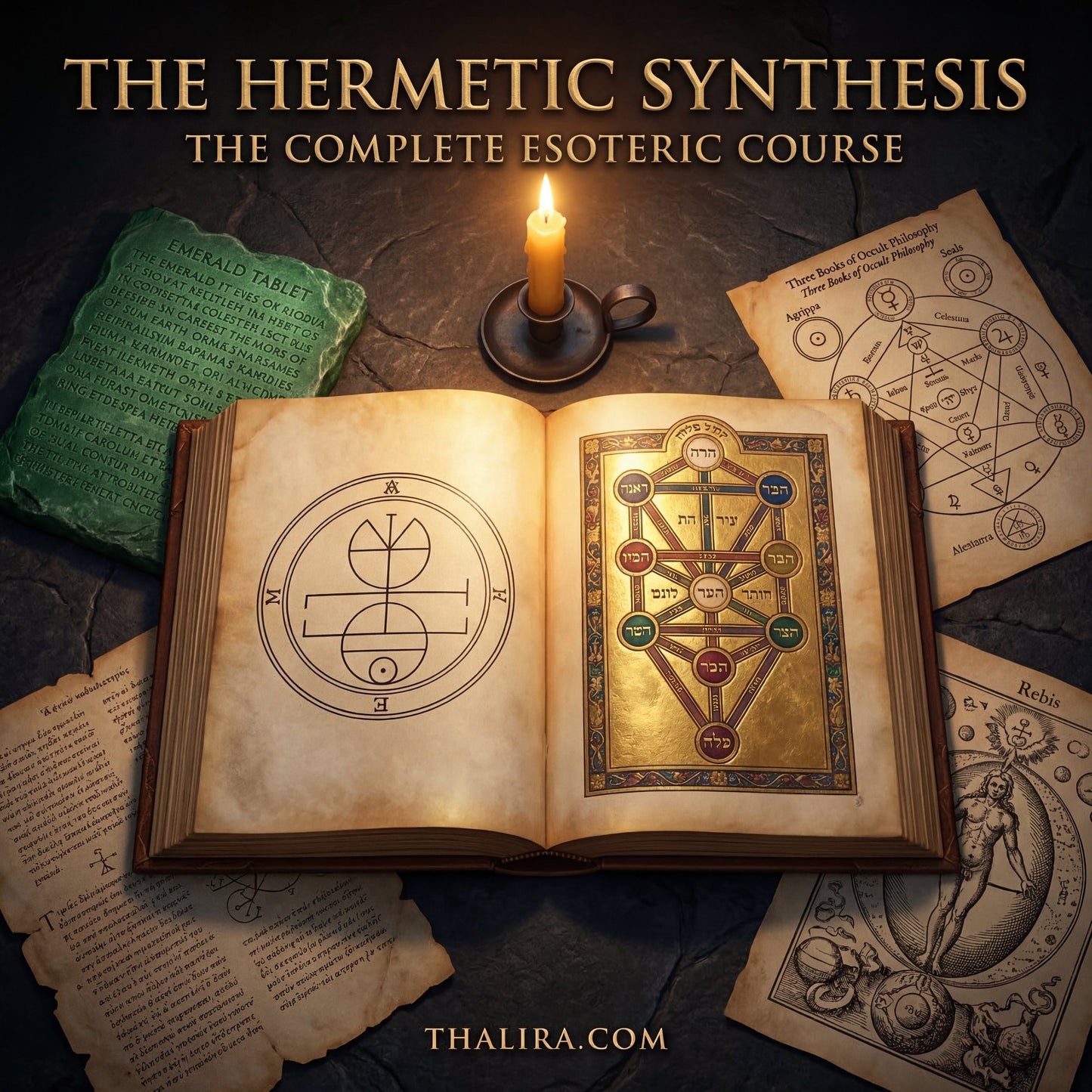
- Agrippa's Three Books of Occult Philosophy (1531) - the foundational work of Western occultism
- The Corpus Hermeticum - the Greek Hermetic dialogues, G.R.S. Mead translation
- The Emerald Tablet - the source of "as above, so below"
- Robert Fludd's Utriusque Cosmi (1617) - macrocosm-microcosm mathematical framework
- John Dee's Monas Hieroglyphica (1564) - sacred geometry as Hermetic technology
- Jacob Boehme, Basil Valentine, the Mutus Liber, and the broader alchemical tradition
- Rudolf Steiner's esoteric science as a 20th-century lens across all of the above
- The Kybalion - treated as the entry point it was designed to be, not the endpoint
The Complete Book, Chapter by Chapter
- Module 1: The Atkinson Synthesis. Who Atkinson was, what he was doing across his body of work, and why assembling the full system requires reading him across pen names and decades.
- Module 2: The Principle of Mentalism. "The All is Mind; the Universe is Mental." The full doctrine reconciled with the Corpus Hermeticum and Agrippa's elemental mind theory.
- Module 3: The Principle of Correspondence. "As above, so below." Traced from the Emerald Tablet through Agrippa's three worlds to Atkinson's practical framework.
- Module 4: The Principle of Vibration. Nothing rests. The full mechanics drawn from the Raja Yoga and Arcane Teaching series, with Fludd's musical cosmology as context.
- Module 5: The Principle of Polarity. Everything is dual. The transmutation method drawn from sources the Kybalion only gestures at, including Boehme's seven-quality system.
- Module 6: The Principle of Rhythm. The pendulum swings. Agrippa's celestial timing system, Valentine's 12-stage alchemical cycle, and the complete neutralization method.
- Module 7: The Principle of Cause and Effect. Every cause has its effect. The Hermetic basis for will and directed consciousness.
- Module 8: The Principle of Gender. Gender is in everything. Properly understood through Fludd, the Mutus Liber, and Bardon, not as modern trends misuse the principle.
- Module 9: Advanced Integration. The principles as a unified operating system with practical structure and synthesis frameworks.
- Module 10: The Hermetic Life. The kind of practitioner Atkinson was actually trying to produce.
Choose Your Edition
| Feature | Printable PDF Course | Complete Package |
|---|---|---|
| All 10 module printable PDFs (220 pages total) | Yes | Yes |
| The Hermetic Concordance (primary source companion, 21-page printable PDF) | No | Yes |
| Franz Bardon Telekinesis Bonus Manual (55-page printable PDF) | No | Yes |
| Bardon bonus full audio narration (~34 min) | No | Yes |
| Hermetic Concordance audio narration (~27 min) | No | Yes |
| Price | CAD $47 | CAD $77 |
The Hermetic Concordance
The Complete Package includes The Hermetic Concordance, a 3,900-word primary source companion that maps every one of the Seven Principles back to its origins in the actual Hermetic texts. For each principle, you get the relevant passages from Agrippa, the Corpus Hermeticum, the Emerald Tablet, Fludd, Dee, Bardon, and Boehme, with Rudolf Steiner's esoteric science as the overseeing lens that reveals the coherence across all of them.
This is not a bibliography. It is a working cross-reference showing how 12 authors across 2,000 years, writing independently, described the same system in different languages. Building this yourself would require reading all 12 texts and cross-referencing them by principle. The Concordance is that work already done.
Also included as a standalone audio narration (~27 minutes).
The Franz Bardon Bonus
Included exclusively with the Complete Package, this bonus manual presents Franz Bardon's systematic approach to physical Hermetic practice from Initiation Into Hermetics. Covering Steps I through V of his elemental training system, it documents Bardon's elemental colour framework, astral and physical body preparation, three distinct telekinesis methods, a realistic progression timeline, and critical warnings for serious practitioners. Available as both a 55-page printable PDF and a full audio narration (~34 minutes).
About William Walker Atkinson
William Walker Atkinson (1862-1932) wrote under at least a dozen pen names and published over 100 volumes of esoteric, metaphysical, and occult philosophy. His pen names included Yogi Ramacharaka, Theron Q. Dumont, and Three Initiates, the credited author of the Kybalion (1908). Reading him under a single name gives you a fragment. Reading him across the full body of work reveals the system he built deliberately across a lifetime.
Who This Book Is For
- Serious students of Hermetic and esoteric philosophy who have outgrown introductory texts
- Those who have read the Kybalion and sensed there was more - because there is
- Practitioners who want a philosophically rigorous foundation, cross-referenced against primary sources
- Anyone willing to do the actual work of understanding a complete system rather than collecting highlights
Delivery
Automatic immediate delivery by email download link after purchase. Printable PDF — print the full 220 pages or read on any device. No waiting, no manual processing, no physical materials shipped.
What the Greatest Scholars of the Tradition Confirmed
In 1928, a 27-year-old named Manly P. Hall published The Secret Teachings of All Ages - a seven-pound atlas documenting over fifty esoteric traditions. Freemasonry. Kabbalah. Hermeticism. The Egyptian mysteries. Alchemy. Rosicrucianism. Pythagorean mathematics.
His central thesis, demonstrated across 550 pages of sourced, referenced scholarship, was this: every authentic mystery school on earth was teaching the same doctrine. Different symbols. Different language. Different cultural context. One teaching.
The Freemasons made him a 33rd degree Mason after the book. He had never been initiated. Roosevelt had a copy. Elvis had a copy. It has never gone out of print in nearly 100 years.
Hall called himself the scholar. He documented where the tradition had been. He mapped the entire territory.
But Hall was direct about one thing: the man who understood what that tradition actually did - the living system behind the history - was Rudolf Steiner.
"I am the scholar. Rudolf Steiner was the authority on the subject."
- Manly P. Hall
Hall mapped the tradition. Steiner operated from inside it.
Bruno Built the Method
Before Hall documented the tradition, before Steiner systematized it, Giordano Bruno built the technology for learning it.
Bruno's Art of Memory - first published in 1582 as De Umbris Idearum - was not a system for memorizing facts. It was a method for restructuring consciousness itself. Bruno organized the entire architecture of reality into mental temples: rooms the mind could walk through, each containing the forces that govern the cosmos.
The Inquisition arrested him in 1592. They interrogated him for seven years. They demanded he recant the infinite universe, the memory system, the Hermetic cosmology. He refused. On February 17, 1600, they burned him alive in the Campo de' Fiori in Rome. Then they burned every copy of his books.
What they did not understand is that the Art of Memory was designed to live inside the mind. Not on paper. Not in libraries. In the architecture of consciousness itself. You cannot burn a system that lives inside the people who learned it.
The system walked out of the fire. And it runs inside this course.
The Course They Never Taught
Hall proved the tradition exists and documented its history.
Bruno built the cognitive method for entering it.
Steiner is the authority who mapped what happens when you do.
This is the course that brings all three together. It was never offered in any university. It was never part of any curriculum. The pieces existed - scattered across rare books, suppressed manuscripts, and institutions that kept them separate on purpose.
The Hermetic Synthesis Course is where the pieces become a working system.
Primary Texts at the Foundation of This Course
- Manly P. Hall - The Secret Teachings of All Ages (1928) - The complete documented survey of the unified esoteric tradition
- Giordano Bruno - De Umbris Idearum (On the Shadows of Ideas) (1582) - The foundational Art of Memory text
- Giordano Bruno - De l'Infinito, Universo e Mondi (On the Infinite, Universe, and Worlds) (1584) - The Hermetic cosmological framework
- The Corpus Hermeticum - Translated by Marsilio Ficino, 1463 - The source document of the entire tradition
- Rudolf Steiner - The Philosophy of Freedom (1894) - The systematic account of what initiation actually produces
Share