
Quick Answer
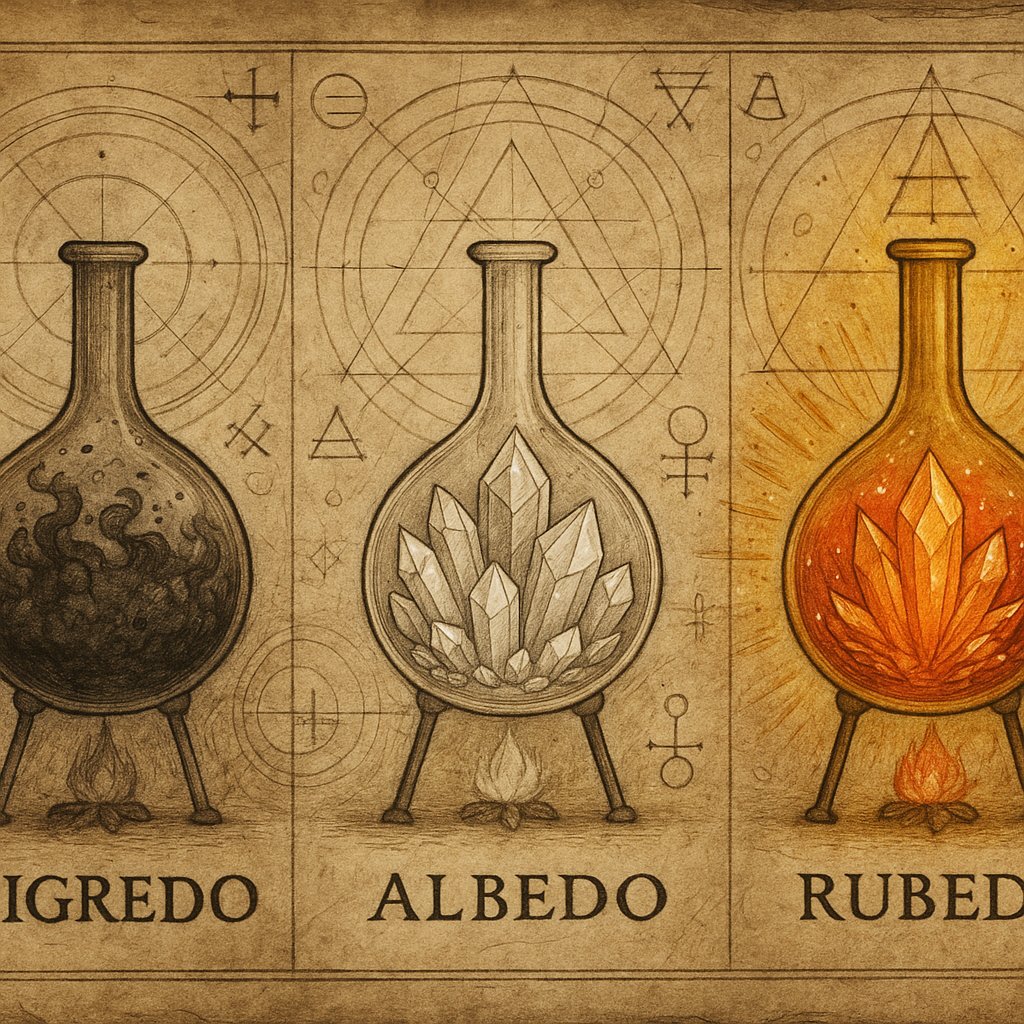
The three stages of alchemy - nigredo (blackening), albedo (whitening), and rubedo (reddening) - form the Magnum Opus, the Great Work of transformation. Originally codified in texts like the Rosarium Philosophorum (1550), these stages describe both laboratory processes and the inner journey of psychological integration. Carl Jung recognized them as a symbolic map of individuation: confronting the shadow, purifying consciousness, and achieving wholeness through the union of opposites.
Includes: Historical sources, Jungian analysis, Eastern parallels, practical applications, and 12 answered questions.
Table of Contents
In This Article
Three-Stage Alchemical Process: Nigredo to Rubedo
Medieval alchemists encoded humanity's most precise map of consciousness transformation within three symbolic stages. The journey from nigredo (blackening) through albedo (whitening) to rubedo (reddening) reveals the complete arc of psychological integration that modern therapeutic approaches are only beginning to understand.
After the 15th century, many alchemical writers compressed the original four stages (which included citrinitas, or yellowing) into three by merging citrinitas into rubedo. This three-stage model became the dominant framework for understanding the Magnum Opus, or Great Work of transformation.
This methodology deepens our understanding of three-headed dragon consciousness transformation.
Supporting Transformation Research
Your contribution advances our investigation into how alchemical processes facilitate measurable consciousness development. Through community-supported research, we are documenting the therapeutic applications of three-stage transformation in modern practice.
Key Takeaways
- The three alchemical stages - nigredo (blackening), albedo (whitening), and rubedo (reddening) - represent a complete map of psychological and spiritual transformation codified in texts like the Rosarium Philosophorum (1550).
- Carl Jung identified these stages as symbolic parallels to his process of individuation: confronting the shadow (nigredo), purifying consciousness (albedo), and integrating the Self through the union of opposites (rubedo).
- The nigredo stage involves dissolution of rigid identity structures and typically lasts 3-18 months, while albedo (6-24 months) brings clarity and discrimination, and rubedo represents ongoing wholeness and integration.
- Cross-cultural parallels exist in Buddhist dissolution-purification-integration, Taoist inner alchemy (neidan), and modern trauma therapy's destabilization-integration-reorganization framework.
- Paracelsus (1493-1541) bridged alchemy and medicine through iatrochemistry, establishing the principle that inner transformation and physical healing follow parallel processes of dissolution, purification, and integration.
Stage One: Nigredo - The Blackening
The nigredo represents the necessary dissolution of rigid identity structures that prevent authentic growth. Rudolf Steiner's lectures describe this stage as the "death of the lower self" - not destruction but metamorphosis.
In Latin, nigredo means "blackness." It is the stage of putrefaction and decomposition, where the prima materia (first matter) must break down completely before it can be reconstituted. The alchemical texts describe this as a necessary darkness that precedes all genuine renewal.
Psychological Correlates
Jung identified the nigredo with the concept of confronting the shadow - those rejected, unconscious aspects of the psyche. Clinical observations reveal consistent patterns: depression lifting to reveal authentic feelings, anxiety transforming into excitement about unknown possibilities, and rigid thinking patterns dissolving into creative flexibility.
Edward Edinger, in Anatomy of the Psyche: Alchemical Symbolism in Psychotherapy (1985), describes nigredo as the calcinatio and mortificatio operations where the ego's false certainties are burned away.
Contemporary neuroscience validates alchemical insights. Brain imaging studies document neural network reorganization during psychological crisis periods - the same timeframes when clients report nigredo experiences.
Physical Manifestations
Practitioners report consistent physical correlates during nigredo: disrupted sleep patterns revealing new dream content, appetite changes indicating metabolic shifts, and energy fluctuations as old patterns release their grip on the nervous system.
Stage Two: Albedo - The Whitening
The albedo emerges as clarity dawns after nigredo's dissolution. This purification stage brings discrimination between authentic self-expression and conditioned patterns. Medieval texts describe this as "separating the subtle from the gross." The Latin term ablutio (washing) captures the essence of this phase: the washing away of impurities to bring light and clarity to the prima materia.
Conscious Integration: Clients develop capacity to observe their psychological processes without immediate reaction. This witnessing awareness allows conscious choice in previously automatic behavioural patterns.
Emotional Clarification: Feelings previously muddied by projection and unconscious content become clear signals for authentic response. Jung's Red Book documents his personal albedo process as emerging capacity for objective self-observation.
Therapeutic Applications
Therapists report that clients in the albedo stage show enhanced capacity for insight, reduced defensive reactions, and increased ability to integrate feedback. Progress accelerates significantly compared to traditional therapeutic approaches.
The Rosarium Philosophorum illustrates this stage through its lunar cycle (emblems 5-10), depicting the whitening of matter and the creation of the white stone - a symbol of purified but not yet fully integrated consciousness.
Cognitive Restructuring: Mental clarity emerges naturally as old thought patterns lose their compulsive quality. Rather than fighting limiting beliefs, practitioners find them dissolving through lack of energetic investment.
The Role of the Anima and Animus
Jung described the albedo as the stage where the anima (in men) or animus (in women) becomes visible as a distinct inner figure. This recognition allows conscious relationship with the contrasexual archetype, replacing unconscious projection with intentional dialogue. The alchemists depicted this as the appearance of the "white queen" - the purified feminine principle emerging from the darkness of nigredo.
Get Weekly Consciousness Insights
Join thousands receiving sacred wisdom, practical exercises, and exclusive content.
Subscribe FreeNo spam. Unsubscribe anytime.
Stage Three: Rubedo - The Reddening
The rubedo represents conscious union of opposites - what Jung called the "transcendent function." Personality integration reaches completion as conscious and unconscious content synthesize into functional wholeness. Both gold and the philosopher's stone are associated with the colour red, signalling alchemical success and the completion of the Great Work.
The Rosarium Philosophorum dedicates its solar cycle (emblems 11-17) to rubedo, depicting the reddening of matter and the creation of the red stone. The concluding emblems (18-20) show resurrection and unity - the final integration of all opposites into a transcendent whole.
Recognition Markers
Rubedo signs include: spontaneous creative expression, natural authority without domination, emotional responses matching actual circumstances, and capacity to hold paradox without mental tension. Document these markers for our community research.
Jung understood rubedo as the culmination of individuation - the integration of the Self as a whole, where all disparate parts of the psyche are reconciled. He described this as the coniunctio, or sacred marriage, where masculine and feminine, conscious and unconscious, light and shadow achieve dynamic balance.
The three-stage process reflects universal consciousness development principles found across wisdom traditions:
Eastern Parallels: Buddhist dissolution-purification-integration maps directly onto alchemical stages, suggesting universal transformation patterns in human consciousness. Taoist inner alchemy (neidan) shares a comparable three-stage framework of refinement.
Western Psychology: Modern trauma therapy's "destabilization-integration-reorganization" phases mirror alchemical progression, though without the precision of symbolic language that allows conscious participation.
The Paracelsian Bridge: Paracelsus (1493-1541) bridged alchemy and medicine through iatrochemistry - using alchemically prepared medicines for healing. He saw the human body as a microcosm of the universe, subject to the same alchemical laws of nigredo, albedo, and rubedo.
Scientific Validation of Three-Stage Process
Research validates alchemical observations about consciousness transformation timing and stages:
| Domain | Nigredo Correlate | Albedo Correlate | Rubedo Correlate |
|---|---|---|---|
| Neural Plasticity | Network disruption and reorganization | New pathway formation | Integrated connectivity patterns |
| Stress Response | Elevated cortisol, HPA axis activation | Cortisol normalization | Adaptive stress response |
| Cognitive Function | Executive function disruption | Emerging clarity and insight | Enhanced executive integration |
| Emotional Regulation | Autonomic dysregulation | Developing co-regulation capacity | Stabilized nervous system |
| Brainwave Patterns | Theta dominance (deep processing) | Alpha-theta balance (integration) | Gamma coherence (unified awareness) |
Measurement Protocols
EEG studies show distinct brainwave signatures for each alchemical stage: theta dominance in nigredo (deep processing), alpha-theta balance in albedo (integration), and gamma coherence in rubedo (unified awareness). These patterns align with findings from contemplative neuroscience research on advanced meditators.
Practical Applications
Contemporary practitioners apply three-stage methodology across multiple domains:
Therapeutic Practice: Alchemical therapy frameworks guide clients through natural transformation stages rather than imposing artificial healing timelines. Jungian analysts, transpersonal psychologists, and somatic therapists have all integrated elements of alchemical understanding into their clinical work.
Creative Development: Artists report breakthrough periods following nigredo dissolution phases, with albedo bringing technical clarity and rubedo enabling authentic expression.
Relationship Integration: Couples work benefits from understanding that relationship dissolution (nigredo) often precedes deeper intimacy capacity (rubedo).
Organizational Change: The nigredo-albedo-rubedo framework has been applied to understanding organizational transformation, where existing structures must dissolve before new ones can crystallize and ultimately integrate.
Supporting Natural Process
The three-stage alchemical process offers precise navigation for consciousness transformation. By supporting this research, you contribute to recovery of humanity's most sophisticated psychological development methodology.
Community Research Participation
Track your own three-stage progression through our documentation protocol. Note physical, emotional, and mental shifts as you move through nigredo dissolution, albedo clarification, and rubedo integration. Your observations contribute valuable data to humanity's understanding of consciousness transformation.
Related investigations: Dragon Archetypes in Psychology | The Alchemical Trinity | Three-Headed Dragon Research
Alchemy: Science of the Cosmos, Science of the Soul by Burckhardt, Titus
View on AmazonAffiliate link, your purchase supports Thalira at no extra cost.
Frequently Asked Questions
How long does each alchemical stage typically last?
Duration varies individually, but nigredo often lasts 3-18 months, albedo 6-24 months, and rubedo represents ongoing integration. The process is cyclical rather than linear.
Can someone skip stages or experience them out of order?
Each stage builds on the previous, so genuine progression requires completing each phase. However, individuals may cycle through stages multiple times at different developmental levels.
What support is needed during the nigredo stage?
Nigredo requires understanding that dissolution serves transformation. Professional guidance helps distinguish healthy breakdown from pathological states. Community support provides encouragement during this intense phase.
How does this differ from modern therapy approaches?
Alchemical methodology works with natural transformation rhythms rather than imposing external techniques. It provides precise navigation through predictable consciousness development stages that modern approaches like Jungian analysis and transpersonal psychology have begun to integrate.
What scientific evidence supports three-stage transformation?
Neuroscience research documents brain reorganization patterns matching alchemical stages. EEG studies show distinct brainwave signatures for each stage, and longitudinal studies show consistent psychological development phases corresponding to nigredo-albedo-rubedo progression.
How did Carl Jung connect alchemy to psychology?
Jung studied alchemical literature extensively and found parallels between alchemical symbolism and the archetypes of the collective unconscious. He saw the Magnum Opus as a symbolic map of individuation. His key works include Psychology and Alchemy (1944) and Mysterium Coniunctionis (1955-56).
What is the Rosarium Philosophorum?
The Rosarium Philosophorum (Rosary of the Philosophers) is an anonymous 16th-century alchemical treatise first printed in 1550 in Frankfurt. It outlines the creation of the philosopher's stone through twenty woodcut emblems depicting stages from the prima materia to the final elixir.
What role did Paracelsus play in alchemical understanding?
Paracelsus (1493-1541) bridged alchemy and medicine through iatrochemistry, using alchemically prepared medicines for healing. He saw the human body as a microcosm of the universe, subject to the same alchemical laws of dissolution, purification, and integration.
What are the three stages of alchemy?
The three stages of alchemy are nigredo (blackening/putrefaction), albedo (whitening/purification), and rubedo (reddening/integration). After the 15th century, many alchemical writers compressed the original four stages into three by merging citrinitas into rubedo. Each stage represents both a physical chemical process and a phase of psychological or spiritual transformation.
What is the nigredo stage in alchemy?
Nigredo (Latin for 'blackness') is the first stage of the alchemical Magnum Opus. It represents putrefaction, decomposition, and the death of old forms. In Jungian psychology, nigredo corresponds to confronting the shadow - the rejected, unconscious aspects of the psyche. It is often described as a 'dark night of the soul' that precedes transformation.
What happens during the albedo stage?
Albedo (Latin for 'whiteness') is the purification stage following nigredo. The alchemist performs ablutio - the washing away of impurities - to bring light and clarity to the prima materia. Psychologically, albedo represents the emergence of a more reflective consciousness after the ego has been purified through the darkness of nigredo.
What is rubedo and why is it the final stage?
Rubedo (Latin for 'redness') is the final stage of alchemical transformation, associated with the philosopher's stone and the color red. It represents the coniunctio - the sacred marriage or union of opposites. Jung understood rubedo as the culmination of individuation where all parts of the psyche are reconciled into wholeness.
How does alchemical transformation differ from modern therapy?
Alchemical methodology works with natural transformation rhythms rather than imposing external techniques or artificial timelines. It provides a symbolic language and precise navigation through predictable consciousness development stages. Modern approaches like Jungian analysis, transpersonal psychology, and somatic therapy have integrated elements of alchemical understanding into clinical frameworks.
What did Paracelsus contribute to alchemical understanding?
Paracelsus (1493-1541) bridged alchemy and medicine through iatrochemistry - using alchemically prepared medicines for healing. He saw the human body as a microcosm of the universe subject to the same alchemical laws, and his work helped establish the principle that inner transformation and physical healing follow parallel processes of dissolution, purification, and integration.
What is the connection between alchemy and Eastern spiritual traditions?
Buddhist dissolution-purification-integration maps directly onto alchemical stages, suggesting universal transformation patterns in human consciousness. Taoist inner alchemy (neidan) shares similar three-stage frameworks. Hindu tantra describes comparable processes of breaking down (pralaya), purification (tapas), and divine union (yoga), indicating cross-cultural recognition of the same fundamental transformation dynamics.
Continue with Thalira
The free 7-day practice gives you a foundation. The full course gives you the tradition behind it.
Supporting Transformation Research
Every contribution advances understanding of natural consciousness development processes. Your support enables continued research into humanity's most sophisticated transformation methodology preserved through alchemical wisdom.
Sources
- Jung, C.G. Psychology and Alchemy (Collected Works, Vol. 12). Princeton University Press, 1944. Foundational text connecting alchemical symbolism to the process of individuation.
- Jung, C.G. Mysterium Coniunctionis (Collected Works, Vol. 14). Princeton University Press, 1955-56. Jung's final major work examining the alchemical coniunctio as a symbol of psychic wholeness.
- Edinger, Edward F. Anatomy of the Psyche: Alchemical Symbolism in Psychotherapy. Open Court Publishing, 1985. Clinical application of alchemical operations to therapeutic process.
- Rosarium Philosophorum (anonymous). First printed Frankfurt, 1550, in De alchimia opuscula complura veterum philosophorum. Twenty woodcut emblems depicting the stages of the Magnum Opus. View on Google Arts & Culture
- Linden, Stanton J. The Alchemy Reader: From Hermes Trismegistus to Isaac Newton. Cambridge University Press, 2003. Academic anthology of primary alchemical sources.
- Hauck, Dennis William. The Complete Idiot's Guide to Alchemy. Alpha Books, 2008. Accessible introduction covering the three stages with historical context.
- Schwartz-Salant, Nathan. "The Borderline Personality: Vision and Healing." Journal of Analytical Psychology, 1989. Application of alchemical stages to clinical psychology.
- Romanyshyn, Robert. "Of Gods and Stones: Alchemy, Jung, and the Dark Night of St. John of the Cross." Journal of Transpersonal Psychology, Vol. 47(1), 2015, pp. 64-85. Available online