
Quick Answer
Baruch Spinoza (1632-1677) was a Dutch philosopher who identified God with Nature itself (Deus sive Natura), denied free will, analyzed human emotions geometrically, and argued that freedom means understanding necessity rather than escaping it. Excommunicated at 23, he became one of the most influential thinkers in Western philosophy and a touchstone for pantheism, biblical criticism, and secular ethics.
Table of Contents
Key Takeaways
- God is Nature: Spinoza's Deus sive Natura identifies the divine with the totality of existence, not a personal creator God who intervenes in history.
- Monist Philosophy: There is only one substance in the universe; everything that exists is a mode or expression of this single infinite substance.
- Freedom Through Understanding: Spinoza rejected ordinary free will but argued for a higher freedom achieved by understanding the causes that determine our behavior.
- Analysis of Emotions: The Ethics contains one of philosophy's most systematic analyses of desire, joy, sadness, and the passions that determine human life.
- Spiritual Resonances: Spinoza's pantheism and his concept of the intellectual love of God echo non-dual spiritual traditions across cultures.
Life and Historical Context
Baruch Spinoza was born in Amsterdam in 1632, the son of Portuguese-Jewish immigrants who had fled the Inquisition. The community he was born into, known as the Portuguese Jewish community or Sephardic community of Amsterdam, was prosperous and culturally sophisticated. It maintained a complex position: outwardly free in tolerant Amsterdam, but internally shaped by trauma, memory of converso life, and strict communal discipline.
Spinoza received a thorough Jewish education in the Talmud Torah school, studying Hebrew scripture, Talmud, and medieval Jewish philosophy. He had access to secular learning as well, including works by Descartes, Hobbes, and the new scientific philosophy of the 17th century. His intellectual formation was genuinely dual: deeply versed in Jewish texts and simultaneously drawn to the emerging rationalist philosophy of his era.
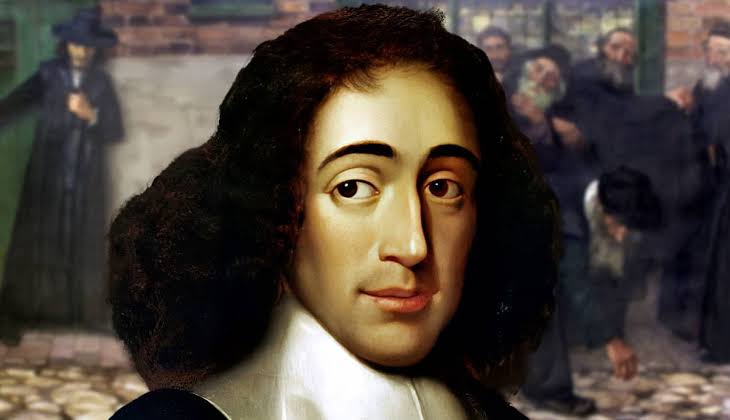
In 1656, when Spinoza was 23, the Amsterdam Jewish community issued against him one of the most severe cheremet (bans or excommunications) in the community's history. The wording was extraordinary in its harshness, speaking of "abominable heresies" and "monstrous deeds," without specifying them. The exact causes remain historically uncertain. Scholars have proposed various factors: his heterodox views on God and the soul, his associations with radical freethinkers and dissenting Christian groups, his failure to maintain communal obligations, and possibly financial disputes following his father's death.
After the excommunication, Spinoza moved away from Amsterdam, eventually settling in The Hague. He supported himself as a lens grinder, a skilled technical trade that connected him to the new optical science of the era. He maintained correspondence with leading scientists and philosophers across Europe, including Henry Oldenburg, the first secretary of the Royal Society in London. He refused a professorship at Heidelberg in 1673, preferring his independence and solitude.
Spinoza died in 1677 at age 44, likely of lung disease exacerbated by years of inhaling glass dust. His Opera Posthuma, including the Ethics and Political Treatise, were published by friends the year of his death. He had published only two works under his own name during his lifetime: the geometric exposition of Descartes' philosophy and the Theological-Political Treatise of 1670, which appeared anonymously.
Spinoza's life is itself a philosophical statement. He chose solitude, refused wealth and academic prestige, supported himself by manual labor, and dedicated himself entirely to understanding. The man who wrote about freedom as a form of understanding lived that understanding with unusual consistency. His contemporaries who admired him noted a quality of inner equanimity that they attributed directly to his philosophy.
God or Nature: Deus sive Natura
The phrase Deus sive Natura, "God or Nature," is Spinoza's most famous formulation and the heart of his metaphysics. It appears in Part IV of the Ethics and crystallizes a position that had been building through the entire first part of the work. To understand what Spinoza means by it, it helps to understand what he is rejecting as much as what he is affirming.
The dominant theological position of Spinoza's era held that God is a personal being who exists outside the world, who created the world ex nihilo, who intervenes in history, who has preferences and commands, who can be pleased or displeased by human behavior. This is the God of Abraham, Isaac, and Jacob; the God who spoke from Sinai and who sent prophets. Spinoza systematically dismantled this picture.
Spinoza's God is substance. He defines substance at the very beginning of the Ethics as "that which is in itself and is conceived through itself," meaning it requires nothing else for its existence or explanation. He then argues that there can only be one such substance, because if there were two, each would need to be explained in terms of the other or they would share attributes, which would collapse the distinction between them. One infinite, self-causing substance: this is Spinoza's God.
This substance has infinite attributes, though humans perceive only two: thought and extension. Extension is the physical world: matter, space, motion. Thought is the mental world: ideas, consciousness, intention. Everything that exists is a mode or finite expression of one or the other of these attributes (or both simultaneously). A human being is simultaneously a mode of extension (a body) and a mode of thought (a mind), and these are not two things interacting but two different ways of describing the same thing.
Understanding Attribute and Mode
Think of it this way. A river is a mode of the hydrological system. You can describe the river in terms of chemistry (H2O, dissolved minerals, temperature) or in terms of physics (flow rate, pressure, energy). These are different attributes of the same substance. Neither description is more real than the other; they are parallel ways of knowing the same thing. Spinoza argues that body and mind stand in exactly this relationship: two attributes of one substance, not two substances that mysteriously interact.
The consequence of this view is that nothing in the universe is accidental. Everything follows necessarily from the nature of the single substance, just as mathematical truths follow necessarily from axioms. God does not choose to create the world; the world is the necessary expression of God's nature. God cannot do otherwise than express itself in infinite modes, because to do otherwise would be to be something other than what it is, which is impossible.
This doctrine was labeled atheism by Spinoza's contemporaries, and in a sense they were right: he had removed the personal God who commands, rewards, and punishes. But Spinoza himself rejected the atheist label. He thought his God was greater, not smaller, than the personal God of tradition. To identify God with all of reality is to say that God is not one being among others but the ground of being itself. Whether this is atheism or the most radical form of theism is a question philosophers still debate.
The Ethics: Geometry of Freedom
The Ethics is one of the most unusual philosophical books ever written. Spinoza chose to structure it in the format of Euclidean geometry: definitions, axioms, propositions, demonstrations, corollaries, and scholia (explanatory notes). This was a deliberate choice. Geometry produces certain, necessary knowledge from first principles. Spinoza wanted to demonstrate that his philosophy had the same necessity and certainty. He was showing, not just arguing, that his conclusions followed as inevitably from his definitions as "the angles of a triangle sum to 180 degrees" follows from the definition of a triangle.
The book is divided into five parts. Part 1, "On God," establishes the metaphysical foundation: the one substance with infinite attributes, the necessary expressions of modes, the absence of teleology (purpose) in nature. Nature does not aim at anything; it simply is what it is and does what it does.
Part 2, "On the Nature and Origin of the Mind," addresses epistemology and the mind-body relationship. The mind is the idea of the body. When the body is affected by external objects, the mind has corresponding ideas of those affections. This is why our perceptions are often confused: they represent the state of our body more than the nature of external things. True knowledge requires moving from this confused first kind of knowledge to adequate ideas that represent things as they truly are in themselves.
Parts 3 and 4 address the emotions and human bondage. Part 3, "On the Origin and Nature of the Affects," is a clinical analysis of desire, joy, sadness, and the dozens of emotions derived from them. Part 4, "On Human Bondage," examines why humans are enslaved to their passions and what this means for ethical life. The word "bondage" is deliberate: when we act from passive emotion, we are determined by external causes rather than by our own nature.
Part 5, "On the Power of the Intellect, or On Human Freedom," is the destination toward which the whole work has been moving. Here Spinoza describes the path to freedom: understanding the causes of our emotions so thoroughly that they lose their coercive grip; developing the kind of knowledge he calls intuitive science (scientia intuitiva), in which we perceive things from the perspective of eternity (sub specie aeternitatis); and ultimately achieving what he calls the intellectual love of God (amor intellectualis Dei), a state of deep understanding and acceptance that constitutes the highest human good.
Free Will, Emotions, and Conatus
Spinoza's denial of free will is one of his most discussed positions. He argues it explicitly and at length, and it follows directly from his metaphysics. If everything that exists is a mode of the one necessary substance, and if everything follows necessarily from prior causes, then human decisions are not exceptions to this necessity. We decide as we do because of prior causes: our desires, our history, our bodily state, our social conditioning. The feeling of being an uncaused agent who could have chosen otherwise is an illusion arising from ignorance of these causes.
The example Spinoza gives in a letter is striking. A stone set in motion would, if it had consciousness, believe it was moving of its own free will. We are in the same position. We are aware of our desires but not of the causes of those desires, so we believe we are choosing freely when we are being carried forward by necessities we do not see.
This sounds bleak. Spinoza thought it was liberating. The person who understands that they are determined acts differently from the person who thinks they are free in the ordinary sense. They do not waste energy in self-condemnation for past actions (the causes were what they were). They do not harbor resentment toward others for their conduct (the other's behavior also followed from necessity). They focus instead on understanding: what causes move me? How can I cultivate causes that move me toward reason and away from passive emotion?
Central to this account is the concept of conatus. Every existing thing, Spinoza says, strives to persist in its own being. This striving is not a conscious choice; it is the very essence of existence. The conatus of a rock is its physical integrity. The conatus of a plant is its growth and reproduction. The conatus of a human being is the complex striving of body and mind to maintain and enhance existence. What we call desire is conatus accompanied by consciousness.
Working with Spinoza's Framework
Spinoza's analysis of emotions is practically useful even outside his metaphysics. The next time you feel a strong emotion (anger, jealousy, anxiety, desire), try what Spinoza suggests: identify the prior cause. What idea triggered this emotion? What belief about the world is the emotion expressing? Does that belief correspond to how things actually are, or to how your body has been conditioned to respond? Spinoza thought that understanding an emotion this clearly begins to dissolve its passive grip.
Joy and sadness are the two primary modifications of the conatus. Joy is any increase in the body-mind's power or vitality; sadness is any decrease. Love is joy accompanied by the idea of an external cause; hate is sadness accompanied by the idea of an external cause. Hope, fear, envy, pride, shame, and hundreds of other emotions are all variations and combinations of these primary three (desire, joy, sadness) and the ideas associated with them.
Spinoza's taxonomy of emotions in Part 3 of the Ethics has been remarkably influential in the psychology of emotion. Philosophers of mind and cognitive scientists have returned to it repeatedly as a precursor to cognitive theories of emotion, which similarly ground emotional states in the appraisal of situations rather than in brute feeling.
Biblical Criticism and Political Thought
The Theological-Political Treatise of 1670, published anonymously, was one of the most dangerous books of the 17th century. It argued positions that were radical even by Dutch tolerationist standards: that the Bible was written by human beings in particular historical contexts and should be interpreted accordingly, that miracles do not violate natural law, that the prophets were morally excellent but not necessarily philosophically enlightened, and that freedom of thought and expression is compatible with civil peace and indeed necessary for it.
Spinoza's method of biblical interpretation anticipated what became the historical-critical method of biblical scholarship two centuries later. He argued that to understand a biblical text you must first understand its language, its historical context, its original audience, and the purposes of its author. You cannot assume that the Bible teaches consistent philosophical doctrine; it was written over centuries by different people for different purposes. It is primarily a moral and political document, not a manual of metaphysics.
His political philosophy was also ahead of its time. In the Theological-Political Treatise and the posthumous Political Treatise, he argued that legitimate government derives its authority from the consent of the governed, that religious persecution is counterproductive because it cannot change inward belief and only produces resentment and hypocrisy, and that freedom of thought benefits the state because it allows error to be corrected by argument rather than suppressed by force.
These ideas fed directly into Enlightenment political thought. John Locke, who was living in the Dutch Republic in the years after the Treatise appeared, denied having read it, but the parallels with his Letter Concerning Toleration are striking. Spinoza's influence on the development of liberal democratic theory has been traced carefully by scholars including Jonathan Israel, who argues that Spinoza was the central figure in the "Radical Enlightenment" from which modern secular democracy emerged.
Spinoza's Influence on Later Thought
Spinoza's influence has been enormous, although for much of the 18th century it was largely underground. His works were on the Catholic Index of Forbidden Books and condemned across Protestant Europe. To be called a Spinozist in the 18th century was to be accused of atheism, the most serious intellectual charge available. Yet his ideas continued to move through European thought in coded and indirect ways.
The German Idealists of the late 18th and early 19th centuries were deeply engaged with Spinoza. Friedrich Schelling's philosophy of nature, which identified the Absolute with Nature and consciousness alike, is essentially a reworking of Spinozist monism in Kantian terms. Hegel said that every philosopher must first become a Spinozist; by this he meant that unless you take seriously the demand for an all-encompassing systematic account of reality, you are not doing serious philosophy. Goethe had a famous period of intense Spinoza reading and described the Ethics as having given him profound inner peace.
Albert Einstein, when asked whether he believed in God, famously replied that he believed in Spinoza's God: the God who reveals himself in the lawful harmony of all that exists. Einstein's remark has been quoted endlessly, but its meaning is precise: Spinoza's identification of God with the rational order of Nature was exactly congruent with Einstein's sense of the cosmos as a place of deep mathematical regularity whose beauty inspired what he called "cosmic religious feeling."
| Thinker | Spinoza's Influence |
|---|---|
| Goethe | Pantheism, philosophy of nature, the whole as organism |
| Hegel | Substance becoming subject; the Absolute as self-knowing |
| Schelling | Nature-philosophy as expression of one infinite substance |
| Einstein | God as the rational order of Nature, cosmic religious feeling |
| Nietzsche | Will to power as analog to conatus, eternal recurrence as necessity |
| Deleuze | Immanence, plane of consistency, body as power of affecting and being affected |
Contemporary philosopher Gilles Deleuze devoted two major studies to Spinoza and considered him the philosopher of immanence, the philosopher who most rigorously refused any transcendent realm beyond this world. For Deleuze, Spinoza's insistence that God is not above or beyond nature but is nature itself was the most radical philosophical move possible: it meant that this world, with all its complexity and creativity, was not a pale imitation of something higher but was itself the whole of what is real.
Spinoza's influence on the neuroscience of emotion has been noted by neuroscientist Antonio Damasio, who titled his 2003 book Looking for Spinoza. Damasio argues that Spinoza's analysis of the emotions as modifications of the conatus, the body's striving to maintain itself, anticipates key findings in affective neuroscience about the role of bodily states in the generation of emotions and the relationship between emotion, reason, and decision-making.
Spinoza and Spiritual Practice
Spinoza is not usually read as a mystic, and he would likely have resisted that label. Yet his philosophy has deep resonances with contemplative traditions that cannot be dismissed as coincidental. Thinkers working at the intersection of philosophy and spirituality have repeatedly found Spinoza to be a useful bridge between Western analytical philosophy and the insights of non-dual traditions.
The most obvious resonance is between Spinoza's Deus sive Natura and the Advaita Vedanta teaching that Brahman is all that is, that the apparent multiplicity of the world is a single self-expressing reality. Spinoza arrived at this position through philosophical argument from Euclidean-style axioms; the Advaita tradition arrives at it through contemplative realization. They converge on the same structure: one undivided reality expressing itself in apparent multiplicity, with liberation consisting in seeing through the illusion of separation.
The concept of sub specie aeternitatis, "from the perspective of eternity" or "under the aspect of eternity," is another point of convergence. Spinoza describes the highest form of knowledge as perceiving things from this eternal perspective rather than from the perspective of time and succession. This resembles descriptions of contemplative states across traditions: the Zen notion of seeing from the Buddha-nature, the Sufi concept of fana (annihilation of the ego-perspective), the Christian mystical description of seeing all things in God.
Amor Intellectualis Dei: The Intellectual Love of God
Spinoza's highest human good, the amor intellectualis Dei or intellectual love of God, is achieved when a person has developed adequate understanding of their place in the whole of reality. This is not an emotional devotion to a personal God but something more like what the Stoics called living according to nature and what contemplative traditions call realization. The person who understands, deeply and not merely abstractly, that they are a finite mode of an infinite substance, that their conatus is a small expression of the infinite striving of reality itself, has achieved something Spinoza regards as both freedom and blessedness. It is a secular account of what the mystical traditions call enlightenment.
Spinoza's approach to the emotions also has practical spiritual value. His method is not to suppress or transcend emotions through discipline but to understand them so thoroughly that their coercive power dissolves. This is closely parallel to the Buddhist practice of investigating the causes and conditions of mental states, not to eliminate feeling but to free oneself from being unconsciously driven by it. Spinoza's claim that an emotion whose causes are clearly understood changes its character, losing its passive grip, is an insight that meditation practitioners often rediscover from the inside.
For a practice-oriented spirituality like Thalira's, Spinoza offers a rigorous philosophical foundation for several core insights: that the divine is not separate from the world but is the world understanding itself; that human consciousness participates in an intelligence vastly larger than the individual mind; that freedom is not escape from reality but a deeper and clearer engagement with it; and that the intellectual and the spiritual are not two different paths but two aspects of the same movement toward wholeness.
Whether read as philosophy, as spiritual text, or as historical document, the Ethics remains one of the most serious attempts in Western thought to describe what it means to be a human being who understands, and why such understanding matters more than anything else.
Ethics by Spinoza, Benedict de
View on AmazonAffiliate link, your purchase supports Thalira at no extra cost.
Frequently Asked Questions
Who was Baruch Spinoza?
Baruch Spinoza (1632-1677) was a Dutch philosopher of Portuguese-Jewish descent, widely considered one of the most original thinkers of the 17th century. He is best known for his Ethics, written in geometric form, and for his identification of God with Nature (Deus sive Natura). He was excommunicated from his Amsterdam Jewish community at age 23 and spent his life as a lens grinder and private scholar.
What is Spinoza's philosophy of God?
Spinoza argued that there is only one substance in the universe, which he called both God and Nature interchangeably (Deus sive Natura). This substance has infinite attributes, of which humans perceive only two: thought and extension (physical matter). Everything that exists is a mode or expression of this single infinite substance. This view is called pantheism or, more precisely, panentheism or monism. It means God is not a personal being who intervenes in history but the totality of existence itself.
What did Spinoza mean by Deus sive Natura?
Deus sive Natura, Latin for "God or Nature," is Spinoza's most famous phrase. It expresses his view that God and Nature are not two different things but two names for the same infinite substance. Everything that exists follows necessarily from the nature of this substance, just as mathematical truths follow necessarily from axioms. There is no external God who created the world; the world simply is God expressing itself in infinite modes and attributes.
What is Spinoza's Ethics about?
Spinoza's Ethics (Ethica Ordine Geometrico Demonstrata) is a philosophical treatise structured like Euclid's geometry, with definitions, axioms, propositions, and demonstrations. It covers metaphysics (Part 1), the nature of the mind (Part 2), the nature and origin of the emotions (Part 3), human bondage to the emotions (Part 4), and human freedom and the intellectual love of God (Part 5). The book argues that freedom consists not in escaping causation but in understanding it deeply enough to live in accordance with reason.
Why was Spinoza excommunicated?
Spinoza was issued a cherem (excommunication or ban) by the Amsterdam Jewish community in 1656 at age 23. The exact reasons are not fully documented. Scholars believe his heretical views on God, scripture, and the nature of the soul were becoming known, possibly combined with association with radical freethinkers and failure to attend synagogue. The cherem used unusually harsh language but gave no specific charges. He never sought reconciliation and continued his philosophical work independently.
What was Spinoza's view on free will?
Spinoza rejected the concept of free will as ordinarily understood. He argued that all events, including human thoughts and actions, follow necessarily from prior causes. The feeling of being a free, uncaused agent is an illusion arising from ignorance of the causes that determine our behavior. True human freedom, for Spinoza, is not the ability to do otherwise but the achievement of self-understanding deep enough that our actions flow from reason rather than passive emotional reaction. It is freedom through understanding, not freedom from causation.
What influence did Spinoza have on later thought?
Spinoza's influence has been enormous, though often indirect. He helped lay the foundations of biblical criticism and secular democracy through his Theological-Political Treatise. Romanticism, especially German Idealism, was shaped by his monism; Schelling, Hegel, and Goethe were deeply influenced by him. Einstein described his concept of God as Spinozist. His influence runs through Freud (the unconscious as necessity), through ecological philosophy, and through contemporary discussions of mind and consciousness.
How does Spinoza view the emotions?
Spinoza offers one of the most detailed analyses of the emotions in philosophical history in Parts 3 and 4 of the Ethics. He identifies three primary affects: desire (conatus, the striving to persist in being), joy (an increase in power or vitality), and sadness (a decrease in power). All other emotions are derived from these three. Spinoza does not moralize about emotions but analyzes them as natural phenomena following from the laws of human nature, just as physical phenomena follow from physical laws.
What is the conatus in Spinoza's philosophy?
Conatus is a Latin term meaning striving or endeavoring. In Spinoza's philosophy, conatus is the fundamental drive of every existing thing to persist in its own being. Rocks persist as rocks, plants grow and reproduce, humans seek self-preservation and self-expression. This striving is not a conscious choice but the very essence of what it means to exist. Spinoza uses conatus as the foundation of his theory of desire and as a bridge between his metaphysics and his ethics.
How does Spinoza connect to spiritual practice?
Spinoza's philosophy has deep resonances with spiritual practice, particularly with non-dual traditions. His identification of God with Nature echoes Advaita Vedanta's identification of Brahman with the world. His concept of the intellectual love of God (amor intellectualis Dei) resembles mystical states described across traditions: a felt unity with the whole of existence achieved through understanding rather than ritual. His ethics of understanding the passions rather than suppressing them parallels Buddhist approaches to working with emotion.
Sources & References
- Spinoza, B. (1677). Ethics Demonstrated in the Geometrical Manner (trans. E. Curley, 1994). Princeton University Press.
- Spinoza, B. (1670). Theological-Political Treatise (trans. M. Silverthorne & J. Israel, 2007). Cambridge University Press.
- Israel, J. (2001). Radical Enlightenment: Philosophy and the Making of Modernity 1650-1750. Oxford University Press.
- Damasio, A. (2003). Looking for Spinoza: Joy, Sorrow, and the Feeling Brain. Harcourt.
- Deleuze, G. (1988). Spinoza: Practical Philosophy (trans. R. Hurley). City Lights Books.
- Nadler, S. (1999). Spinoza: A Life. Cambridge University Press.
- Hampshire, S. (1951). Spinoza and Spinozism. Oxford University Press.