

Quick Answer
The Shepherd of Hermas is the most popular non-canonical Christian text of the first four centuries, composed in Rome around 100-160 CE. It contains five Visions (including the famous tower allegory for the Church), twelve Mandates (moral commandments), and ten Similitudes (parables). Its central teaching is that Christians who sin after baptism may receive one more chance at repentance.
Table of Contents
- What Is the Shepherd of Hermas?
- Who Was Hermas?
- The Five Visions
- The Tower Allegory: The Church Being Built
- The Twelve Mandates
- The Ten Similitudes
- Repentance Theology: The Second Chance
- The Angel of Repentance
- Why It Nearly Made the Canon
- Manuscript Tradition and Popularity
- Spiritual Significance for Modern Seekers
- Frequently Asked Questions
Key Takeaways
- The most popular non-canonical text for four centuries: More manuscript fragments of the Shepherd survive from early Christianity than of many books that did make the New Testament canon
- The tower allegory maps the structure of the Church: Built on water (baptism), constructed from stones (believers) of varying quality, the tower remains unfinished, giving sinners time to repent before completion
- Post-baptismal sin can be forgiven once: The Shepherd's central theological contribution was arguing that Christians who sinned after baptism could receive one more chance at repentance, a position that influenced the later sacrament of penance
- The elderly woman who grows younger represents the Church: Through the five Visions, the woman representing the Church progresses from aged and weak to young and radiant, symbolising renewal through repentance
- It appears in Codex Sinaiticus alongside Revelation: This fourth-century manuscript, one of the most important biblical codices, includes the Shepherd after the canonical books, demonstrating how close it came to permanent inclusion
Affiliate Disclosure
This article contains affiliate links to books we genuinely recommend. If you purchase through these links, Thalira earns a small commission at no extra cost to you. This supports our mission to make ancient wisdom accessible to all seekers.
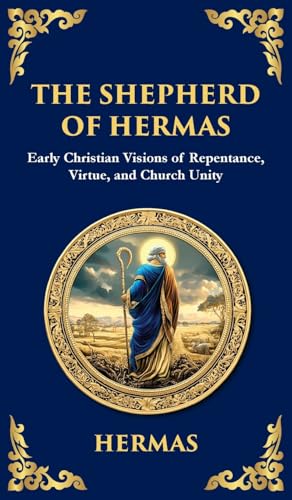
The Shepherd of Hermas: A Timeless Guide to Faith, Repentance, and Spiritual Growth
Deluxe Hardbound Edition (Library of Alexandria)
ASIN: 1804215902
View on AmazonWhat Is the Shepherd of Hermas?
The Shepherd of Hermas is one of the most remarkable texts in early Christian literature. Composed in Rome over several decades during the first half of the second century CE, it tells the story of Hermas, a freed slave turned prosperous Christian, who receives a series of divine revelations through visions, angelic instruction, and extended parables.
The text is divided into three sections of unequal length. The five Visions introduce Hermas's situation and present symbolic revelations about the state of the Church. The twelve Mandates deliver practical moral commandments through the mouth of an angel dressed in shepherd's clothing. The ten Similitudes (or parables) use extended metaphors to teach about faith, repentance, wealth, suffering, and the relationship between the Christian and the world.
What sets the Shepherd apart from other early Christian texts is its combination of personal narrative, moral instruction, and apocalyptic vision. Hermas is not a theological abstractionist. He is a flawed human being struggling with family problems, business anxieties, and spiritual doubt. His revelations come not to a saint on a mountaintop but to an ordinary man in the streets and fields of Rome, making the text remarkably accessible across the centuries.
With 1,600 monthly searches, the Shepherd of Hermas continues to attract readers interested in early Christianity's diversity. For a text that was read more widely than many books of the New Testament during the first four centuries, its relative obscurity today is itself a story worth understanding.
Who Was Hermas?
Hermas introduces himself as a former slave who was sold to a woman named Rhoda in Rome. After gaining his freedom, he became a merchant, married, and raised a family. But prosperity brought its own spiritual dangers. His children fell into apostasy and betrayed their parents during a persecution. His wife spoke too freely and sinfully. Hermas himself, while not a grave sinner, was spiritually lukewarm, too absorbed in business and worldly concerns to devote himself fully to God.
The Muratorian Fragment, an early list of canonical books dated to around 170 CE, identifies Hermas as the brother of Pius, who served as Bishop of Rome from approximately 140 to 155 CE. If this identification is correct, the text (or at least its final form) dates to the mid-second century and was composed by someone with close connections to the Roman church leadership.
Some scholars have proposed that different sections of the text were written at different times, possibly by different authors. The Visions may date to the early second century, while the Mandates and Similitudes may have been added later. This layered composition would explain certain tensions within the text and its unusually long narrative arc.
Whether Hermas was a historical individual or a literary persona, his characterisation as an imperfect, anxious, and spiritually struggling Christian gives the text its emotional power. Readers in every century have recognised something of their own spiritual struggles in Hermas's story. He is not a hero of the faith but a bumbling pilgrim, and his very ordinariness makes his revelations all the more compelling.
The Five Visions
The Visions section establishes the dramatic framework for the entire text. Each vision builds upon the previous one, creating a narrative of growing spiritual awareness and deepening revelation.
Vision One opens with Hermas seeing his former owner Rhoda being carried up into heaven. She appears to him and accuses him of having harboured sinful desire toward her. Hermas protests that he had regarded her only as a sister, but Rhoda insists that even the thought of desire constitutes sin. This vision establishes the text's rigorous moral standard: sin begins not with action but with intention.
Vision Two introduces the central figure of the elderly woman, who represents the Church. She gives Hermas a small book to copy, containing a message of repentance for the Christian community. The book's contents are later revealed: the Church is old because she was created before all other things, and the world itself was fashioned for her sake. This cosmic ecclesiology places the Church at the centre of God's purposes.
Vision Three presents the most famous image in the text: the tower being built upon the waters. The elderly woman shows Hermas a great tower under construction. Six young men are building it, assisted by thousands of other men who bring stones from the deep and from the land. Some stones fit perfectly into the tower. Others are rejected, cracked, chipped, or thrown far away. Each type of stone represents a different category of Christian, from the faithful to the apostates.
Vision Four depicts a great beast representing coming tribulation. The beast has four colours on its head: black (the present world), red (destruction by blood and fire), gold (those refined through suffering), and white (the age to come). Hermas passes the beast without harm because of his faith, demonstrating that trust in God overcomes fear.
Vision Five is the transition point. The angel appears dressed as a shepherd and announces that he has been sent to live with Hermas for the rest of his life, delivering the Mandates and Similitudes. This shepherd figure gives the entire text its name and establishes the pastoral framework for the moral instruction that follows.
A striking detail runs through the Visions: the elderly woman who represents the Church grows progressively younger. In the first vision she is ancient and seated in a chair. By the third vision she is young, beautiful, and standing. This rejuvenation symbolises the Church's renewal through repentance. The Church is old in her origins (created before the world) but young in her vitality when her members turn from sin and return to faithfulness.
The Tower Allegory: The Church Being Built
The tower allegory, which appears in both Vision Three and the extended Ninth Similitude, is the theological centre of the Shepherd of Hermas. The image is simple but rich in meaning: the Church is a tower being built upon water (the water of baptism), and every Christian is a stone in that construction.
The square, white stones that fit perfectly into the tower represent the apostles, bishops, teachers, and deacons who served blamelessly. They fit together without gaps because their lives were in harmony with the building's design. These are the foundation stones, the structural elements without which the tower could not stand.
Stones pulled from the deep represent those who suffered and died for the name of God. Stones brought from the land represent newer Christians whose faith was recently proven. Stones placed near the tower but not yet built in are those who appear righteous but have not yet been fully tested. The variety of stones reflects the diversity of the Christian community and the different paths by which people come to faith.
Most significantly, some stones are cracked, chipped, or misshapen. These are not immediately rejected. They are set aside near the tower, where they may be reshaped and eventually fitted into the building. These represent Christians who have sinned but may yet repent. The tower's construction is not yet complete, and until it is finished, there remains time for the cracked stones to be restored.
But other stones are thrown far from the tower and roll into rough, impassable terrain. These are apostates who have permanently abandoned the faith. They cannot be reshaped because they have hardened beyond repair. Still others fall near the water but cannot roll into it, representing those who wished to be baptised but turned back from the Christian life.
The allegory's power lies in its pastoral balance. It takes sin seriously without despairing of sinners. It insists on holiness without denying the possibility of restoration. And it places individual spiritual life within a communal context: you are not a solitary pilgrim but a stone in a building, and your fitness depends not just on your own shape but on your relationship to the whole structure.
The Twelve Mandates
The twelve Mandates form the ethical core of the Shepherd of Hermas. Delivered by the angel in shepherd's clothing, they provide a comprehensive moral code for Christian living, combining theological principles with practical guidance.
Mandate 1 establishes the foundation: "First of all, believe that God is one, who created all things and set them in order, and brought all things from non-existence into being." Faith in one God who creates out of nothing is the starting point for all that follows.
Mandate 2 teaches simplicity and innocence: be guileless, speak evil of no one, and give generously to those in need without questioning who deserves help. The simplicity Hermas describes is not naivety but a deliberate refusal to calculate moral debts.
Mandate 3 commands truthfulness. "Love truth, and let nothing but truth proceed out of your mouth." Hermas learns that lying is especially dangerous because it undermines the integrity of the whole community.
Mandate 4 addresses chastity and remarriage. This mandate contains the text's most explicit teaching on repentance: if a spouse commits adultery, the other should separate and remain unmarried, in case the sinner repents. Hermas asks whether post-baptismal sin can be forgiven, and the angel replies that one additional repentance is possible, but repeated sinning and repenting makes true restoration unlikely.
Mandates 5 through 12 address patience and temperance, trust in righteousness over wickedness, fear of God rather than the devil, self-control in distinguishing good from evil, the danger of double-mindedness (dipsychia), the need to put away grief, the testing of true and false prophets, and the avoidance of evil desire. Each mandate combines moral instruction with encouragement, assuring Hermas that obedience is possible through divine help.
The Mandate on false prophets (Mandate 11) is particularly interesting. It describes how a false prophet operates: he sits in a seat of authority, takes payment for prophecy, tells people what they want to hear, and cannot prophesy in a genuine assembly of the faithful. A true prophet, by contrast, is meek, quiet, speaks only when God fills him, and can prophesy in the presence of righteous people. This description connects to the same concerns about travelling prophets found in the Didache.
The Ten Similitudes
The Similitudes (parables) use extended metaphors drawn from agriculture, pastoral life, and daily experience to illustrate spiritual truths. They are less systematic than the Mandates but more imaginative, using narrative and imagery to communicate what abstract instruction cannot.
Similitude 1 presents Christians as residents of a foreign city. You have bought fields, luxuries, and property in this city (the world), but your true city (the city of God) is far away. When the lord of this city expels you, what will you do with all your property? Better to invest in your true homeland by caring for widows, orphans, and the poor.
Similitude 2 offers the beautiful image of the elm and the vine. The elm tree bears no fruit, but it supports the vine, which bears abundant fruit. Similarly, the rich person may produce little spiritual fruit, but by supporting the poor (who pray and give thanks to God), the rich person becomes fruitful through partnership. Neither rich nor poor is complete without the other.
Similitude 3 compares faithful and sinful Christians to trees in winter: when all the trees have lost their leaves, you cannot tell the living from the dead. In this present age, righteous and sinners look alike. Only in the summer (the age to come) will the difference become apparent.
Similitudes 4-8 develop themes of suffering, fasting, false and true shepherds, and the willow tree whose branches represent different types of Christians. The willow parable is particularly elaborate: Michael the archangel cuts branches from the great willow and distributes them to the people. When they return the branches, some are withered, some budding, some bearing fruit, and each condition represents a different spiritual state.
Similitude 9, the longest and most complex, retells the tower allegory in expanded form. Twelve mountains of different colours represent twelve nations called to faith. Twelve maidens (virtues) guard the gate of the tower. The Son of God is revealed as both the rock on which the tower stands and the gate through which the stones must pass. This extended allegory draws together all the text's themes into a comprehensive vision of the Church, its diversity, its struggles, and its ultimate completion.
Similitude 10 concludes the text with the angel's final exhortation to Hermas: keep these commandments, and your house will be set right. Walk in them, and all who walk in them will be blessed.
Repentance Theology: The Second Chance
The Shepherd of Hermas made its most significant contribution to Christian theology through its teaching on post-baptismal repentance. In the earliest decades of Christianity, baptism was understood as a complete cleansing of sin. The question that inevitably arose was: what happens when a baptised Christian sins? Is there any remedy, or is the person irredeemably lost?
Some early Christians took the stricter position. The Epistle to the Hebrews (6:4-6) seemed to say that those who have been "enlightened" (baptised) and then fallen away cannot be renewed to repentance. This rigorism created a practical crisis: as the church grew and persecution tested believers, many Christians sinned, apostatised, or compromised, and the question of their readmission became urgent.
The Shepherd of Hermas proposed a middle way. Yes, post-baptismal sin can be forgiven, but the opportunity is limited. The Angel of Repentance tells Hermas: "After that great and holy calling, if anyone, being tempted by the devil, shall sin, he has one repentance. But if he shall often sin and repent, repentance shall be of no advantage to such a person, for he shall live with difficulty."
This teaching was both generous and strict. It offered hope to those who had sinned (the cracked stones that might still be reshaped for the tower), while maintaining that repentance is a serious matter, not to be treated as a revolving door. The text adds urgency by declaring that this opportunity for repentance is temporary: "these days of repentance have a limit," and those who delay risk finding the tower completed without them.
This theology had enormous practical consequences for the development of Christianity. It provided the theological foundation for the penitential system that would later develop: the idea that confessed sin could be forgiven through prescribed acts of penance. Without the Shepherd's insistence that post-baptismal forgiveness was possible, the church's pastoral response to human failure would have been far more rigid.
The Angel of Repentance
The angel dressed as a shepherd, who gives the text its name, is one of the most distinctive figures in early Christian literature. Identified as the Angel of Repentance, he appears in the Fifth Vision and remains with Hermas for the rest of the text, delivering the Mandates and Similitudes.
His shepherd's clothing connects to the rich biblical tradition of God as shepherd (Psalm 23, Ezekiel 34) and anticipates the Christian image of Christ as the Good Shepherd (John 10). But the Angel of Repentance is not Christ. He is a distinct angelic being whose specific mission is to guide sinners back to the fold. His existence implies that repentance is important enough to warrant its own angelic ministry.
The angel's manner is stern but compassionate. He rebukes Hermas for his spiritual laziness and his family's sins, but he also provides patient instruction, answers questions, and offers repeated encouragement. When Hermas doubts whether he can keep the Mandates, the angel assures him that obedience is possible with divine help: "Keep these commandments, and you will walk in the ways of righteousness. All who walk in them will be blessed in their life."
The angel also serves as a hermeneutical guide, interpreting the Visions and Similitudes for Hermas when their meaning is not clear. This interpretive function reflects the text's assumption that spiritual truth often comes in symbolic form and requires angelic assistance to understand, a pattern found throughout apocalyptic literature from 1 Enoch to the Book of Revelation.
Why It Nearly Made the Canon
The Shepherd of Hermas came closer to canonical status than almost any other excluded text. Understanding why it was ultimately left out illuminates the complex process by which the New Testament canon was formed.
The case for inclusion was strong. Irenaeus of Lyon (circa 180 CE) quoted the Shepherd as "scripture." Clement of Alexandria treated it as divinely inspired. Origen considered it valuable, if not universally accepted. Tertullian initially respected it, though he later became hostile. The text appears in the fourth-century Codex Sinaiticus, one of the oldest and most important biblical manuscripts, placed immediately after the Book of Revelation.
The case against inclusion was also strong. The Muratorian Fragment (circa 170 CE) acknowledged the Shepherd's value but stated it should not be read publicly in the church "because it was written quite recently in our own times." This objection was fundamentally about dating: texts included in the canon needed to be of apostolic origin (written by or closely associated with the apostles), and the Shepherd was too recent to qualify.
Eusebius of Caesarea (circa 325 CE) listed the Shepherd among the "rejected" writings, though he acknowledged that others considered it useful. Athanasius of Alexandria, whose 39th Festal Letter (367 CE) provides the earliest list matching the modern New Testament canon exactly, excluded the Shepherd from scripture but recommended it as suitable for instruction of new converts.
The decisive factors were date and authorship. If the Shepherd had been attributed to an apostolic figure, it might well have been included. But its association with Pius's brother (a mid-second century figure) placed it outside the window of apostolic authenticity. Its theology of limited post-baptismal repentance, while pastorally useful, also made some theologians uncomfortable, as it seemed to imply that God's forgiveness had limits.
Manuscript Tradition and Popularity
The manuscript evidence for the Shepherd of Hermas is remarkable. More fragments of this text survive from the first five centuries of Christianity than of many canonical New Testament books. In the surviving Christian manuscripts of Egypt, the Shepherd is the most frequently attested non-canonical text well into the fifth century.
The text survives in several forms. The complete text exists in a fifteenth-century Greek manuscript (Codex Athous) and in two Latin translations (the Vulgata and the Palatina). Partial Greek text appears in Codex Sinaiticus (fourth century, covering roughly the first quarter of the text) and in the third-century Michigan Codex (papyrus). Numerous papyrus fragments from Egypt confirm the text's wide circulation.
Ethiopic, Coptic, Middle Persian, and Georgian fragments indicate that the Shepherd was translated into multiple languages and read across a wide geographical area. Its influence extended from Rome to Egypt to Persia to Ethiopia, a distribution that rivals many canonical texts.
This popularity is itself theologically significant. The Shepherd spoke to the real needs of ordinary Christians in ways that more sophisticated theological texts did not. Its message, that there is hope for sinners, that repentance is possible, that the Church is being built and there is still time to find your place in the tower, addressed the actual anxieties of people trying to live faithfully in a hostile world.
Spiritual Significance for Modern Seekers
For students of consciousness and spiritual development, the Shepherd of Hermas offers a model of spirituality that is refreshingly honest about human limitation. Hermas is not a mystic, a saint, or a spiritual athlete. He is an ordinary person who struggles with desire, doubt, and distraction. His spiritual growth comes not through heroic achievement but through patient instruction, repeated failure, and the willingness to begin again.
The tower allegory offers a powerful image for understanding spiritual community. We are not isolated individuals pursuing private enlightenment. We are stones in a building, and our spiritual formation is determined not just by our individual quality but by how we fit with others. The cracked stone that is reshaped to fit the tower has a different kind of beauty from the perfect stone, the beauty of transformation through struggle.
The twelve Mandates provide a practical framework for moral development that avoids both rigid legalism and vague sentimentality. Each mandate addresses a specific virtue or vice in concrete terms, offering not just the principle but the practical psychology of how it operates. The mandate on double-mindedness (dipsychia), for example, does not simply condemn wavering but explores how doubt undermines spiritual practice at every level.
In the Hermetic tradition, the shepherd figure resonates with the guide or initiator who leads the seeker through stages of understanding. The Poimandres ("Shepherd of Men") in the Corpus Hermeticum serves a similar function, appearing as a divine being who reveals cosmic truths to the seeker. Whether the Shepherd of Hermas drew on this tradition or developed independently, the structural parallel is striking: in both texts, a shepherd figure guides a spiritual novice from confusion to understanding through a series of revelations.
The Shepherd's theology of the second chance holds particular relevance for anyone who has experienced spiritual failure. The message is not that sin does not matter or that repentance is easy. It is that the building is not yet finished. The tower of your spiritual life is still under construction. There is still time to be reshaped, refitted, and restored to your place in the living architecture of wisdom.
Hermetic Synthesis Course
Ready to explore the connections between early Christian visionary texts, Hermetic philosophy, and the perennial path of spiritual transformation? Our Hermetic Synthesis Course traces how the Shepherd tradition connects to the broader current of Western esotericism.
Frequently Asked Questions
What is the Shepherd of Hermas?
The Shepherd of Hermas is an early Christian apocalyptic text composed in Rome between approximately 100-160 CE. It consists of three sections: five Visions (including the famous tower allegory representing the Church), twelve Mandates (moral commandments delivered by an angel in shepherd's clothing), and ten Similitudes (parables about faith, repentance, and spiritual growth). It was the most popular non-canonical Christian text for the first four centuries of Christianity.
Who was Hermas?
Hermas presents himself as a former slave in Rome who was sold to a woman named Rhoda. After gaining his freedom, he became a prosperous but spiritually compromised Christian whose family had fallen into sin. The Muratorian Fragment identifies him as the brother of Pius, Bishop of Rome (circa 140-155 CE), which would place the text's composition in the mid-second century. Whether Hermas was a real individual or a literary persona remains debated among scholars.
What is the tower allegory in the Shepherd of Hermas?
The tower allegory, appearing in both the Third Vision and the extended Ninth Similitude, represents the Church being built upon the waters of baptism. The tower is constructed from stones representing different types of believers: square, white stones that fit perfectly are the apostles and faithful; cracked or chipped stones are repentant sinners being reshaped; rejected stones thrown far from the tower are those who have permanently abandoned the faith. The tower is not yet complete, giving sinners time to repent before construction finishes.
Why was the Shepherd of Hermas not included in the Bible?
The Shepherd of Hermas came closer to canonical status than almost any other excluded text. Irenaeus, Clement of Alexandria, Origen, and Tertullian all treated it as scripture. It appears in the fourth-century Codex Sinaiticus after the Book of Revelation. However, several factors counted against it: the Muratorian Fragment (circa 170 CE) stated it should be read privately but not publicly in church; its theology of post-baptismal repentance was controversial; and its relatively late date (mid-second century) made apostolic authorship impossible.
What are the twelve Mandates in the Shepherd of Hermas?
The twelve Mandates are moral commandments delivered to Hermas by the angel in shepherd's clothing. They cover: (1) faith in one God, (2) simplicity and innocence, (3) truthfulness, (4) chastity, (5) patience and temperance, (6) trust in righteousness over wickedness, (7) fear of God not the devil, (8) self-control in good and evil, (9) avoiding double-mindedness, (10) putting away grief, (11) testing true and false prophets, and (12) avoiding evil desire. They form a practical ethical code for Christian living.
What is the repentance theology of the Shepherd of Hermas?
The Shepherd of Hermas teaches that Christians who sin after baptism may receive one additional opportunity for repentance. This was significant because some early Christians taught that post-baptismal sin was unforgivable. Hermas presents a middle position: repentance is possible, but not indefinitely. A specific period of repentance has been granted, after which the opportunity closes. This theology influenced the later development of the Christian sacrament of penance and the practice of granting absolution for sins committed after baptism.
What are the Visions in the Shepherd of Hermas?
The five Visions include: (1) Hermas encounters his former owner Rhoda in a heavenly vision and is convicted of sinful desire; (2) an elderly woman (representing the Church) gives him a book to copy containing a message of repentance; (3) the same woman shows him the tower being built on water, representing the Church; (4) Hermas sees a great beast representing coming tribulation; and (5) the angel dressed as a shepherd appears and begins delivering the Mandates and Similitudes. The elderly woman grows progressively younger through the Visions, representing the Church's renewal through repentance.
What are the Similitudes in the Shepherd of Hermas?
The ten Similitudes (parables) use extended metaphors to teach spiritual truths. Key similitudes include: the two cities (Christians as strangers in this world), the elm and vine (rich and poor supporting each other), the willow tree (branches representing different spiritual states), the shepherd separating sheep (types of Christians), and the great tower (extended allegory of the Church). The Ninth Similitude is the longest, providing an elaborate retelling of the tower vision with twelve mountains representing twelve nations called to faith.
How popular was the Shepherd of Hermas in early Christianity?
The Shepherd of Hermas was extraordinarily popular. It is the most frequently attested non-canonical text in surviving Christian manuscripts from Egypt, well into the fifth century. More manuscript fragments of the Shepherd survive from the first five centuries than of many canonical New Testament books. It appears alongside Revelation in the fourth-century Codex Sinaiticus. Church fathers including Irenaeus, Clement of Alexandria, Origen, and Tertullian cited it as scripture. Its popularity only declined after it was definitively excluded from the canon in the fourth century.
What is the significance of the angel dressed as a shepherd?
The angel dressed as a shepherd, who appears in the Fifth Vision and delivers the Mandates and Similitudes, is identified as the Angel of Repentance. His shepherd's clothing connects to the biblical image of God as shepherd and anticipates the Christian imagery of Christ as Good Shepherd. The angel's role as guide and instructor rather than judge reflects the text's pastoral theology: the divine response to human sin is not immediate punishment but patient instruction, moral guidance, and the offer of a second chance through repentance.
What is the Shepherd of Hermas?
The Shepherd of Hermas is an early Christian apocalyptic text composed in Rome between approximately 100-160 CE. It consists of three sections: five Visions (including the famous tower allegory representing the Church), twelve Mandates (moral commandments delivered by an angel in shepherd's clothing), and ten Similitudes (parables about faith, repentance, and spiritual growth). It was the most popular non-canonical Christian text for the first four centuries of Christianity.
Who was Hermas?
Hermas presents himself as a former slave in Rome who was sold to a woman named Rhoda. After gaining his freedom, he became a prosperous but spiritually compromised Christian whose family had fallen into sin. The Muratorian Fragment identifies him as the brother of Pius, Bishop of Rome (circa 140-155 CE), which would place the text's composition in the mid-second century. Whether Hermas was a real individual or a literary persona remains debated among scholars.
What is the tower allegory in the Shepherd of Hermas?
The tower allegory, appearing in both the Third Vision and the extended Ninth Similitude, represents the Church being built upon the waters of baptism. The tower is constructed from stones representing different types of believers: square, white stones that fit perfectly are the apostles and faithful; cracked or chipped stones are repentant sinners being reshaped; rejected stones thrown far from the tower are those who have permanently abandoned the faith. The tower is not yet complete, giving sinners time to repent before construction finishes.
Why was the Shepherd of Hermas not included in the Bible?
The Shepherd of Hermas came closer to canonical status than almost any other excluded text. Irenaeus, Clement of Alexandria, Origen, and Tertullian all treated it as scripture. It appears in the fourth-century Codex Sinaiticus after the Book of Revelation. However, several factors counted against it: the Muratorian Fragment (circa 170 CE) stated it should be read privately but not publicly in church; its theology of post-baptismal repentance was controversial; and its relatively late date (mid-second century) made apostolic authorship impossible.
What are the twelve Mandates in the Shepherd of Hermas?
The twelve Mandates are moral commandments delivered to Hermas by the angel in shepherd's clothing. They cover: (1) faith in one God, (2) simplicity and innocence, (3) truthfulness, (4) chastity, (5) patience and temperance, (6) trust in righteousness over wickedness, (7) fear of God not the devil, (8) self-control in good and evil, (9) avoiding double-mindedness, (10) putting away grief, (11) testing true and false prophets, and (12) avoiding evil desire. They form a practical ethical code for Christian living.
What is the repentance theology of the Shepherd of Hermas?
The Shepherd of Hermas teaches that Christians who sin after baptism may receive one additional opportunity for repentance. This was significant because some early Christians taught that post-baptismal sin was unforgivable. Hermas presents a middle position: repentance is possible, but not indefinitely. A specific period of repentance has been granted, after which the opportunity closes. This theology influenced the later development of the Christian sacrament of penance and the practice of granting absolution for sins committed after baptism.
What are the Visions in the Shepherd of Hermas?
The five Visions include: (1) Hermas encounters his former owner Rhoda in a heavenly vision and is convicted of sinful desire; (2) an elderly woman (representing the Church) gives him a book to copy containing a message of repentance; (3) the same woman shows him the tower being built on water, representing the Church; (4) Hermas sees a great beast representing coming tribulation; and (5) the angel dressed as a shepherd appears and begins delivering the Mandates and Similitudes. The elderly woman grows progressively younger through the Visions, representing the Church's renewal through repentance.
What are the Similitudes in the Shepherd of Hermas?
The ten Similitudes (parables) use extended metaphors to teach spiritual truths. Key similitudes include: the two cities (Christians as strangers in this world), the elm and vine (rich and poor supporting each other), the willow tree (branches representing different spiritual states), the shepherd separating sheep (types of Christians), and the great tower (extended allegory of the Church). The Ninth Similitude is the longest, providing an elaborate retelling of the tower vision with twelve mountains representing twelve nations called to faith.
How popular was the Shepherd of Hermas in early Christianity?
The Shepherd of Hermas was extraordinarily popular. It is the most frequently attested non-canonical text in surviving Christian manuscripts from Egypt, well into the fifth century. More manuscript fragments of the Shepherd survive from the first five centuries than of many canonical New Testament books. It appears alongside Revelation in the fourth-century Codex Sinaiticus. Church fathers including Irenaeus, Clement of Alexandria, Origen, and Tertullian cited it as scripture. Its popularity only declined after it was definitively excluded from the canon in the fourth century.
What is the significance of the angel dressed as a shepherd?
The angel dressed as a shepherd, who appears in the Fifth Vision and delivers the Mandates and Similitudes, is identified as the Angel of Repentance. His shepherd's clothing connects to the biblical image of God as shepherd and anticipates the Christian imagery of Christ as Good Shepherd. The angel's role as guide and instructor rather than judge reflects the text's pastoral theology: the divine response to human sin is not immediate punishment but patient instruction, moral guidance, and the offer of a second chance through repentance.
How does the Shepherd of Hermas connect to spiritual development?
The Shepherd of Hermas connects to spiritual development through its vision of the spiritual life as a process of ongoing purification, repentance, and growth. The tower allegory shows that spiritual formation is not instantaneous but requires continual shaping. The twelve Mandates provide a practical framework for moral development. The progressive rejuvenation of the elderly woman (representing the Church) through the Visions symbolises how repentance and spiritual practice can renew both individuals and communities. The text models a spirituality of second chances and patient transformation.
Sources & References
- Osiek, C. (1999). Shepherd of Hermas: A Commentary. Fortress Press (Hermeneia Series). The definitive modern scholarly commentary.
- Ehrman, B.D. (2003). The Apostolic Fathers, vol. 2. Harvard University Press (Loeb Classical Library). Greek text with English translation.
- Lage, F. (2022). The Shepherd of Hermas in Latin: Critical Edition of the Oldest Translation. De Gruyter.
- Hellholm, D. (2001). "The Shepherd of Hermas" in The Apostolic Fathers: An Introduction. Baylor University Press.
- Young, S. (2019). "The Shepherd of Hermas and the Development of Early Christian Penance." Journal of Early Christian Studies 27(1): 1-28.
- Verheyden, J. (2007). "The Shepherd of Hermas" in The Writings of the Apostolic Fathers. T&T Clark.