

Quick Answer
The Didache is the earliest known Christian manual of practice, written between 50-120 CE. It contains the Two Ways ethical doctrine, the oldest known baptismal instructions, the earliest Eucharistic prayers outside the New Testament, rules for travelling prophets, and guidelines for church organisation. Lost for centuries, it was rediscovered in a Constantinople monastery library in 1873.
Table of Contents
- What Is the Didache?
- The Lost Text Rediscovered: Constantinople 1873
- The Two Ways: Life and Death
- Baptismal Instructions
- The Earliest Eucharistic Prayers
- Fasting, Prayer, and the Lord's Prayer
- Testing Prophets and Apostles
- Early Church Organisation
- The Apocalyptic Conclusion
- Dating, Authorship, and Origins
- Spiritual Significance for Modern Seekers
- Frequently Asked Questions
Key Takeaways
- The oldest surviving Christian manual of practice: Written between 50-120 CE, the Didache provides our earliest window into how ordinary Christian communities actually lived, worshipped, and organised themselves
- The Two Ways doctrine has Jewish roots: The ethical framework of the Way of Life and the Way of Death draws on pre-Christian Jewish moral instruction, showing the deep continuity between Judaism and early Christianity
- Baptism could be adapted to circumstances: The Didache's practical flexibility about water temperature, immersion versus pouring, and preparation fasting reveals a community more concerned with spiritual reality than rigid ritual
- Prophets were tested by their behaviour, not their words: A prophet who stayed more than two days, asked for money, or ordered food "in the Spirit" and ate it himself was considered false
- Church structure was still fluid: The Didache shows a transitional period where travelling prophets coexisted with locally appointed bishops and deacons, before the hierarchical system later became standard
Affiliate Disclosure
This article contains affiliate links to books we genuinely recommend. If you purchase through these links, Thalira earns a small commission at no extra cost to you. This supports our mission to make ancient wisdom accessible to all seekers.
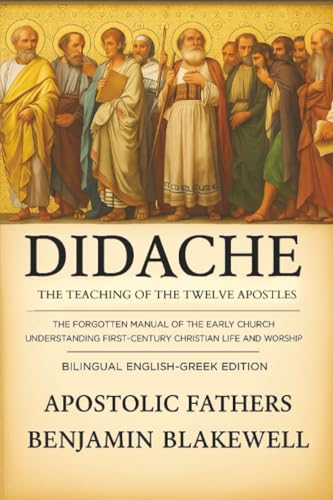
Didache: The Teaching of the Twelve Apostles
Bilingual English-Greek Edition
ASIN: 9371236876 | With introduction by Philip Schaff
View on AmazonWhat Is the Didache?
The Didache (pronounced did-ah-KAY, from the Greek word for "teaching") is the earliest known Christian manual of practice. Its full title, "The Lord's Teaching Through the Twelve Apostles to the Nations," positions it as apostolic instruction for Gentile converts entering the Christian community. In just sixteen short chapters, it provides a remarkably complete guide to the Christian life as it was actually lived in the first or early second century CE.
What makes the Didache extraordinary is not its literary sophistication or theological depth but its practicality. This is not a work of theology or mystical vision. It is a handbook, a set of instructions for people who needed to know, in concrete terms, what it meant to be a Christian. How should you be baptised? What should you pray? How often should you fast? When a prophet comes to your community, how do you know if he is genuine? What should you do when he asks for money?
These practical questions reveal a Christianity that is closer to the ground than the theological sophistication of Paul's letters or the visionary grandeur of the Book of Revelation. The Didache shows us Christianity as a lived practice, a way of life adopted by small, scattered communities of converts who needed guidance for their daily lives and communal worship.
With 1,900 monthly searches, the Didache continues to attract readers who are interested not just in what early Christians believed but in how they actually practised their faith. For students of consciousness and spiritual development, the Didache offers a rare glimpse of spirituality as communal practice rather than individual achievement.
The Lost Text Rediscovered: Constantinople 1873
For most of Christian history, the Didache was known only by name. Early church writers, including Eusebius of Caesarea, Athanasius of Alexandria, and Clement of Alexandria, mentioned it and sometimes quoted from it. But the actual text had been lost. No manuscript survived in any Western library. Scholars knew that such a document had once existed, but they could not read it.
That changed in 1873, when Philotheos Bryennios, an Orthodox Metropolitan serving in Nicomedia, was examining manuscripts in the library of the Jerusalem Monastery of the Most Holy Sepulcher in Constantinople (modern Istanbul). Among the manuscripts he found a codex written by a single scribe in 1056 CE, now known as Codex Hierosolymitanus. Bound within this codex, alongside the Epistle of Barnabas and other early Christian texts, was a complete copy of the Didache.
Bryennios published the text in 1883, and it caused an immediate sensation in the scholarly world. Here was a document that appeared to predate much of the New Testament, offering direct evidence of how the earliest Christian communities organised their worship, administered sacraments, and maintained ethical standards. Scholars debated its date, authorship, and relationship to other early Christian texts, and the discussion continues to this day.
The codex that preserved the Didache also contained other treasures: the full Greek text of the Epistle of Barnabas, the two letters of Clement of Rome, and the longer recension of the letters of Ignatius of Antioch. But it was the Didache that attracted the most attention, precisely because it was the most surprising. No one had expected to find a manual of Christian practice this early, this practical, and this different from the Christianity that later centuries would develop.
The Two Ways: Life and Death
The Didache opens with one of the most ancient ethical frameworks in the Judeo-Christian tradition: "There are two ways, one of life and one of death, but a great difference between the two ways." This Two Ways doctrine, occupying the first six chapters, serves as the moral foundation for everything that follows.
The Way of Life begins with the double commandment of love: "First, you shall love God who made you; second, love your neighbour as yourself." It immediately adds the Golden Rule in its negative form: "And all things whatsoever you would not have done to you, do not do to another." The positive form ("do unto others as you would have them do unto you") is found in Matthew 7:12, but the Didache's negative form reflects an older Jewish formulation also found in the Book of Tobit.
The ethical instruction that follows is detailed and specific. Do not murder, do not commit adultery, do not corrupt children, do not steal, do not practise divination, do not use potions, do not abort a child or kill a newborn. Do not desire what belongs to your neighbour. Do not swear false oaths. Do not be double-minded or double-tongued. Be meek, patient, merciful, and guileless. Do not exalt yourself. Do not take counsel with the rich but with the righteous. Accept whatever happens to you as good, knowing that nothing occurs apart from God.
The Way of Death is described more briefly as a catalogue of vices: "murders, adulteries, lusts, fornications, thefts, idolatries, acts of magic, sorceries, robberies, false testimonies, hypocrisies, duplicity, deceit, arrogance, malice, stubbornness, greediness, filthy talk, jealousy, overconfidence, haughtiness, boastfulness." The list builds to a climactic description of those who follow the Way of Death: "persecutors of the good, hating truth, loving lies, not knowing the reward of righteousness, not cleaving to good nor to righteous judgement."
This Two Ways framework has clear Jewish roots. Similar structures appear in the Dead Sea Scrolls' Community Rule (which describes the spirits of truth and falsehood), in the Testament of Asher, and in the Epistle of Barnabas (which includes a version clearly related to the Didache's). The Christianisation of this Jewish ethical tradition demonstrates how deeply embedded the earliest Christianity was in its Jewish matrix.
Baptismal Instructions
Chapter 7 of the Didache contains the oldest known Christian baptismal instructions, and they are remarkably practical. After reviewing "all these things" (the Two Ways teaching, which evidently served as pre-baptismal catechesis), the text provides specific guidance:
"Baptise thus: having first said all these things, baptise in the name of the Father, and of the Son, and of the Holy Spirit, in living water. But if you have no living water, baptise in other water; and if you cannot do so in cold water, do so in warm. But if you have neither, pour out water three times upon the head in the name of the Father and Son and Holy Spirit."
Several features of these instructions are striking. First, the preference for "living" (running) water connects baptism to Jewish purification practices, where running water (mayim hayyim) was considered superior to still water. Second, the pragmatic allowance for alternatives shows a community that valued the spiritual reality of baptism over the precise form. If you cannot find a river, use a pool. If the water is too cold, use warm. If you cannot immerse, pour.
Third, the instruction that both the baptiser and the candidate should fast for one or two days beforehand reveals that baptism was not a casual event but a serious spiritual commitment requiring preparation. The wider community was also invited to fast, creating a communal framework around the individual's initiation.
These instructions present a Christianity that is simultaneously principled and flexible. The Trinitarian formula is non-negotiable. The ethical preparation is mandatory. But the physical circumstances can be adapted to what is available. This combination of spiritual seriousness and practical flexibility would characterise much of the early church's approach to ritual before standardisation became the norm.
The Earliest Eucharistic Prayers
Chapters 9 and 10 of the Didache contain the earliest known Eucharistic prayers outside the New Testament, and they are unlike anything found in later Christian liturgy. They are simple, direct, and deeply Jewish in character, with imagery drawn from agricultural life and Old Testament thanksgiving psalms.
The prayers begin with the cup, not the bread: "We thank you, our Father, for the holy vine of David your servant, which you made known to us through Jesus your servant." Then comes the bread: "We thank you, our Father, for the life and knowledge which you made known to us through Jesus your servant." The bread prayer includes a striking image: "Even as this broken bread was scattered over the hills, and was gathered together and became one, so let your church be gathered together from the ends of the earth into your kingdom."
The gathered-grain metaphor is beautiful and theologically rich. It presents the church not as an institution but as a gathering, a community brought together from scattered isolation into unity, just as individual grains of wheat are gathered into a single loaf. The prayer asks God to accomplish this gathering "from the four winds," echoing prophetic language about the ingathering of Israel's exiles.
A important rubric follows: "But let no one eat or drink of your Eucharist, unless they have been baptised in the name of the Lord. For concerning this also the Lord has said: 'Give not that which is holy to the dogs.'" The Eucharist is closed to outsiders, restricted to those who have undergone the baptismal initiation described in chapter 7. This "closed communion" practice reflects a community that understood the shared meal as an intimate act of fellowship, not a public demonstration.
The post-meal thanksgiving prayer in chapter 10 adds further depth: "You, Master Almighty, have created all things for your name's sake; you gave food and drink to all people for enjoyment, that they might give thanks to you; but to us you freely gave spiritual food and drink and life eternal through your servant." This prayer distinguishes between the physical nourishment that God provides to all people and the spiritual nourishment given specifically through Jesus, connecting the communal meal to the broader gifts of creation.
Fasting, Prayer, and the Lord's Prayer
Chapter 8 addresses the practical rhythm of Christian devotion: fasting and prayer. Its instructions are notable for their deliberate differentiation from Jewish practice: "But let not your fasts be with the hypocrites, for they fast on Monday and Thursday. Rather, fast on Wednesday and Friday."
This instruction reveals a community that is defining itself in relation to, but distinct from, its Jewish context. The "hypocrites" here are not necessarily insincere people but Jews following the standard Jewish fasting schedule. The Christian community fasts on different days to maintain its own identity, while preserving the practice of twice-weekly fasting itself.
The Didache then provides a version of the Lord's Prayer that closely matches the text of Matthew 6:9-13, with the addition of the doxology ("For yours is the power and the glory forever"). Christians are instructed to pray this prayer three times a day, establishing a rhythm of daily prayer that would later develop into the monastic offices and the Liturgy of the Hours.
These seemingly minor details about fasting days and prayer frequency are historically significant. They show a community actively constructing its identity through shared practices, using common disciplines (fasting, prayer) but performing them on a distinct schedule that marks the community as Christian rather than Jewish. Identity is formed not through dramatic theological statements but through the small, repeated actions of daily life.
Testing Prophets and Apostles
Chapters 11-13 address one of the most practical challenges facing early Christian communities: how to deal with travelling prophets, apostles, and teachers who moved from community to community claiming spiritual authority. The Didache's approach is remarkably pragmatic, testing spiritual claims not by theological criteria but by observable behaviour.
The basic rule for travelling apostles is strict: "Let every apostle who comes to you be received as the Lord. But he shall not remain more than one day; or two days, if there is a need. But if he remains three days, he is a false prophet." If a departing apostle asks for money, he is false. If he asks only for bread to carry him to his next lodging, he may be genuine.
Prophets receive more nuanced treatment. A prophet who speaks "in the Spirit" (in a state of inspired utterance) should not be tested or judged, "for every sin shall be forgiven, but this sin shall not be forgiven." This protection of prophetic speech from communal judgement reflects a community that still valued charismatic gifts and recognised the danger of suppressing genuine inspiration.
However, the Didache immediately adds behavioural criteria: "Not everyone who speaks in the Spirit is a prophet; he is only a prophet if he walks in the ways of the Lord. Therefore from their ways shall the false prophet and the prophet be known." A prophet who orders a table spread "in the Spirit" and then eats from it is false. A prophet who teaches truth but does not practise what he teaches is false. A prophet who asks for money for himself (rather than for the poor) is false.
These practical tests reveal a community wrestling with the tension between spiritual openness and institutional order. The prophetic gift is valued and protected, but the community has clearly been burned by false prophets and has developed concrete strategies for protection. The solution is not to eliminate prophecy but to test it by its fruits, an approach that echoes Jesus' teaching in Matthew 7:15-20.
Early Church Organisation
Chapter 15 provides a brief but significant glimpse into the institutional structure of the Didache's community: "Therefore, appoint for yourselves bishops and deacons worthy of the Lord, men who are meek, unattached to money, truthful, and proven; for they also render to you the service of prophets and teachers."
This instruction reveals a community in transition. The travelling prophets and teachers who had been the primary spiritual authorities are being supplemented (and perhaps replaced) by locally appointed bishops (episkopoi, "overseers") and deacons (diakonoi, "servants"). The text even needs to defend these appointed leaders against the higher prestige of the charismatics: "Therefore do not despise them, for they are your honourable ones, together with the prophets and teachers."
This transitional moment is historically significant. In Paul's letters, written in the 50s CE, church leadership is primarily charismatic (prophets, teachers, healers, speakers in tongues). By the time of the Pastoral Epistles (1 Timothy, 2 Timothy, Titus), written perhaps in the early second century, the episcopal-diaconal structure has become standard. The Didache captures the moment between these two stages, when both models coexisted and the community was actively negotiating their relationship.
The qualifications for bishops and deacons are practical rather than theological: they should be meek, not greedy, truthful, and proven by experience. There is no mention of apostolic succession, ordination ritual, or theological education. Leadership is a function, not a status, and its criteria are moral rather than institutional.
The Apocalyptic Conclusion
The final chapter of the Didache shifts abruptly from practical instruction to apocalyptic warning: "Watch for your life's sake. Let not your lamps be quenched, nor your loins be loosed; but be ready, for you know not the hour in which our Lord comes."
The text describes the end times in compressed but vivid terms. In the last days, false prophets and corrupters will multiply. Sheep will be turned into wolves. Love will be turned into hate. Then the "world-deceiver" (a figure corresponding to the Antichrist) will appear, performing signs and wonders and committing "iniquities which have never yet come to pass since the beginning."
Humanity will be tested, and many will fall away. But those who endure will be saved "by the accursed one himself," a mysterious phrase that has generated considerable scholarly debate. Three signs will accompany the end: the sign of an opening in heaven, the sign of the sound of a trumpet, and the sign of the resurrection of the dead, "not of all, but as it is said: the Lord shall come and all his holy ones with him."
This brief apocalyptic section connects the Didache to the broader tradition of early Christian eschatology. The expectation of an imminent return of Christ, the appearance of a deceiver figure, and the final resurrection are themes shared with the Synoptic Gospels (particularly Matthew 24), 2 Thessalonians, and the Book of Revelation. But the Didache's treatment is notably restrained, occupying only a single chapter compared to the elaborate visions found in more developed apocalyptic texts.
Dating, Authorship, and Origins
The dating of the Didache remains one of the most debated questions in early Christian studies. Estimates range from as early as 50 CE (making it contemporary with Paul's earliest letters) to as late as 150 CE. Most scholars now favour a date around 80-120 CE, roughly contemporary with the Gospel of Matthew, though some sections, particularly the Two Ways material, may be considerably older.
The community that produced the Didache was likely located in Syria, possibly in or near Antioch. Several features point to a Syrian origin: the agricultural imagery (grain scattered on hills), the concern with travelling prophets (Syria was a major trade route), and the close relationship with the Gospel of Matthew, which is also traditionally associated with Antioch.
The text shows no awareness of Paul's theology, which is striking if it was written after Paul's letters had become widely circulated. There is no mention of justification by faith, no discussion of the relationship between law and grace, and no reference to Paul's distinctive understanding of the cross. This silence may indicate an early date, a community outside Paul's sphere of influence, or both.
The Didache's relationship to Matthew's Gospel is particularly complex. The Lord's Prayer in Didache 8:2 closely matches Matthew 6:9-13. The ethical material in the Two Ways parallels the Sermon on the Mount. But the direction of dependence is disputed. Did the Didache draw on Matthew, or did both draw on a common source? The question remains open, and the answer has significant implications for understanding the development of early Christian tradition.
Spiritual Significance for Modern Seekers
For students of consciousness and spiritual development, the Didache offers something that more theological texts do not: a portrait of spirituality as communal practice. In an age when spiritual seeking is often understood as an individual pursuit, the Didache reminds us that the earliest Christians understood spiritual life as something practised together, in the context of shared meals, mutual accountability, and communal worship.
The Two Ways doctrine presents spiritual development not as an ascent through mystical stages but as the daily, practical choice between generosity and selfishness, truth and deception, compassion and cruelty. This is spirituality without glamour, without ecstatic visions or cosmic revelations. It is the spirituality of doing the next right thing, repeatedly, in community.
The Didache's approach to ritual, principled flexibility, offers a model for contemporary practice. The community cares about baptism, prayer, and shared meals, but it does not insist that these must be performed in one and only one way. The spirit matters more than the form, but the form matters too. This balance between freedom and structure resonates with modern seekers who value both authenticity and tradition.
In the Hermetic tradition, the concept of "the Way" (hodos) as a path of practical wisdom rather than theoretical knowledge connects to the Didache's Two Ways framework. The Hermetic path is walked, not merely studied. Similarly, the Didache presents Christianity not as a set of beliefs to be affirmed but as a way of life to be practised, a path to be walked daily in the company of others.
For those interested in philosophy and the origins of Western spiritual practice, the Didache provides an invaluable primary source. It shows us what Christianity looked like before the creeds, before the councils, before the institutional structures that would later define the religion. It shows us a community of seekers, doing their best to live according to the teachings they had received, adapting those teachings to their circumstances, and creating something that would outlast all of them.
Hermetic Synthesis Course
Interested in exploring the connections between early Christian practice, Hermetic wisdom, and the perennial philosophy? Our Hermetic Synthesis Course traces how the practical spirituality of the early church connects to broader streams of wisdom tradition.
Frequently Asked Questions
What is the Didache?
The Didache (pronounced did-ah-KAY) is the earliest known Christian manual of practice, written in Koine Greek probably between 50-120 CE. Its full title is "The Lord's Teaching Through the Twelve Apostles to the Nations." It contains ethical instruction based on the Two Ways doctrine, practical guidelines for baptism, fasting, prayer, and the Eucharist, rules for dealing with travelling prophets and apostles, and a brief apocalyptic conclusion about the end times.
When was the Didache written?
Scholars date the Didache to the late first or early second century CE, with estimates ranging from 50 to 120 CE. Some sections may be even older, particularly the Two Ways material which has Jewish roots predating Christianity. The text likely developed over time, with different layers added by different editors. Its earliest material may be contemporary with some New Testament writings, making it one of the oldest Christian documents outside the Bible itself.
How was the Didache rediscovered?
The Didache was rediscovered in 1873 by Orthodox Metropolitan Philotheos Bryennios in the library of the Jerusalem Monastery of the Most Holy Sepulcher in Constantinople (modern Istanbul). He found it in a manuscript collection known as Codex Hierosolymitanus, written in 1056 CE by a single scribe. Bryennios published the text in 1883, causing a sensation in the scholarly world as this lost document of early Christianity became available for study for the first time in centuries.
What is the Two Ways doctrine in the Didache?
The Two Ways doctrine, found in Didache chapters 1-6, presents the moral life as a choice between two paths: the Way of Life and the Way of Death. The Way of Life begins with the commands to love God and love your neighbour, then provides detailed ethical instruction including the Golden Rule. The Way of Death catalogues vices and sins to avoid. This framework has Jewish origins and was likely used as a pre-baptismal catechism for converts preparing to enter the Christian community.
What does the Didache say about baptism?
The Didache provides the earliest known Christian baptismal instructions (chapter 7). It prescribes baptism in the name of the Father, Son, and Holy Spirit, preferably in running (living) water. If no running water is available, still water may be used. If cold water is unavailable, warm water is acceptable. If full immersion is impossible, water may be poured over the head three times. Both the baptiser and the candidate should fast beforehand, ideally for one or two days.
What does the Didache say about the Eucharist?
The Didache contains the earliest known Eucharistic prayers outside the New Testament (chapters 9-10). The prayers give thanks over the cup first and then the bread, reversing the order found in Paul's letters. The bread is compared to grain scattered on the hills and gathered into one loaf, symbolising the church gathered from the ends of the earth. Only baptised Christians may participate. A post-meal thanksgiving prayer asks God to gather the church from the four winds into the kingdom.
What does the Didache say about prophets?
The Didache provides practical tests for distinguishing true prophets from false ones (chapters 11-13). A true prophet should be welcomed but not stay more than two days. If a prophet asks for money, he is false. If a prophet orders a meal "in the Spirit" and then eats it himself, he is false. Prophets who teach truth but do not practice it are false. However, genuine prophets speaking in the Spirit should not be tested or judged, as this constitutes the unforgivable sin.
Is the Didache in the Bible?
The Didache is not included in any modern biblical canon. However, it was highly regarded by early church fathers. Eusebius of Caesarea (circa 300 CE) listed it among the "disputed" writings. Athanasius of Alexandria recommended it for catechetical instruction. Clement of Alexandria appears to have cited it as scripture. It came very close to inclusion in the New Testament canon and was used as a teaching document in early Christian communities before eventually being lost until its rediscovery in 1873.
How does the Didache compare to the New Testament?
The Didache shares ethical material with the Sermon on the Mount (Matthew 5-7) but organises it differently. Its Lord's Prayer version closely matches Matthew 6:9-13. Its Eucharistic prayers differ from Paul's account in 1 Corinthians 11. It describes a church structure with travelling apostles and prophets alongside locally appointed bishops and deacons, reflecting an earlier, more fluid organisational model than the established hierarchy seen in the Pastoral Epistles. These differences make it invaluable for understanding early Christian diversity.
What does the Didache reveal about early Christianity?
The Didache reveals a Christianity that is practical rather than theological, communal rather than hierarchical, and closely tied to its Jewish roots. It shows a community where prophets still wandered from town to town, where baptism could be adapted to available resources, where the Eucharist was a full communal meal, and where church leadership was transitioning from charismatic prophets to appointed bishops and deacons. This practical, grassroots Christianity contrasts with the more developed theology found in Paul's letters.
What is the spiritual significance of the Didache?
The Didache's spiritual significance lies in its vision of spiritual life as practical, communal, and grounded in daily ethical choices. The Two Ways doctrine presents spiritual development not as mystical experience but as the daily choice between generosity and selfishness, truth and deception. Its emphasis on community, shared meals, and mutual accountability offers a model of spiritual practice rooted in relationship rather than individual achievement. It reminds us that the earliest Christians understood spirituality as something lived, not just believed.
What is the Didache?
The Didache (pronounced did-ah-KAY) is the earliest known Christian manual of practice, written in Koine Greek probably between 50-120 CE. Its full title is 'The Lord's Teaching Through the Twelve Apostles to the Nations.' It contains ethical instruction based on the Two Ways doctrine, practical guidelines for baptism, fasting, prayer, and the Eucharist, rules for dealing with travelling prophets and apostles, and a brief apocalyptic conclusion about the end times.
When was the Didache written?
Scholars date the Didache to the late first or early second century CE, with estimates ranging from 50 to 120 CE. Some sections may be even older, particularly the Two Ways material which has Jewish roots predating Christianity. The text likely developed over time, with different layers added by different editors. Its earliest material may be contemporary with some New Testament writings, making it one of the oldest Christian documents outside the Bible itself.
How was the Didache rediscovered?
The Didache was rediscovered in 1873 by Orthodox Metropolitan Philotheos Bryennios in the library of the Jerusalem Monastery of the Most Holy Sepulcher in Constantinople (modern Istanbul). He found it in a manuscript collection known as Codex Hierosolymitanus, written in 1056 CE by a single scribe. Bryennios published the text in 1883, causing a sensation in the scholarly world as this lost document of early Christianity became available for study for the first time in centuries.
What is the Two Ways doctrine in the Didache?
The Two Ways doctrine, found in Didache chapters 1-6, presents the moral life as a choice between two paths: the Way of Life and the Way of Death. The Way of Life begins with the commands to love God and love your neighbour, then provides detailed ethical instruction including the Golden Rule. The Way of Death catalogues vices and sins to avoid. This framework has Jewish origins and was likely used as a pre-baptismal catechism for converts preparing to enter the Christian community.
What does the Didache say about baptism?
The Didache provides the earliest known Christian baptismal instructions (chapter 7). It prescribes baptism in the name of the Father, Son, and Holy Spirit, preferably in running (living) water. If no running water is available, still water may be used. If cold water is unavailable, warm water is acceptable. If full immersion is impossible, water may be poured over the head three times. Both the baptiser and the candidate should fast beforehand, ideally for one or two days.
What does the Didache say about the Eucharist?
The Didache contains the earliest known Eucharistic prayers outside the New Testament (chapters 9-10). The prayers give thanks over the cup first and then the bread, reversing the order found in Paul's letters. The bread is compared to grain scattered on the hills and gathered into one loaf, symbolising the church gathered from the ends of the earth. Only baptised Christians may participate. A post-meal thanksgiving prayer asks God to gather the church from the four winds into the kingdom.
What does the Didache say about prophets?
The Didache provides practical tests for distinguishing true prophets from false ones (chapters 11-13). A true prophet should be welcomed but not stay more than two days. If a prophet asks for money, he is false. If a prophet orders a meal 'in the Spirit' and then eats it himself, he is false. Prophets who teach truth but do not practice it are false. However, genuine prophets speaking in the Spirit should not be tested or judged, as this constitutes the unforgivable sin.
Is the Didache in the Bible?
The Didache is not included in any modern biblical canon. However, it was highly regarded by early church fathers. Eusebius of Caesarea (circa 300 CE) listed it among the 'disputed' writings. Athanasius of Alexandria recommended it for catechetical instruction. Clement of Alexandria appears to have cited it as scripture. It came very close to inclusion in the New Testament canon and was used as a teaching document in early Christian communities before eventually being lost until its rediscovery in 1873.
How does the Didache compare to the New Testament?
The Didache shares ethical material with the Sermon on the Mount (Matthew 5-7) but organises it differently. Its Lord's Prayer version closely matches Matthew 6:9-13. Its Eucharistic prayers differ from Paul's account in 1 Corinthians 11. It describes a church structure with travelling apostles and prophets alongside locally appointed bishops and deacons, reflecting an earlier, more fluid organisational model than the established hierarchy seen in the Pastoral Epistles. These differences make it invaluable for understanding early Christian diversity.
What does the Didache reveal about early Christianity?
The Didache reveals a Christianity that is practical rather than theological, communal rather than hierarchical, and closely tied to its Jewish roots. It shows a community where prophets still wandered from town to town, where baptism could be adapted to available resources, where the Eucharist was a full communal meal, and where church leadership was transitioning from charismatic prophets to appointed bishops and deacons. This practical, grassroots Christianity contrasts with the more developed theology found in Paul's letters.
What is the spiritual significance of the Didache?
The Didache's spiritual significance lies in its vision of spiritual life as practical, communal, and grounded in daily ethical choices. The Two Ways doctrine presents spiritual development not as mystical experience but as the daily choice between generosity and selfishness, truth and deception. Its emphasis on community, shared meals, and mutual accountability offers a model of spiritual practice rooted in relationship rather than individual achievement. It reminds us that the earliest Christians understood spirituality as something lived, not just believed.
Sources & References
- Niederwimmer, K. (1998). The Didache: A Commentary. Fortress Press. The standard modern scholarly commentary.
- Milavec, A. (2003). The Didache: Faith, Hope, and Life of the Earliest Christian Communities, 50-70 C.E. Paulist Press.
- Draper, J.A. (ed.) (1996). The Didache in Modern Research. Brill. Collection of scholarly essays on dating, origin, and theology.
- Ehrman, B.D. (2003). Lost Christianities: The Battles for Scripture and the Faiths We Never Knew. Oxford University Press.
- Schaff, P. (1885). The Oldest Church Manual Called the Teaching of the Twelve Apostles. Charles Scribner's Sons. Early scholarly edition with commentary.
- Jefford, C.N. (2013). Didache: The Teaching of the Twelve Apostles. Salem, OR: Polebridge Press. Recent critical translation.