

Quick Answer
The Dancing Wu Li Masters by Gary Zukav is a National Book Award-winning exploration of modern physics for non-scientists that draws illuminating parallels between quantum mechanics and Eastern philosophy. Published in 1979, it covers quantum theory, relativity, and particle physics through the metaphor of "Wu Li" (the Chinese word for physics, meaning "patterns of organic energy"), suggesting that modern science and ancient wisdom are converging on the same understanding of reality.
Table of Contents
- Overview and Significance
- Who Is Gary Zukav?
- The Meaning of Wu Li
- The Esalen Origins
- Quantum Mechanics: The Heart of the Book
- Wave-Particle Duality and Buddhist Interdependence
- The Uncertainty Principle and Taoist Insight
- The Observer Effect and the Participatory Universe
- Relativity: Space, Time, and Interconnection
- Particle Physics and the Dance of Creation
- The Eastern Philosophy Parallels
- Comparison with The Tao of Physics
- Scientific Reception and Controversy
- Lasting Relevance
- Get The Dancing Wu Li Masters
- Frequently Asked Questions
Key Takeaways
- Physics as dance: Zukav presents physics not as a dry mathematical discipline but as a dynamic, participatory dance of energy and consciousness, where the observer and the observed are inseparable partners.
- Multiple meanings of reality: Like the Chinese word "Wu Li," which carries five different meanings, reality itself has multiple layers of meaning that different approaches (science, philosophy, mysticism) reveal from different angles.
- The observer participates: Quantum mechanics reveals that the act of observation affects the observed, suggesting that consciousness is not a passive spectator but an active participant in creating reality.
- Science and mysticism converge: Zukav argues that the discoveries of 20th-century physics, particularly quantum mechanics, point toward the same understanding of reality that Eastern contemplative traditions have described for millennia.
- No math required: The book successfully explains quantum theory, relativity, and particle physics to readers with no scientific background, using analogies, stories, and Eastern philosophical concepts as entry points.
Overview and Significance
The Dancing Wu Li Masters: An Overview of the New Physics was published in 1979 and won the American Book Award for Science in 1980, an extraordinary achievement for a first book by a non-scientist. The book arose from a physics conference at the Esalen Institute in Big Sur, California, where Zukav, a journalist and former Special Forces officer, discovered that the findings of modern physics resonated deeply with the insights of Eastern philosophy.
The book covers three main areas of physics: quantum mechanics (the physics of the very small), relativity (the physics of the very fast and very massive), and particle physics (the physics of the fundamental building blocks of matter). Each area is presented without mathematical formalism but with conceptual clarity and illustrated with parallels from Buddhism, Taoism, and Hinduism.
Zukav's central thesis is that modern physics and Eastern philosophy are converging on the same understanding of reality: that the universe is not a collection of separate objects but a dynamic, interconnected whole in which the observer and the observed, the subject and the object, are inseparable aspects of a single process. This thesis, while controversial among physicists, captured the imagination of a generation of readers and helped to catalyze the broader cultural conversation about science and spirituality that continues to this day.
Who Is Gary Zukav?
Gary Zukav was born in 1942 and graduated from Harvard University. After serving as a Special Forces officer in the Vietnam War, he pursued a career in journalism. He had no formal training in physics when he attended the Esalen conference that inspired the book, a fact he turns to advantage: his outsider's perspective allows him to ask the naive questions that experts take for granted and to see connections that specialists might miss.
After The Dancing Wu Li Masters, Zukav wrote The Seat of the Soul (1989), which shifted focus from physics to the evolution of consciousness and became a major bestseller after Oprah Winfrey featured it on her show. The two books reflect different phases of Zukav's intellectual journey: the first explores the external universe through physics, the second explores the internal universe through psychology and spirituality.
The Meaning of Wu Li
At the Esalen conference in 1976, tai chi master Al Huang explained that the Chinese word for physics, "Wu Li," has five different meanings depending on pronunciation and context:
| Pronunciation | Meaning | Physics Parallel |
|---|---|---|
| Wu Li | Patterns of Organic Energy | The fundamental patterns that physics discovers in nature |
| Wu Li | My Way | Each physicist finds their own path to understanding |
| Wu Li | Nonsense | Quantum mechanics often seems nonsensical to common sense |
| Wu Li | I Clutch My Ideas | The danger of becoming attached to theories |
| Wu Li | Enlightenment | The deepest understanding of physics leads to insight into the nature of reality itself |
This multiple-meaning structure becomes the organizing principle of the book. Each chapter explores a different aspect of physics through the lens of one or more Wu Li meanings, suggesting that the scientific enterprise is not merely an accumulation of facts but a journey toward understanding that has spiritual as well as intellectual dimensions.
The Esalen Origins
The Esalen Institute in Big Sur, California, has been a crucible for the intersection of science, philosophy, and consciousness studies since its founding in 1962. The 1976 physics conference that inspired Zukav's book brought together physicists including Jack Sarfatti, Fred Alan Wolf, and Nick Herbert with tai chi master Al Huang and other participants interested in the philosophical implications of the new physics.
The Esalen environment, where rigorous scientific discussion coexisted with meditation, bodywork, and philosophical speculation, provided the intellectual context that made the book possible. In a university physics department, the connections between quantum mechanics and Buddhist philosophy would be considered irrelevant to the science. At Esalen, they were the entire point.
Quantum Mechanics: The Heart of the Book
The book's most substantial chapters deal with quantum mechanics, the physics of the subatomic world. Zukav presents the key findings with remarkable clarity:
Wave-particle duality: Quantum entities (photons, electrons) behave sometimes as particles (localized points) and sometimes as waves (distributed patterns), depending on how they are observed. There is no "real" state underneath: the entity is genuinely both and neither until an observation forces it into one mode or the other.
The uncertainty principle: Werner Heisenberg's principle establishes that certain pairs of properties (position and momentum, energy and time) cannot both be known with precision simultaneously. This is not a limitation of our instruments but a fundamental feature of reality: nature itself is "uncertain" at the quantum level.
Quantum superposition: Before measurement, a quantum system exists in a superposition of all possible states simultaneously. The act of measurement causes the superposition to "collapse" into a single definite state. The probability of each outcome can be calculated, but which specific outcome will occur cannot be predicted.
Non-locality (entanglement): Particles that have interacted remain correlated regardless of the distance between them. Measuring one particle instantaneously affects the other, even if they are on opposite sides of the universe. Einstein called this "spooky action at a distance" and rejected it, but subsequent experiments (Bell's theorem, Aspect's experiments) have confirmed that quantum non-locality is real.
Wave-Particle Duality and Buddhist Interdependence
Zukav draws a parallel between wave-particle duality and the Buddhist teaching of interdependence (pratityasamutpada). In Buddhism, nothing has an independent, fixed essence; everything exists in dependence on conditions and relationships. A "particle" is not a thing-in-itself but a pattern of relationships. Change the context (the experimental setup), and the "thing" changes (from particle to wave).
Similarly, the Buddhist concept of sunyata (emptiness) does not mean that things do not exist but that they do not exist independently, as fixed, self-contained entities. Quantum mechanics arrives at a structurally similar insight: subatomic entities do not have definite properties independent of observation. Their properties are co-created by the interaction between the observed and the observer.
The Uncertainty Principle and Taoist Insight
Zukav connects Heisenberg's uncertainty principle to the Taoist insight that reality cannot be fully captured in concepts. The opening line of the Tao Te Ching, "The Tao that can be told is not the eternal Tao," expresses the same recognition that the deepest reality escapes conceptual description. The uncertainty principle, in Zukav's reading, is physics arriving at the same conclusion: nature at its most fundamental level resists being pinned down by the mind's desire for certainty.
The Observer Effect and the Participatory Universe
Perhaps the most philosophically significant chapter deals with the observer effect: the finding that the act of observation affects the system being observed. Zukav connects this to physicist John Wheeler's concept of the "participatory universe," in which the observer is not a passive spectator but an active participant in creating reality.
"In the new physics," Zukav writes, "there is no such thing as an objective observer. The observer always participates in the phenomenon being observed." This has implications that extend far beyond physics: if consciousness participates in creating reality at the quantum level, then the sharp division between mind and matter, subject and object, that has defined Western thought since Descartes may be an artefact of an incomplete worldview.
Eastern philosophy, Zukav argues, has always recognized this participatory nature of consciousness. The Buddhist teaching that "mind creates the world" and the Hindu teaching that "the observer and the observed are one" express in philosophical language what quantum mechanics expresses in experimental results.
Relativity: Space, Time, and Interconnection
Zukav's treatment of relativity covers both special relativity (the physics of objects moving near the speed of light) and general relativity (Einstein's theory of gravity as the curvature of spacetime). He presents the key insights:
- Space and time are not separate but form a four-dimensional spacetime continuum
- The speed of light is absolute; everything else (length, mass, time) is relative
- Mass and energy are interconvertible (E = mc2)
- Gravity is not a force but the curvature of spacetime caused by mass
Zukav connects these findings to Eastern concepts of the unity of space and time, the illusory nature of separation, and the dynamic, interconnected nature of reality. While the parallels are looser than those with quantum mechanics, they contribute to the book's central argument that physics is progressively dismantling the mechanistic worldview and revealing a reality more consonant with contemplative wisdom.
Particle Physics and the Dance of Creation
The book's chapters on particle physics cover the zoo of subatomic particles, the Standard Model, quarks, and the fundamental forces of nature. Zukav presents particle physics as a "dance of creation and destruction" in which particles constantly appear, interact, and transform into other particles in a continuous flow of energy.
He connects this to the Buddhist concept of impermanence (anicca): nothing in the subatomic world endures. Particles are not permanent building blocks but transient patterns in an underlying field. The universe is not a collection of things but a process of becoming, a dance of energy that never rests.
The Eastern Philosophy Parallels
Zukav draws on several Eastern traditions throughout the book:
Buddhism: The concepts of interdependence, emptiness, impermanence, and the inseparability of observer and observed provide the primary philosophical framework. Zukav references Huayan Buddhism (particularly Fazang's treatise on the Golden Lion) and its teaching of mutual interpenetration: every phenomenon contains every other phenomenon, just as every part of a hologram contains the whole.
Taoism: The concepts of wu wei (non-forcing), the relativity of opposites, and the inadequacy of conceptual thought to capture ultimate reality provide parallels with the uncertainty principle and the limits of scientific measurement.
Hinduism: The concept of maya (the illusory nature of the phenomenal world) and the teaching that consciousness (Brahman) is the fundamental reality provide parallels with quantum mechanics' suggestion that the material world has no independent existence apart from observation.
Comparison with The Tao of Physics
| Aspect | Dancing Wu Li Masters (1979) | Tao of Physics (1975) |
|---|---|---|
| Author background | Journalist, Harvard graduate | Physicist (PhD, University of Vienna) |
| Physics detail | More extensive, wider range | More focused on quantum mechanics |
| Eastern philosophy | Buddhism, Taoism, Hinduism (lighter touch) | Buddhism, Taoism, Hinduism (deeper engagement) |
| Claim strength | Suggestive parallels | Stronger convergence claims |
| Tone | Playful, accessible | More scholarly |
| Best for | Physics beginners, general readers | Readers wanting deeper philosophy |
Scientific Reception and Controversy
The book has been received differently by different audiences:
General readers: Enthusiastic reception. The book sold millions of copies and introduced quantum physics to readers who would never have opened a textbook. Many credit it with sparking lifelong interests in both physics and contemplative practice.
Physicists: Mixed reception. Most physicists acknowledge that Zukav's presentation of the physics is generally accurate at a popular level but object to the philosophical conclusions he draws. Physicist Murray Gell-Mann (who named the quark) reportedly said he wished people would stop trying to find mysticism in quantum mechanics. Others, like David Bohm and John Wheeler, were more sympathetic to the connections Zukav explored.
Philosophers: The book has been discussed in the context of the "science and religion" dialogue, with some philosophers arguing that the parallels Zukav identifies are genuine structural similarities and others arguing that they are superficial analogies that obscure fundamental differences between scientific and mystical ways of knowing.
Lasting Relevance
Nearly five decades after its publication, The Dancing Wu Li Masters remains relevant for several reasons:
The measurement problem in quantum mechanics (what constitutes an "observation"? does consciousness play a role?) remains unresolved. The philosophical questions Zukav raised are, if anything, more pressing now than in 1979, as quantum computing and quantum information theory push the implications of quantum mechanics into practical applications.
The dialogue between science and contemplative traditions has expanded enormously since 1979, with the Mind and Life Institute (founded by the Dalai Lama and neuroscientist Francisco Varela) sponsoring ongoing research at the intersection of Buddhist practice and neuroscience. Zukav's book was one of the works that helped to legitimate this dialogue.
Get The Dancing Wu Li Masters
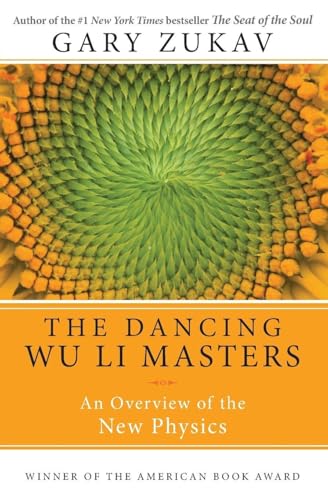
Get The Dancing Wu Li Masters on Amazon
As an Amazon Associate, Thalira earns from qualifying purchases.
Deepen Your Hermetic Practice
The Hermetic Synthesis Course guides you through all seven principles with structured daily practices.
Explore the CourseFrequently Asked Questions
What is The Dancing Wu Li Masters about?
An exploration of modern physics (quantum theory, relativity, particle physics) for non-scientists that draws parallels with Eastern philosophy. Won the 1980 National Book Award for Science.
What does Wu Li mean?
The Chinese word for physics, carrying five meanings: patterns of organic energy, my way, nonsense, I clutch my ideas, and enlightenment.
Who is Gary Zukav?
A Harvard-educated American author who wrote this book after a physics conference at Esalen. He later wrote The Seat of the Soul about consciousness evolution.
How does it connect physics and Eastern philosophy?
Wave-particle duality parallels Buddhist interdependence. The uncertainty principle parallels Taoist insight. The observer effect parallels the participatory nature of consciousness in contemplative traditions.
Is it scientifically accurate?
Physics descriptions are generally accurate at a popular level. The philosophical parallels with Eastern traditions are more controversial. Best read as exploration rather than proof.
How does it compare to The Tao of Physics?
Both explore physics-philosophy parallels. Capra's book is by a physicist with deeper Eastern philosophy engagement. Zukav's is more accessible with wider physics coverage. They are complementary.
What topics does it cover?
Quantum mechanics (wave-particle duality, uncertainty, superposition, entanglement), special and general relativity, particle physics (quarks, Standard Model), and quantum field theory.
Did it win awards?
Yes, the 1980 American Book Award (National Book Award) for Science.
What is the Esalen connection?
The book originated from a 1976 physics conference at the Esalen Institute where tai chi master Al Huang explained the meaning of Wu Li.
Is it still relevant?
Yes. The measurement problem and the role of consciousness in physics remain unresolved. The science-spirituality dialogue has expanded enormously since 1979.
How does the book connect physics and Eastern philosophy?
Zukav draws parallels between quantum mechanics findings and Eastern philosophical concepts: wave-particle duality parallels the Buddhist teaching of interdependence; the observer effect parallels the Buddhist teaching that the observer and the observed cannot be separated; quantum non-locality parallels the mystical experience of universal interconnection; and the uncertainty principle parallels the Taoist insight that reality cannot be fully captured in concepts.
Is The Dancing Wu Li Masters scientifically accurate?
The physics descriptions are generally accurate as popular-level explanations of quantum mechanics and relativity. The parallels Zukav draws with Eastern philosophy are more controversial. Most physicists accept his presentation of the science but reject the philosophical conclusions he draws from it. The book is best understood as an exploration of resonances between two ways of understanding reality rather than as a demonstration that they are saying the same thing.
What topics does the book cover?
The book covers the foundations of quantum mechanics (wave-particle duality, the uncertainty principle, the measurement problem), special and general relativity, particle physics (quarks, the Standard Model), and quantum field theory. Each topic is presented without mathematical formalism but with clear conceptual explanations and illustrated with analogies drawn from everyday experience and Eastern philosophy.
Did the book win any awards?
The Dancing Wu Li Masters won the 1980 American Book Award (now the National Book Award) in the Science category, a remarkable achievement for a first book by an author with no scientific training. The award recognized both the quality of the physics exposition and the originality of the philosophical framework.
Is the book still relevant?
While the physics has not changed fundamentally since 1979, new developments (quantum computing, quantum entanglement experiments, the Higgs boson discovery) have extended the territory the book covers. The philosophical questions Zukav raises about the role of consciousness in physics remain unresolved and arguably more urgent than when the book was written. As an introduction to quantum physics for non-scientists, it remains one of the most engaging and accessible options available.
Sources and References
- Zukav, G. (1979). The Dancing Wu Li Masters: An Overview of the New Physics. William Morrow.
- Capra, F. (1975). The Tao of Physics. Shambhala.
- Bohm, D. (1980). Wholeness and the Implicate Order. Routledge.
- Wheeler, J. A. (1983). "Law Without Law." In Quantum Theory and Measurement. Princeton University Press.
- Herbert, N. (1985). Quantum Reality: Beyond the New Physics. Anchor Books.