
Quick Answer
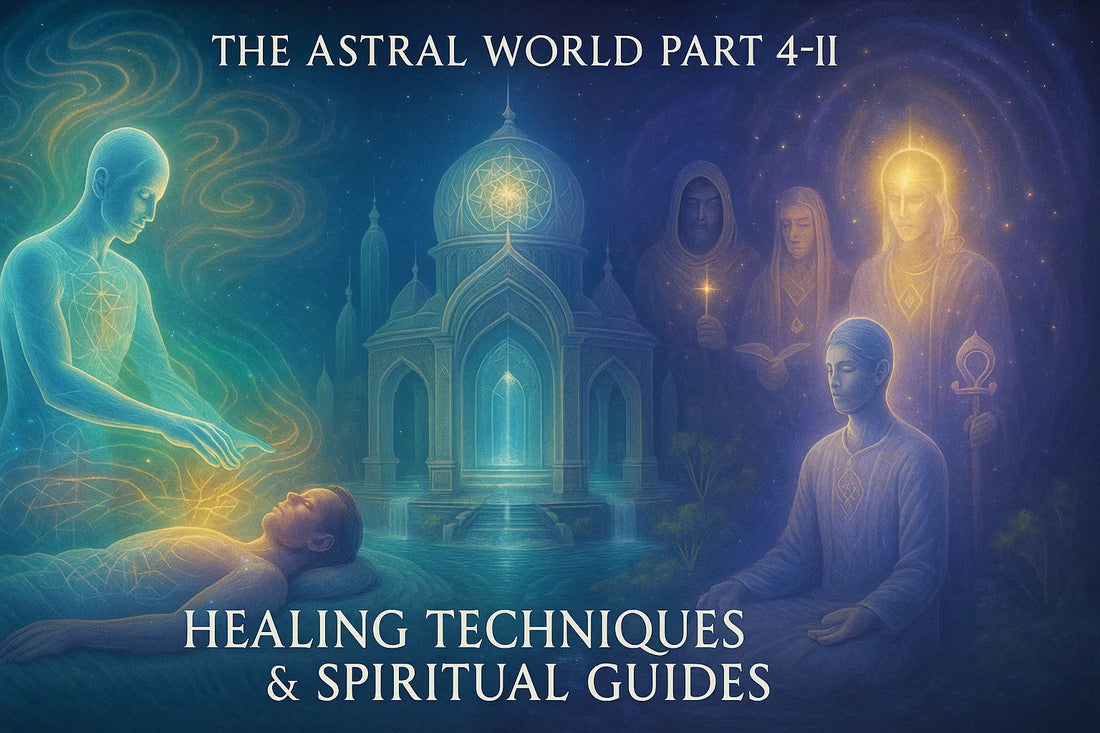
Astral healing works with the etheric and astral energy body to address energetic roots of physical and psychological conditions. The cross-cultural tradition of spiritual guides, from Steiner's Guardian Angel to shamanic spirit helpers to Mahayana Bodhisattvas, describes beings who assist human development from non-physical dimensions. Distinguishing genuine guidance from projection requires noticing whether the communication flatters or challenges, confirms existing preferences or calls you toward greater responsibility.
Table of Contents
- Astral Healing: Working with the Energy Body
- Etheric Body Healing Techniques
- Cord Cutting and Energetic Boundary Work
- Distance Healing: Cross-Cultural Tradition and Research
- The Cross-Cultural Tradition of Spiritual Guides
- Steiner's Spiritual Hierarchy
- The Guardian Angel in Steiner's Anthroposophy
- Astral Temples and Sacred Inner Space
- Discernment: Genuine Guidance vs. Projection
- Frequently Asked Questions
Key Takeaways
- Layered Healing: Astral healing works from the understanding that physical symptoms often have energetic roots in the etheric and astral dimensions. Addressing these roots can complement conventional treatment by working at the level where the condition originated.
- Cross-Cultural Consistency: The concept of spiritual guides, beings who assist human development from non-physical dimensions, appears independently across virtually every human culture, suggesting it points to a genuine feature of the cosmos rather than a culturally specific projection.
- Steiner's Hierarchy: Steiner described nine levels of spiritual beings above the human level, in three triads, with the Angeloi (Angels) level working most directly with individual human beings through the personal Guardian Angel.
- Projection Risk: The most significant practical challenge in guide work is the risk of projecting one's own wishes onto the guide relationship. Genuine guidance does not flatter; it consistently calls toward greater responsibility and honesty.
- Prayer as Orientation: Prayer works as a conscious act of inner orientation that makes consciousness receptive to guidance. Its effectiveness depends on the quality of inner sincerity and receptivity rather than verbal formulation.
Astral Healing: Working with the Energy Body
The term "astral healing" covers a broad range of practices that share one fundamental premise: that the human being has a non-physical energy body whose condition directly affects physical and psychological health, and that this energy body can be worked with intentionally to produce healing effects at levels that physical intervention alone cannot reach.
This premise, while not part of mainstream biomedical theory, appears across virtually every traditional healing system. Chinese medicine works with qi (life energy) flowing through meridian pathways. Ayurvedic medicine works with prana (life force) and the structure of the subtle body through chakras and nadis. Tibetan medicine works with the subtle wind-and-channel system of the Vajrayana tradition. Shamanic healing traditions worldwide work with the spirit body, the soul, and its relationship to the natural world's spirit dimension. Traditional European medicine, before the Cartesian mechanistic revolution of the 17th century, worked with humors and elemental forces that were understood as the physical expression of non-physical organisational principles.
What distinguishes this tradition from mere superstition is its internal coherence and its practical effectiveness within its own terms. The Chinese meridian system was developed through millennia of careful clinical observation and has produced an acupuncture tradition whose clinical efficacy for certain conditions (particularly pain management and nausea) has been demonstrated in randomised controlled trials. The Ayurvedic tradition developed specific diagnostic methods for assessing prana quality and specific therapeutic interventions that have been in continuous clinical use for over 3,000 years. These traditions were not arbitrary. They were systematic clinical sciences working with dimensions of the human being that 17th-century mechanism chose to bracket.
Steiner's Account of Healing
Steiner's contribution to the healing tradition was to provide a theoretical framework that integrated the etheric and astral dimensions into a comprehensive account of the human being's constitution. In his model, the etheric body is the seat of life and vitality, and etheric imbalances express as conditions of excess or deficiency in the life forces: inflammatory conditions involving too much etheric activity in the wrong location, or degenerative conditions involving too little. The astral body is the seat of the soul's desires and reactions, and astral imbalances express as conditions rooted in unintegrated emotional material. The ego works through both and its imbalances express as conditions involving the will and the relationship between thinking and action. Anthroposophic medicine diagnoses and treats across all four levels simultaneously.
Etheric Body Healing Techniques
The etheric body, as the organising life field that maintains the physical body in living form, is the most accessible level of the energy body for healing work. Its spatial extension slightly beyond the physical body and its sensitivity to the healer's attention make it the primary focus of hands-on energy healing traditions.
Therapeutic touch, developed in the 1970s by Dolores Krieger and Dora Kunz, is one of the most extensively researched hands-on energy healing modalities. Practitioners work with what Krieger and Kunz described as the energy field around the physical body, assessing its quality and consistency, clearing areas of congestion or deficiency, and supporting the field's own organisational capacity. A 1998 JAMA study by Emily Rosa (famously conducted by a nine-year-old for a school science fair project) found that therapeutic touch practitioners could not reliably detect the presence of a human energy field under blinded conditions, raising questions about the basic premise. More recent research has found positive effects of therapeutic touch on anxiety and pain in specific clinical populations, though the mechanism remains debated.
Reiki, a healing tradition developed in Japan by Mikao Usui in the early 20th century, works through the practitioner's hands as a channel for what Usui called Reiki (universal life energy), which is directed to the recipient through specific hand positions. Reiki has been incorporated into hospital settings in the United States and Europe for complementary care, particularly for pain management, relaxation, and anxiety reduction. A 2014 systematic review in the Journal of Evidence-Based Complementary and Alternative Medicine found suggestive but not conclusive evidence for Reiki's effectiveness for pain and anxiety, consistent with most energy healing research.
In the Steiner-derived tradition, rhythmical massage (developed by Ita Wegman, Steiner's medical colleague) is designed specifically to work with the etheric body through specific gentle massage strokes that follow the natural flow directions of the etheric formative forces rather than the mechanical direction of conventional massage. The strokes are designed to enhance the etheric body's own activity rather than imposing an external mechanical effect, making rhythmical massage a genuinely etheric-level intervention within Steiner's theoretical framework.
Cord Cutting and Energetic Boundary Work
One of the most widely practised forms of astral healing is cord cutting: the deliberate intention to sever energetic connections to past relationships, situations, or patterns that continue to draw on one's vitality beyond the appropriate time.
The concept of energetic cords has a long history in various esoteric traditions. In the Hawaiian Huna tradition, aka threads connect all beings who have been in significant relationship, carrying life force back and forth between them. In Theosophical and subsequent clairvoyant literature, etheric and astral cords are described as literally visible to practitioners who can perceive the etheric and astral dimensions: varying in width, colour, and quality depending on the nature and history of the relationship from which they arise.
The practical experience of energetic cords is accessible even without supersensible perception. Most people can recognise the phenomenon: the way a relationship that should be complete continues to draw on mental and emotional attention long after the physical separation has occurred; the way thoughts of a specific person arise uninvited with unusual frequency; the way certain past situations seem to have an energetic grip on the present that does not diminish in proportion to their actual importance.
Cord cutting practices work with this phenomenon through intention, visualisation, and sometimes physical ritual. The standard practice involves entering a meditative state, becoming aware of the specific cord (usually felt as an energetic connection to the solar plexus, heart, or another energy centre), bringing the connection to conscious awareness without judgment, and then using a specific intention, visualisation, or symbolic action (cutting with an imagined knife, dissolving with light, returning the cord's energy to its source) to sever the connection.
The effectiveness of cord cutting depends significantly on the practitioner's honesty about what they are cutting. A cord with a person or situation to which significant unprocessed emotional material is still attached cannot be fully cut by intention alone: the emotional material is itself the cord's substance. Cord cutting works best as the final act in a process of genuinely working through the relationship's material, not as a substitute for that work.
A Simple Cord Cutting Practice
Sit quietly and allow your attention to settle. Bring to mind a relationship, situation, or pattern from the past that you recognise as continuing to draw on your energy beyond what is appropriate. Place one hand on your solar plexus and one on your heart. Breathe slowly and allow yourself to feel the actual energetic quality of the connection, without trying to change it immediately. When you have a clear sense of its quality, bring your intention clearly: you are returning this connection to its natural state of completion, freeing both yourself and the other party from obligation beyond what has been genuinely fulfilled. Visualise the connection gradually releasing, from both ends, returning to a natural state of completion. Rest in the resulting spaciousness for several minutes before opening your eyes.
Distance Healing: Cross-Cultural Tradition and Research
Distance healing, the practice of directing healing intention toward a person who is not physically present, is one of the most consistently reported phenomena in the cross-cultural healing tradition and one of the most scientifically contested.
The cross-cultural prevalence is striking. Shamanic traditions worldwide include distance healing as a standard capacity: the shaman journeys to the spirit world on behalf of an absent patient and retrieves information or healing interventions that affect the patient's condition at a distance. Prayer traditions across the Abrahamic religions include intercessory prayer for the sick, with specific reports of healing effects occurring at a distance. Traditional healers in African, Native American, and Asian traditions all include distance diagnosis and healing as part of their professional repertoire.
The scientific literature on distance healing is genuinely ambiguous. A 2000 meta-analysis by Wayne Jonas and Cindy Crawford examining randomised controlled trials of various distant healing methods found a statistically significant positive effect compared to controls, with an overall effect size of 0.40 (medium by Cohen's conventions). However, subsequent methodological reviews have raised concerns about publication bias, blinding adequacy, and variability in what counts as "distance healing" across the included studies. A 2003 Cochrane review by Astin et al. found 23 eligible trials with generally positive results but concluded that the evidence was suggestive rather than conclusive.
The theoretical mechanism for distance healing, whatever it is, would need to operate non-locally, that is, without being limited by the inverse-square law that governs physical force transmission across distance. Such non-local effects are not permitted within classical physics but are a feature of quantum mechanics (quantum entanglement, famously called "spooky action at a distance" by Einstein). Whether quantum non-locality provides any mechanism for biological or healing effects remains an active area of speculative research, with most mainstream physicists sceptical that quantum effects at the molecular scale can have meaningful consequences at the macroscopic biological level.
The Cross-Cultural Tradition of Spiritual Guides
The concept of spiritual guides is one of the most universally consistent elements in the world's spiritual traditions. In virtually every culture for which we have historical or ethnographic records, the assumption that human beings have access to assistance from non-physical beings who can see more clearly, care more comprehensively, and act with greater resources than ordinary human consciousness is not presented as a belief but as a description of experienced reality.
In the Abrahamic traditions, the concept of guardian angels is both ancient and theologically consistent across all three traditions. The word "angel" derives from the Greek angelos and the Hebrew malach, both meaning "messenger." The Catholic, Orthodox Christian, Jewish, and Islamic traditions all maintain specific teachings about personal guardian angels: beings assigned to specific individuals for the duration of their earthly life, whose role is to protect, guide, and inspire their charges toward their highest possibilities.
In Mahayana Buddhism, the Bodhisattva ideal creates a specific class of beings who function as spiritual guides of the most comprehensive kind. A Bodhisattva who has taken the vow to remain accessible to all suffering beings until universal liberation is achieved is understood to be genuinely present and responsive to sincere requests for assistance. Avalokiteshvara (Guanyin in the Chinese tradition), Manjushri, and Tara are Bodhisattvas specifically invoked for compassionate assistance, wisdom, and liberation from fear respectively. The practice of reciting their mantras or calling on their presence is understood as literally effective, not merely symbolic.
In shamanic traditions across Siberia, the Americas, Africa, and Oceania, the practitioner's relationship with spirit helpers is the central technology of healing and divination. These spirit helpers, which may appear as animals, ancestors, nature spirits, or non-human beings, are accessed through specific methods (drumming-induced trance, plant medicine journey, dream incubation) and work with the shaman in specific tasks that require more than human resources.
The Greek tradition of the daimon, given its most famous articulation by Plato's account of Socrates, describes a personal guiding spirit that speaks to the individual about specific decisions, warning against harmful choices (in Socrates' case, consistently warning him away from specific actions but never instructing him toward others). Plato's own account of the soul's journey in the Republic describes souls, before incarnation, choosing their daimon as the guide who will accompany them through life.
The Ancestor Dimension
African traditional religions, along with many indigenous traditions worldwide, emphasise the ancestor spirits as the most immediately accessible form of spiritual guidance. Unlike the hierarchical angelic beings of the Abrahamic traditions or the cosmic Bodhisattvas of Mahayana Buddhism, ancestor spirits are specific deceased individuals whose kinship connection to the living makes them naturally interested in the well-being of their descendants. They can be approached through specific ritual means (offerings, prayers, drumming) and consulted for guidance on family, health, and life decisions. Steiner's anthroposophy does not emphasise ancestor work specifically, but his account of the post-mortem state includes the recognition that the deceased maintain real connections to the living for significant periods after death, and that these connections can be consciously supported or disrupted by the living's inner orientation toward the dead.
Steiner's Spiritual Hierarchy
Rudolf Steiner's account of the spiritual hierarchy is one of the most systematically developed in the Western esoteric tradition. He described nine orders of spiritual beings above the human level, arranged in three triads, each working with specific aspects of cosmic evolution and human development.
The First Hierarchy (sometimes called the First Triad or High Triad) consists of the Seraphim (Spirits of Love), the Cherubim (Spirits of Harmony), and the Thrones (Spirits of Will). These beings work at the level of cosmic will forces: the fundamental impulses that shape the overall direction of cosmic evolution. They are among the most ancient and evolved beings in the spiritual cosmos, and their activity is barely accessible even to the most advanced human spiritual cognition.
The Second Hierarchy consists of the Dominions or Kyriotetes (Spirits of Wisdom), the Mights or Dynamis (Spirits of Motion), and the Powers or Exusiai (Spirits of Form). These beings work with wisdom forces and with the specific forms that cosmic evolution takes: the shapes of organisms, the patterns of ecosystems, and the structural principles that organise existence at the level of species and planetary conditions.
The Third Hierarchy consists of the Principalities or Archai (Spirits of Time or Primal Beginnings), the Archangels or Archangeloi, and the Angels or Angeloi. This is the level that works most directly with human beings. The Archai work with the largest-scale cultural and evolutionary conditions of human history: they are the beings whose activity creates what Steiner called "cultural epochs" (each lasting approximately 2,160 years) within the larger evolutionary arc. The Archangeloi work with the spiritual dimensions of nations and peoples (what Steiner called "folk souls"). The Angeloi work directly with individual human beings.
The Hierarchy and Human Evolution
One of the most distinctive features of Steiner's hierarchy is his account of its dynamic relationship with human evolution. The spiritual hierarchy is not static: beings within it evolve, just as humans evolve. In Steiner's account, the Angels (Angeloi) were once at a human-like stage of development in a previous cosmic cycle. Human beings, in their future evolutionary phases, will themselves reach the Angel level and beyond. The hierarchy is not a permanent arrangement of superior beings condescending to help inferior ones but a dynamic community of evolving consciousnesses at different stages of the same cosmic journey, helping one another because helping is the expression of the cosmic law of love that governs the whole.
The Guardian Angel in Steiner's Anthroposophy
Of all the beings in Steiner's hierarchy, the personal Guardian Angel is the one most directly relevant to individual practitioners. In Steiner's account, every human being has an assigned Angel from the Angeloi level who accompanies them across incarnations, working constantly to guide them toward their individual spiritual destiny.
The Guardian Angel's mode of operation is primarily through the will: it works through what Steiner called the "unconscious spirit," inspiring impulses toward right action and moral development in ways that the individual normally experiences only as vague conscience, intuitive directional feelings, or seemingly coincidental guidance from outer events and encounters. The Angel cannot override human freedom: it can inspire and suggest but not compel. The practitioner who develops the capacity for genuine supersensible cognition, specifically the Inspiration stage of Steiner's development path, can eventually develop direct conscious communication with their Guardian Angel.
Steiner gave a specific and touching account of the Angel's situation in relation to the modern human being. In lectures given in 1918 (collected as The Work of the Angels in Man's Astral Body), he described the Angels as engaged in an intensive work within humanity's astral bodies: specifically, building spiritual images of the ideal future human community within the astral bodies of sleeping individuals. These images, created through the accumulated spiritual work of the angels, are intended to pass gradually into human consciousness and inspire the development of genuine brotherhood and love as the foundation of social organisation. The Angels' work in this sense is not private guidance for individual development but part of a cosmic social project: the creation of the spiritual seeds of a genuinely human community within the bodies of sleeping humans.
Astral Temples and Sacred Inner Space
The concept of an astral temple, a non-physical sacred space constructed through imagination and ritual intention, is one of the practical tools of the Western Hermetic tradition and several related esoteric schools.
In the Golden Dawn tradition (late 19th-century British Hermeticism), the astral temple is built by systematic visualisation of a specific architectural space, furnished with symbolic objects corresponding to the cosmic principles the practitioner is working with. The construction of the temple is considered real work: each session of visualisation adds to the etheric structure of the space, stabilising it progressively from a pure imagination into something that approaches objective reality on the etheric level.
The logic of the astral temple, in Steiner's framework, connects to his account of how the etheric body builds up stable forms through repeated processes. Just as a physical space that has been used for specific activities over long periods acquires a distinct etheric character that sensitive visitors can detect, an astral temple that has been built and used through sustained practice develops an objective etheric presence that is more than mere imagination. It becomes a genuine meeting point between the practitioner's astral body and the spiritual world, a location in the etheric dimension where the practitioner's orientation toward specific spiritual realities has created a stable channel.
The practical construction of an astral temple begins simply: choose a location (it may be based on an existing physical space you love, or an imagined ideal space), and return to it consistently in meditation. Over time, add specific elements: an altar or focus, light sources (often candles or a central flame), specific symbolic objects corresponding to what you are working with. The most important feature is consistency: visiting the same inner space in the same inner state, with the same quality of intention, builds the etheric structure that makes the space genuinely useful.
Discernment: Genuine Guidance vs. Projection
The most practically important question in all guide work is discernment: how do you distinguish genuine contact with a spiritual guide from the products of your own unconscious projections, wishful thinking, or Doppelganger activity?
This question deserves complete honesty. The capacity for self-deception in spiritual matters is large, and the investment most people have in believing that they are receiving genuine higher guidance is significant. Any framework for discernment that is not genuinely rigorous will simply become another tool for confirming existing beliefs.
Several practical indicators are worth working with. The first is whether the guidance flatters. Genuine higher guidance consistently calls you toward greater responsibility, more honest self-knowledge, and actions that serve others rather than your own comfort or status. Guidance that confirms your existing self-image, affirms your special spiritual status, or tells you that you are being asked to do what you already wanted to do is very likely projection or Doppelganger activity rather than genuine contact with a being of the level of a Guardian Angel or Bodhisattva.
The second indicator is consistency. Genuine guidance from a real being maintains consistent character across many sessions and across varying emotional states. The message you receive when you are anxious and seeking reassurance should not contradict the message you receive when you are calm and genuinely open. If the quality and content of your guide communication varies significantly with your emotional state, it is primarily reflecting your emotional state rather than the perspective of an independent being.
The third indicator is the quality of clarity that accompanies the guidance. Genuine guidance from a higher being tends to bring a distinctive quality of inner spaciousness, increased clarity of thinking, and a sense of being oriented rather than merely reassured. Projected guidance tends to bring relief or excitement without the underlying clarity and orientation that genuine guidance produces.
The fourth indicator is predictive accuracy. Genuine guidance occasionally produces specific predictions or insights about future events or about situations outside the practitioner's direct knowledge. When these can be checked against subsequent reality or against independent information, they provide the most objective test of the guidance's source. Projected guidance rarely passes this test with consistent precision.
The traditions of astral healing and spiritual guidance represent humanity's long engagement with the non-physical dimensions of existence that conventional materialism has bracketed but not disproven. Working in these dimensions honestly, with genuine discernment and the willingness to be corrected rather than merely confirmed, is one of the most demanding and most valuable practices available to contemporary practitioners. The beings of the hierarchy, if Steiner's account is even partially accurate, have invested enormous care in humanity's development. Engaging with that investment consciously, honestly, and with genuine receptivity to what it asks of us rather than what we want from it, is the appropriate response.
Frequently Asked Questions
Astral Dynamics: The Complete Book of Out-of-Body Experiences by Bruce, Robert
View on AmazonAffiliate link, your purchase supports Thalira at no extra cost.
What are astral healing techniques?
Astral healing techniques work with the non-physical energy body to address the energetic roots of physical and psychological conditions. Major categories include energy body work (hands-on or distance healing with the etheric and astral fields), cord cutting (severing energetic connections to past relationships that continue to drain energy), and light body activation practices. The theoretical premise is that physical symptoms often have roots in the etheric or astral dimension that can be addressed through these methods.
What is the cross-cultural tradition of spiritual guides?
The concept of spiritual guides, beings who assist human development from a non-physical dimension, appears consistently across cultures: guardian angels in Abrahamic traditions, Bodhisattvas in Mahayana Buddhism, spirit guides in shamanic traditions, the daimon of Greek tradition, ancestor spirits in African and indigenous traditions, and the Ishta Devata of Hindu tantra. Despite different cultural frameworks, the core concept is consistent: human beings have access to guidance from beings whose vantage point exceeds ordinary human consciousness.
How did Steiner describe the hierarchy of spiritual beings?
Steiner described nine levels of spiritual beings in three triads: the first triad (Seraphim, Cherubim, Thrones) works with the will forces of the cosmos; the second triad (Dominions, Mights, Powers) works with wisdom forces; the third triad (Principalities, Archangels, Angels) works most directly with human beings. Each individual human being has an assigned Guardian Angel from the Angeloi level who accompanies them across incarnations.
What is Steiner's concept of the Guardian Angel?
Every individual human being has a Guardian Angel from the Angeloi level who accompanies them across incarnations and works to guide them toward their individual spiritual destiny. The Angel works through the "unconscious spirit," inspiring impulses toward right action that the individual normally experiences as vague conscience or intuitive feelings. The Angel cannot override human freedom but can inspire and suggest. Direct conscious communication becomes possible through the Inspiration stage of Steiner's development path.
How do shamanic spirit guides differ from Steiner's guardian angel?
Shamanic spirit guides are accessed through ritualised trance states and may come and go depending on the shaman's specific work. They include nature spirits, ancestors, and totemic animals. Steiner's Guardian Angel is a permanent companion specific to the individual's spiritual evolution across multiple incarnations, operating at a higher hierarchy level than nature spirits, and accessible through developed supersensible cognition rather than trance states.
What is an astral temple and how is it used?
An astral temple is a non-physical sacred space constructed in imagination and progressively stabilised through regular practice. The concept appears in the Western Hermetic tradition (particularly Golden Dawn-derived ritual magic), where the astral temple corresponds to specific symbolic and cosmic principles. Regular practice stabilises the visualised space across sessions; well-established astral temples develop a quality of objective presence distinct from ordinary imagination.
How can you distinguish genuine higher guidance from unconscious projection?
Genuine guidance does not flatter: it calls toward greater responsibility rather than confirming existing preferences. It maintains consistent character across different sessions and emotional states. It brings inner spaciousness and increased clarity rather than mere relief or excitement. And occasionally it produces specific, checkable predictions that can be verified against subsequent reality. Projected guidance tends to be emotionally responsive, unusually affirming, and inconsistent with your changing mood.
What is distance healing and is there evidence for its effectiveness?
Distance healing directs healing intention toward an absent person through non-local mechanisms. A 2000 meta-analysis of 23 randomised controlled trials found a statistically significant positive effect compared to controls, though effect sizes were small and methodological concerns remain. The evidence is suggestive but not conclusive by evidence-based medicine standards. The mechanism, if real, would need to be non-local in a way that classical physics does not accommodate.
What is the Bodhisattva ideal and how does it connect to spiritual guide traditions?
A Bodhisattva in Mahayana Buddhism has vowed to remain accessible to all sentient beings until universal liberation is achieved. They are not simply exemplary teachers but genuinely responsive to sincere requests for guidance from practitioners anywhere. Steiner described the Bodhisattva level as one in which the being has completely transformed their lower members and can work as a genuine helper of human evolution from the spiritual world.
How does prayer function as a means of connecting with spiritual guides?
Prayer functions as a deliberate act of conscious reaching toward a specific spiritual reality: the practitioner's own higher self, their Guardian Angel, a Bodhisattva, or the highest spiritual principle. In Steiner's framework, prayer creates a specific quality of inner orientation that makes consciousness receptive to guidance from the spiritual beings it is directed toward. Its effectiveness depends on sincerity, humility, and genuine receptivity to what the spiritual world responds with, not on verbal formulation.
Sources and References
- Steiner, Rudolf. The Work of the Angels in Man's Astral Body. Rudolf Steiner Press, 1972 (lectures 1918).
- Steiner, Rudolf. Spiritual Hierarchies and Their Reflection in the Natural World. Anthroposophic Press, 1996 (lectures 1909).
- Harner, Michael. The Way of the Shaman. HarperOne, 1990.
- Astin, J.A., E. Harkness, and E. Ernst. "The efficacy of 'distant healing': a systematic review of randomized trials." Annals of Internal Medicine 132.11 (2000): 903-910.
- Jonas, Wayne B., and Cindy Crawford, eds. Healing, Intention and Energy Medicine. Churchill Livingstone, 2003.
- Kunz, Dora. Spiritual Healing. Quest Books, 1995.
- Regardie, Israel. The Golden Dawn: The Original Account of the Teachings, Rites and Ceremonies of the Hermetic Order. Llewellyn Publications, 1989.
- Simonton, O.C., S. Matthews-Simonton, and J. Creighton. Getting Well Again. Bantam Books, 1978. (Visualisation and healing traditions)