

Quick Answer
Supernormal by Dean Radin maps Patanjali's Yoga Sutras siddhis (extraordinary abilities including telepathy, clairvoyance, precognition, and psychokinesis) against decades of laboratory parapsychology research. Radin argues the convergence between two independent lines of evidence, ancient yogic description and modern controlled experiment, provides strong grounds for taking these abilities seriously as real phenomena.
Table of Contents
- What Is Supernormal?
- Patanjali's Yoga Sutras and the Vibhuti Pada
- The Eight Major Siddhis
- Samyama: The Mechanism of Siddhis
- Laboratory Evidence for the Siddhis
- Remote Viewing and the Stargate Program
- DMILS: Influencing Living Systems at a Distance
- The Convergence Argument
- Can Anyone Develop Siddhis?
- Criticisms
- Get the Book
- Frequently Asked Questions
Key Takeaways
- Two Independent Evidence Streams: The siddhis described in Patanjali's 2,000-year-old Yoga Sutras map closely onto the psi phenomena documented in modern parapsychology laboratories, two independent systems describing the same real phenomena.
- Samyama Is the Key: Patanjali describes samyama, combined concentration, meditation, and absorption, as the practice that cultivates siddhis. Radin argues that advanced contemplative practice enhances psi ability in ways consistent with this framework.
- Government-Funded Evidence: The US government's Stargate program at SRI International ran for over 20 years, producing statistically significant evidence for remote viewing, the laboratory analog of Patanjali's siddhi of knowing distant events.
- Practical Siddhis Are Real: Radin focuses his evidentiary argument on the siddhis that have laboratory analogs: telepathy, clairvoyance, precognition, psychokinesis, and distant healing. He does not claim laboratory evidence for dramatic siddhis like levitation.
- 384 Sources: Supernormal cites 384 references, more than one per page, making it one of the most heavily documented books in popular science writing on consciousness.
What Is Supernormal?
Published in 2013, Supernormal: Science, Yoga, and the Evidence for Extraordinary Psychic Abilities is Dean Radin's third major book and in some ways his most ambitious. Where The Conscious Universe (1997) made the case for psi from within modern science alone, Supernormal adds the second pillar: the classical Indian contemplative tradition, and specifically the detailed description of extraordinary abilities in Patanjali's Yoga Sutras.
Radin's central argument is the convergence argument: that two entirely independent systems of inquiry, a 2,000-year-old Sanskrit text on the theory and practice of meditation, and a century of controlled Western laboratory research on psi phenomena, describe the same phenomena, arrived at through different methodologies, with no direct communication between them. This convergence, he argues, is powerful evidence that the phenomena are real rather than products of cultural belief or experimental artifact.
The book follows a structure that alternates between classical yoga philosophy and modern parapsychology. For each major siddhi described in Patanjali's Vibhuti Pada (the third book of the Yoga Sutras, which catalogues the extraordinary abilities), Radin presents the relevant laboratory evidence from the parapsychology literature. The result is a kind of double helix: ancient wisdom and modern science winding around each other, pointing consistently toward the same conclusions.
Why This Book Is Different From Others on Psychic Abilities
The literature on psychic abilities is large and mostly unconvincing, credulous compilations of anecdote, or dismissive skeptical debunking. Supernormal occupies a different position entirely: it is the work of a credentialed researcher who has spent decades conducting and reviewing the best controlled experiments available, placing that evidence in dialogue with the most sophisticated classical framework for understanding extraordinary abilities ever developed. It is not credulous and it is not dismissive. It is rigorous.
Patanjali's Yoga Sutras and the Vibhuti Pada
The Yoga Sutras of Patanjali is a collection of 196 aphorisms organized into four chapters (padas). Written around the 4th-5th century CE, they systematize yoga philosophy and practice in a form that has been foundational to all subsequent Indian traditions of meditation.
The third chapter, the Vibhuti Pada (the chapter on powers or perfections), describes the siddhis, extraordinary abilities that Patanjali says arise as byproducts of advanced samyama practice. The chapter includes descriptions of: knowledge of past and future lives; knowledge of the contents of other minds; knowledge of the time of one's death; strength of an elephant; knowledge of distant and hidden things; knowledge of the subtle, obscured, and remote; knowledge of the arrangement of stars; knowledge of the structure of the body; and the ability to enter another's body, among others.
Patanjali is careful to note that the siddhis are obstacles to liberation if they become objects of attachment, but that they arise naturally as signs of progress in practice. He does not present them as the goal of yoga, the goal is samadhi and liberation, but he describes them matter-of-factly as features of advanced practice, to be recognized and not grasped.
This attitude, that extraordinary abilities are real but not the point, is characteristic of the classical yoga framework. It contrasts sharply with both the popular tendency to treat siddhis as the main attraction, and the skeptical tendency to dismiss them as pure mythology.
The Eight Major Siddhis
The classical yoga texts describe eight primary siddhis arising from advanced practice:
Anima, the ability to become as small as an atom
Mahima, the ability to become infinitely large
Garima, the ability to become infinitely heavy
Laghima, the ability to become weightless (levitation)
Prapti, the ability to reach any place instantaneously
Prakamya, the fulfillment of any desire
Vashitva, the ability to control natural forces
Ishitva, the ability to create and destroy at will
Radin addresses these dramatically physical siddhis honestly: he does not claim laboratory evidence for levitation or invisibility. He argues instead that some of these descriptions encode, in the language and cosmology of classical India, phenomena that are more subtle and more consistent with what laboratory research has documented. "Becoming infinitely small" may describe a state of consciousness rather than a physical transformation; "reaching any place instantaneously" may describe the clairvoyant knowledge of distant events rather than physical teleportation.
This interpretive move is reasonable but worth noting: Radin is reading the dramatic siddhis charitably, finding the laboratory-compatible interpretation where a literal reading would be extraordinary. He is more persuasive when addressing the siddhis that Patanjali himself describes in terms of knowledge rather than physical transformation.
Samyama: The Mechanism of Siddhis
Patanjali describes samyama, the combined and sustained application of dharana (concentration), dhyana (meditation), and samadhi (absorption) to a specific object, as the mechanism through which siddhis arise. When samyama is directed toward the mind of another person, direct knowledge of that person's thoughts arises. When samyama is directed toward the position of stars, knowledge of their arrangement arises. When samyama is directed toward the structure of the body, knowledge of subtle bodily processes arises.
The mechanism, as Radin understands it, is that advanced samyama practice dissolves the ordinary boundary between the meditator's consciousness and the object of meditation. The concentration is so complete and the absorption so total that there is, in the state of samyama, no gap between knower and known. The knowledge that arises is not inferential or sensory, it is direct.
This description of direct knowing through the dissolution of subject-object separation is consistent with what many advanced meditators across traditions report, and it is consistent with the phenomenology of some psi experiences as reported by experimental subjects. Whether it provides a mechanism in the scientific sense, a causal account of how consciousness influences or is connected to distant systems, is a harder question that Radin does not fully answer.
Working With Samyama in Your Practice
Patanjali's instructions for samyama are specific: first develop concentration to the point where attention can rest on an object without wavering (dharana); then allow that concentration to become effortlessly sustained (dhyana); then allow the boundary between attention and object to dissolve (samadhi). Direct knowledge arises when these three are applied together as samyama to a specific object of inquiry. The practice is not visualization or imagination, it is the application of clear, stable, absorbed attention to whatever one wishes to understand directly.
Laboratory Evidence for the Siddhis
Radin's primary contribution in Supernormal is the systematic mapping of siddhis onto laboratory findings. He covers several research domains in detail.
Telepathy and the Ganzfeld: Patanjali's sutra 3.19 states that samyama on the mark (the distinguishing quality) of another's mind produces knowledge of that mind. The Ganzfeld telepathy protocol, the most extensively replicated psi experiment, tests exactly this. The meta-analysis shows hit rates of 32-35% against a 25% chance baseline, consistent across over 700 trials in multiple independent laboratories.
Precognition and presentiment: Sutras 3.16-3.18 describe knowledge of past and future arising through samyama. Radin's own presentiment research, and the broader database of precognition experiments reviewed in The Conscious Universe, shows consistent evidence for unconscious physiological responses to future emotional stimuli. The effect is small but statistically strong.
Clairvoyance and remote viewing: Sutra 3.25 describes knowledge of subtle, hidden, and remote things through samyama. Remote viewing research, particularly the Stargate program data, provides the strongest evidence in the parapsychology literature for this type of siddhi.
Psychokinesis: Sutra 3.24 describes mastery over the body through samyama, which Radin connects to the broader evidence for mind-matter interaction from the PEAR laboratory and related research. The micro-PK effects documented in REG studies are small but consistent with a real influence of intention on physical systems.
Remote Viewing and the Stargate Program
One of the most significant bodies of evidence Radin presents concerns remote viewing, the ability to describe the physical characteristics of a distant or hidden target without sensory access to it.
Remote viewing was extensively researched from 1972 to 1995 in a classified program at SRI International (Stanford Research Institute) funded by the CIA and Defense Intelligence Agency. The program, known at various times as Project SCANATE, Project Gondola Wish, and ultimately the Stargate program, employed physicists Russell Targ and Harold Puthoff to investigate whether remote viewing could serve as an intelligence tool.
The results, when declassified, showed statistically significant evidence for remote viewing ability across hundreds of trials with multiple subjects. Program evaluator Jessica Utts, a statistician at UC Davis, concluded in her official evaluation that the research provided "overwhelming statistical evidence for the existence of remote viewing" and that the effect was consistent and not explained by methodological artifacts.
Radin notes that the Stargate program provides an unusually clean evidence base: it was conducted under rigorous military-grade protocols designed specifically to prevent fraud and methodological weakness, by researchers with no prior commitment to parapsychology, funded by an organization (the CIA) with strong institutional reasons to be skeptical of unproven claims.
DMILS: Influencing Living Systems at a Distance
Direct Mental Interaction with Living Systems (DMILS) research tests whether one person can influence the physiology of another at a distance, without any normal communication channel. The standard protocol: a "receiver" sits alone in a shielded room while their skin conductance (a measure of autonomic arousal) is continuously recorded. In another room, a "sender" alternately focuses intense attention on the receiver and then relaxes. Neither person knows when the attention periods occur; the schedule is randomized by computer.
Meta-analyses of DMILS studies show consistent effects: receivers show significantly greater skin conductance arousal during the periods when senders are focusing attention on them, compared to relaxation periods. The effect size is modest but consistent across multiple independent research teams in the United States, the Netherlands, and Germany.
Radin maps DMILS directly onto the yoga tradition of shakti transmission, the transfer of spiritual energy or attention from teacher to student, and the related traditions of distant healing found across cultures. He argues that DMILS provides laboratory validation for what yoga has always described: that consciousness can influence the physical state of another person without physical contact or sensory channels.
The Convergence Argument
The heart of Supernormal is what Radin calls the convergence argument. Two entirely independent systems arrived at descriptions of the same phenomena:
Patanjali, working in the Indian contemplative tradition around 1,600 years ago, described a systematic program of meditation practice that produces, as byproducts, specific extraordinary abilities: knowledge of distant events, knowledge of other minds, knowledge of past and future, influence on physical and living systems at a distance.
Parapsychology researchers, working in modern Western laboratories over the past century, have documented the same phenomena, telepathy, clairvoyance, precognition, psychokinesis, distant healing, through controlled experiments using statistical methods developed entirely independently of any yoga tradition.
The convergence between these two lines of evidence does not prove that either is correct. But it does substantially raise the prior probability that the phenomena are real. The hypothesis "both the Yoga Sutras and modern parapsychology are describing real phenomena" accounts for both bodies of evidence. The hypothesis "both are describing nothing real" requires a more elaborate explanation: that thousands of meditators across 1,600 years were systematically deluded in the same specific ways, and that parapsychology researchers with different methods and no contact with the yoga tradition produced false positives in precisely the categories that Patanjali described.
Can Anyone Develop Siddhis?
Patanjali's answer is yes, in principle, but the path is long and demanding. The Yoga Sutras describe siddhis as arising naturally from advanced practice rather than being achieved through effort directed specifically at them. The practitioner who follows the eight limbs of yoga, ethical conduct (yamas and niyamas), physical practice (asana), breath control (pranayama), withdrawal of senses (pratyahara), concentration (dharana), meditation (dhyana), and absorption (samadhi), will find that siddhis arise as natural consequences.
Radin discusses the evidence from studies of experienced meditators that suggests psi ability increases with depth of practice. The IONS meditator studies, comparing experienced practitioners with novices, found larger psi effects in the experienced group. While the studies are not large enough to be definitive, the pattern is consistent with Patanjali's framework.
His practical recommendation: if you want to cultivate psi ability, the most evidenced-based approach is exactly what Patanjali recommends, develop a deep, sustained, devoted meditation practice, not as a means to siddhis but as a means to samadhi. The siddhis, if the framework is correct, will follow.
Criticisms
The main criticisms of Supernormal parallel those directed at The Conscious Universe. Skeptics argue that the psi evidence Radin presents remains statistically small and theoretically unexplained; that the mapping of siddhis onto laboratory findings involves interpretive charity that may not be warranted; and that the convergence argument has a simpler explanation, that the authors of the Yoga Sutras were describing states of consciousness from advanced meditation, some of which involved genuine perceptual shifts, and that modern parapsychology is measuring subtle normal effects (subtle sensory cues, statistical artifacts) that happen to be in the same general territory.
These are fair challenges. Radin's evidence is genuinely suggestive rather than conclusive, and the convergence argument, while compelling as a rhetorical structure, does not by itself establish what the converging systems are both pointing at. The book is at its strongest when presenting specific experimental data and at its weakest when making broader interpretive claims.
Nonetheless, Supernormal remains the most serious and well-documented attempt available to connect the classical yoga framework for extraordinary abilities with the modern scientific evidence for psi. The question it poses is genuine, the evidence it presents is real, and the connections it draws deserve serious consideration from anyone interested in the full range of what human consciousness can do.
Affiliate Disclaimer
This article contains Amazon affiliate links. If you purchase through these links, Thalira earns a small commission at no extra cost to you. We only link to books we have reviewed directly.
Get the Book
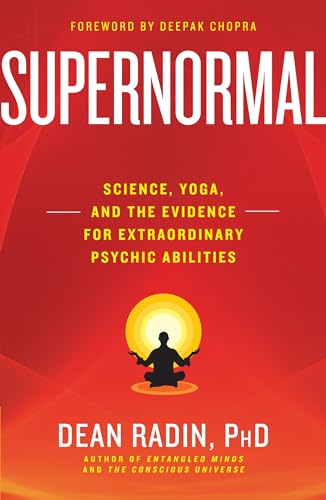
Supernormal: Science, Yoga, and the Evidence for Extraordinary Psychic Abilities
Dean Radin | Crown, 2013
The definitive scientific and philosophical case for the reality of the yoga siddhis. Foreword by Deepak Chopra. 384 sources cited.
View on AmazonDeepen Your Practice
The Hermetic Synthesis Course provides the samyama-like concentrated practice that Patanjali and Radin both point toward, structured daily work with concentration, meditation, and direct knowing.
Explore the CourseFrequently Asked Questions
What is Supernormal about?
It maps Patanjali's Yoga Sutras siddhis (extraordinary abilities) against decades of parapsychology laboratory research, arguing the convergence of these two independent evidence streams supports the reality of telepathy, clairvoyance, precognition, and psychokinesis.
What are the siddhis?
Extraordinary abilities described in Patanjali's Yoga Sutras as arising from advanced samyama practice: knowledge of other minds, distant events, past and future, influence on physical systems, and eight major power abilities including levitation and invisibility.
What is samyama?
Combined practice of dharana (concentration), dhyana (meditation), and samadhi (absorption) applied to a single object. Patanjali describes it as the mechanism through which siddhis arise, when these three are directed toward an object, direct knowledge of that object emerges.
What is DMILS research?
Direct Mental Interaction with Living Systems, experiments testing whether one person can influence another's physiology at a distance. Meta-analyses show consistent effects above chance, mapping onto the yoga tradition of shakti transmission and distant healing.
What is the Stargate program?
A classified US government program from 1972-1995 at SRI International, funded by the CIA and DIA, testing remote viewing as an intelligence tool. The data showed statistically significant evidence for remote viewing across hundreds of trials under rigorous protocols.
Does the book claim meditators levitate?
No. Radin addresses dramatic siddhis like levitation honestly, focusing his evidentiary argument on those with direct laboratory analogs: telepathy, clairvoyance, precognition, and psychokinesis.
Who wrote the foreword?
Deepak Chopra, physician and author who has long argued for a consciousness-based scientific framework.
How does Supernormal differ from The Conscious Universe?
The Conscious Universe makes the statistical case for psi from within modern science alone. Supernormal adds the classical yoga framework as an independent evidence stream, making the convergence argument for the reality of extraordinary abilities.
Can anyone develop siddhis?
Patanjali says yes, through sustained advanced practice. Radin cites evidence that experienced meditators show larger psi effects than novices in laboratory studies, consistent with this framework.
What are the main criticisms?
Critics argue psi evidence remains small and theoretically unexplained; that the siddhi mapping involves interpretive charity; and that the convergence argument has simpler normal explanations. The book is strongest on specific experimental data and weaker on broader interpretive claims.
What is the Vibhuti Pada?
The third chapter of Patanjali's Yoga Sutras, the chapter on powers or perfections. It describes the siddhis arising from samyama practice and their specific objects of application.
How many references does Supernormal cite?
384 references, more sources than pages in the book, making it one of the most heavily documented books in popular consciousness science.
What is Supernormal by Dean Radin about?
Supernormal examines the siddhis — extraordinary abilities described in Patanjali's Yoga Sutras — through the lens of modern parapsychology research. Radin argues that the siddhis (telepathy, clairvoyance, precognition, psychokinesis, and others) correspond directly to the psi phenomena documented in laboratory studies, and that this convergence is evidence that advanced contemplative practice can genuinely cultivate these abilities.
What are the siddhis in yoga?
Siddhis are extraordinary abilities described in Patanjali's Yoga Sutras (circa 400 CE) as arising from advanced samyama practice — concentrated meditation applied to specific objects. The siddhis include knowledge of past and future, knowledge of other minds, knowledge of distant places, levitation, invisibility, extreme smallness and largeness, and direct knowledge of the subtle body. Radin maps each of these against the psi phenomena documented in laboratory research.
What are Patanjali's Yoga Sutras?
The Yoga Sutras of Patanjali is a collection of 196 aphorisms on the theory and practice of yoga, written around the 4th-5th century CE. The text describes an eight-limb path (ashtanga yoga) leading to samadhi and liberation. The third book, the Vibhuti Pada, describes the siddhis as byproducts of advanced samyama practice.
What is samyama in the Yoga Sutras?
Samyama is the combined practice of dharana (concentration), dhyana (meditation), and samadhi (absorption) applied to a single object. Patanjali describes samyama as the mechanism through which siddhis arise: when the three practices are directed toward a specific object or quality, direct and accurate knowledge of that object is produced.
What specific siddhis does Radin test in laboratory conditions?
Radin discusses laboratory analogs for: knowledge of other minds (telepathy, tested via Ganzfeld), knowledge of distant events (remote viewing), knowledge of future events (precognition and presentiment), influence on physical objects (psychokinesis, tested via random event generators), and physiological effects of distant healing (DMILS experiments). He argues that each of these maps directly onto a siddhi described by Patanjali.
What is DMILS research?
DMILS stands for Direct Mental Interaction with Living Systems. These experiments test whether one person can influence the physiology of another at a distance, typically measuring skin conductance or other autonomic responses in a 'receiver' while a 'sender' in another room alternately focuses attention on or away from the receiver. Meta-analyses of DMILS research show consistent effects significantly above chance.
Does Supernormal claim that meditators actually levitate?
Radin addresses the dramatic siddhis like levitation honestly. He does not claim laboratory evidence for levitation. He argues that some siddhis may be metaphorical or may describe experiences from the interior of deep meditation rather than observable external phenomena. He focuses his evidentiary argument on the siddhis that have laboratory analogs in psi research.
Who wrote the foreword to Supernormal?
The foreword was written by Deepak Chopra, physician, author, and proponent of mind-body medicine, who has long argued for a scientific framework that takes consciousness seriously as a foundational principle.
How does Supernormal relate to The Conscious Universe?
The Conscious Universe (1997) made the statistical case for psi from a purely scientific perspective. Supernormal (2013) adds the classical yogic framework: showing that the same abilities documented in parapsychology laboratories were systematically described and cultivated in the Indian contemplative tradition two thousand years ago. The convergence of these two independent lines of evidence — modern science and ancient practice — is the book's central argument.
What is the significance of the convergence between parapsychology and the Yoga Sutras?
Radin argues that the convergence is significant because the Yoga Sutras describe siddhis arising from specific practices in a specific developmental sequence, and because the laboratory findings show the same phenomena appearing under controlled conditions. This is not two traditions independently inventing fantasy — it is two independent systems describing the same real phenomena, one through empirical inner investigation and one through controlled external measurement.
What is remote viewing and how does it relate to yoga siddhis?
Remote viewing is the ability to describe the physical characteristics of a distant or hidden target without sensory access to it. It was extensively researched at SRI International (Stanford Research Institute) in a classified program for the US government from 1972 to 1995, producing statistically significant results across hundreds of trials. Radin maps this directly onto Patanjali's sutra on knowledge of distant objects through samyama.
What is the government-funded remote viewing program?
The Stargate program (and its predecessors, including Project SCANATE and Project Gondola Wish) was a classified US government research program funded by the CIA and DIA to investigate remote viewing as an intelligence tool. Research was conducted at SRI International by physicists Russell Targ and Harold Puthoff. The program ran from 1972 to 1995 and produced results that program evaluator Jessica Utts described as providing 'overwhelming evidence' for remote viewing as a real phenomenon.
Sources and References
- Radin, Dean. Supernormal: Science, Yoga, and the Evidence for Extraordinary Psychic Abilities. Crown, 2013.
- Patanjali. The Yoga Sutras of Patanjali. Trans. Edwin Bryant. North Point Press, 2009.
- Targ, Russell and Harold Puthoff. "Information transmission under conditions of sensory shielding." Nature 251 (1974): 602-607.
- Utts, Jessica. "An assessment of the evidence for psychic functioning." Journal of Scientific Exploration 10.1 (1996): 3-30.
- Schlitz, Marilyn and William Braud. "Distant intentionality and healing: Assessing the evidence." Alternative Therapies 3.6 (1997): 62-73.
- Honorton, Charles. "Psi and internal attention states." In Handbook of Parapsychology, ed. Benjamin Wolman. Van Nostrand Reinhold, 1977.
- Radin, Dean. The Conscious Universe. HarperOne, 1997.