

Quick Answer
The Sefer Bahir (Book of Illumination) is the oldest systematic Kabbalistic text, first appearing in twelfth-century Provence. It introduced the sefirot as living divine powers, the cosmic tree metaphor for divine structure, soul transmigration (gilgul), and the mystical interpretation of Hebrew letters. All subsequent Kabbalistic literature is built on the foundations it laid.
Table of Contents
- What Is the Sefer Bahir?
- Origins and Authorship
- Structure and Method
- The Sefirot as Divine Powers
- The Cosmic Tree
- The Mystical Significance of Hebrew Letters
- Soul Transmigration: The Bahir's Bold Claim
- The Shekhinah and the Feminine Divine
- Gnostic Connections and Jewish Roots
- Influence on Kabbalah and the Zohar
- How to Read the Bahir
- Frequently Asked Questions
Key Takeaways
- The first: The Bahir is the first Kabbalistic text to present the sefirot as dynamic divine powers, inaugurating the entire Kabbalistic symbolic tradition.
- Provocative on the soul: It is the first major Jewish text to explicitly teach soul transmigration (gilgul), a concept that became central to Lurianic Kabbalah.
- Living letters: Hebrew letters are not merely symbols but channels of divine creative power whose shapes, sounds, and values encode cosmic truths.
- Non-linear method: The Bahir uses a midrashic teaching style that moves associatively through topics rather than building a systematic argument.
- Foundation of everything: The Zohar, the Lurianic system, and all subsequent Kabbalah are built on the symbolic vocabulary the Bahir introduced.
What Is the Sefer Bahir?
If you trace the family tree of Kabbalistic thought backward far enough, you eventually arrive at the Sefer Bahir. Before the Zohar, before the Lurianic system, before the elaborate sefirot diagrams that appear in every popular Kabbalah book today, there was the Bahir: a short, enigmatic, deeply strange collection of approximately 200 passages that first appeared in Provence in the twelfth century and changed the course of Jewish mysticism forever.
The name Bahir means "brilliant" or "illuminating" in Hebrew, from the verse in Job: "Now they cannot see the light that is brilliant in the skies." This name is apt: the Bahir does not explain things in the way a textbook explains them. It illuminates them the way lightning illuminates a landscape at night, briefly and partially, leaving you with the vivid impression of something large and real that has not been fully resolved into clear detail.
The text is organized as a series of short teaching passages in a midrashic style: scriptural verse is quoted, a question is posed, and a mystical interpretation is offered, often through parable, often surprising. The passages circle around a set of central themes without developing them in linear sequence. Reading the Bahir is an exercise in living with unresolved paradox and multiple layers of meaning rather than in accumulating doctrines.
For anyone interested in Kabbalah, the Bahir is essential reading not merely as historical background but as a living encounter with the symbolic imagination that underlies the entire Kabbalistic tradition. The metaphors and images of the Bahir pulse through the Zohar, the Lurianic system, and contemporary Kabbalistic practice. To read it is to encounter the root of a vast tree.
Origins and Authorship
The Bahir is pseudepigraphically attributed to Rabbi Nehuniah ben haKana, a first-century Talmudic sage associated with mystical traditions in the rabbinic literature. This attribution is traditional rather than historical. Scholars, following Gershom Scholem's foundational analysis in "Major Trends in Jewish Mysticism" (1941), are confident that the Bahir was composed or compiled in Provence (southern France) in the late twelfth century, with the earliest known reference to it dating to around 1176 CE.
The question of authorship is more complex than simply attributing it to a single author. The Bahir appears to be a compilation of earlier materials: some sections seem to draw on older Merkabah and Hekhalot traditions, others on the Sefer Yetzirah tradition, and others appear to reflect influences from Gnostic or Neoplatonic sources that were in circulation in Provence at the time. The compiler who assembled these materials into the form we have today is unknown.
What is clear is that the Bahir emerged at a specific historical juncture: twelfth-century Provence was a meeting point for Jewish, Christian, and Islamic intellectual traditions; for the Albigensian Cathar movement (which had significant similarities to Gnostic theology); and for the beginnings of the troubadour tradition with its attention to the mystical dimensions of love and beauty. The Bahir emerged from this rich and contested environment and carries its complexity.
Provence: The Cradle of Kabbalah
The emergence of Kabbalah in twelfth and thirteenth-century Provence was not accidental. Provence was a region of unusual intellectual openness and cross-cultural exchange. Jewish communities there had access to Arabic philosophical and scientific texts through Spain, to Christian mystical traditions (especially through the Cistercian movement and the cathedral schools), and possibly to Gnostic influences through the Cathar communities of southern France. The Bahir's complex synthesis of Jewish, possibly Gnostic, and Neoplatonic elements reflects this environment. When the Kabbalistic tradition moved from Provence to Gerona in Catalonia and then to the main center in Castile, it carried the Provence synthesis with it into the milieu that eventually produced the Zohar.
Structure and Method
The Bahir consists of approximately 200 sections in most editions (the exact number varies slightly by edition and counting method). These sections range from a single sentence to several paragraphs and are organized in a way that is associative and thematic rather than linear or systematic.
The Bahir's primary interpretive method is the midrash: it begins with a scriptural verse or a Talmudic statement, asks a question about its meaning, and then unfolds a mystical interpretation through parable, analogy, or symbolic exegesis. This method is familiar from rabbinic literature but used here for purposes quite different from the rabbis' usual concerns: where the rabbis typically use midrash to explore legal or narrative dimensions of scripture, the Bahir uses it to reveal the hidden cosmic structure that the scripture encodes.
A characteristic example: the Bahir asks why the Torah begins with the letter Bet (the first letter of the word Bereshit, "In the beginning") rather than with Alef, the first letter of the alphabet. The answer unfolds through multiple layers: Bet means "house" (bayit), and the world was created to be a dwelling place for the divine; Alef is associated with the first sefirah and is too exalted to begin a narrative; the shape of Bet (open on one side, closed on three) maps onto the structure of the divine realm. In twenty lines, a simple question about a single letter opens into the entire Kabbalistic symbolic world.
The Sefirot as Divine Powers
The Bahir's most historically significant contribution to Kabbalistic thought is its development of the sefirot as ten dynamic divine powers through which God acts in the world and through which creation unfolds. The term sefirot appears in the Sefer Yetzirah (the earlier foundational text of Jewish mysticism), but in the Sefer Yetzirah the sefirot are more abstract principles (ten primordial numbers) than the living divine powers they become in the Bahir and the subsequent Kabbalistic tradition.
The Bahir does not provide a systematic exposition of all ten sefirot; rather, it introduces and explores individual sefirot in the context of specific scriptural passages and teachings. The sefirot appear as divine attributes (wisdom, understanding, loving-kindness, judgment, beauty, and so on), as cosmic qualities associated with specific divine names, and as aspects of the divine personality that interact with each other and with the world in dynamic ways.
The Bahir introduces the idea that the sefirot are not merely abstract qualities but divine "vessels" or "garments" through which the Ein Sof (the Infinite) makes itself accessible and perceptible. This distinction between the hidden Ein Sof and the manifest sefirot becomes central to all later Kabbalistic theology and is the key to understanding how a radically transcendent God can also be intimately present in creation.
The Cosmic Tree
One of the Bahir's most striking and influential metaphors is the cosmic tree. Unlike the conventional tree image with roots below and branches above, the divine tree has its roots in the divine source above and its branches extending downward into the world: "A king planted trees in his garden. He watered them with one source. They produced fruits, each according to its nature. He planted a fig tree, a vine, and a pomegranate, and watered them with the same water."
This image captures the Kabbalistic understanding of the sefirot in a single metaphor: the divine source (the Ein Sof or its immediate emanation, Keter) is the root, and the ten sefirot are the tree's branches, each expressing a different quality of divine life while drawing from the single divine source. The world is the garden in which the tree grows; human beings are both part of the garden and able to work with the gardener in tending the tree (through Torah, mitzvot, and mystical practice).
The Bahir's tree metaphor became foundational for the entire Kabbalistic tradition. The Tree of Life diagram that appears in virtually every contemporary Kabbalah book is the graphic representation of this metaphor, with the ten sefirot arranged on three pillars (mercy, judgment, and balance) and connected by the 22 paths corresponding to the Hebrew letters.
The Mystical Significance of Hebrew Letters
Building on the Sefer Yetzirah's treatment of the Hebrew alphabet as the fundamental creative medium, the Bahir develops an extensive system of letter symbolism that assigns cosmic significance to the shape, sound, and position of each letter.
The Bahir's treatment of letter shapes is particularly notable. Each Hebrew letter has a distinct form that is not arbitrary but encodes specific cosmic meanings. The letter Alef, with its two diagonal strokes connected by a central diagonal, is understood as encoding the relationship between the divine and material realms. The letter Dalet (meaning "door") is shaped like a door, pointing toward the concept of divine opening and accessibility. The letter Shin, with its three upward strokes, is associated with fire and the divine name El Shaddai.
The Bahir also explores the mystical dimensions of the cantillation marks (trop) and vowel points (nikud) that appear on Hebrew scripture. In the Kabbalistic system, even these seemingly secondary linguistic markers encode layers of divine meaning: the vowels are understood as the divine breath animating the consonantal body of the text, and the cantillation marks indicate the emotional and spiritual qualities with which each word should be sounded and contemplated.
Soul Transmigration: The Bahir's Bold Claim
The Bahir's most theologically controversial contribution to Jewish thought is its explicit teaching on gilgul neshamot, the transmigration or reincarnation of souls. This concept was not part of mainstream rabbinic Judaism (which generally taught a single lifetime, resurrection at the end of days, and reward and punishment in the afterlife), and its appearance in the Bahir represents a significant departure from or expansion of the prior tradition.
The Bahir presents gilgul through the parable of a king who plants an orchard. A person plants grape vines, olive trees, and fig trees, watering them all the same way. Some produce fruit immediately; others do not. The parable asks: must they be uprooted? No, says the Bahir: the king tends them patiently until they are ready to produce fruit. Similarly, souls require multiple lifetimes to achieve the spiritual development and the fulfillment of their purpose that they were created for.
The Bahir does not use the word "gilgul" explicitly in this passage (that terminology is developed more fully in later Kabbalistic texts), but the concept is unmistakable. The text also discusses how souls can be returned to the world for specific purposes, and how the conditions of a person's life can reflect the unfinished business of a prior incarnation.
This teaching had enormous influence on subsequent Kabbalah. The Lurianic system of the sixteenth century made gilgul central to its entire cosmology, teaching that souls are sparks from the primordial Adam who shattered at the beginning and that each soul's journey through multiple lifetimes is part of the cosmic process of tikkun (repair). The Bahir's seed teaching is at the root of this entire development.
The Shekhinah and the Feminine Divine
The Bahir is one of the earliest texts to develop the concept of the Shekhinah as a feminine aspect of divinity. In rabbinic literature, the Shekhinah (from the Hebrew word for "dwelling") referred to the divine presence, generally without a specifically feminine connotation. The Bahir begins to associate the Shekhinah with the tenth sefirah (later called Malkuth, "Kingdom"), the divine quality most immediately present in the material world, and to describe it in feminine terms.
This feminization of the Shekhinah opens a rich vein of Kabbalistic theology about the masculine and feminine aspects of the divine, their relationship, their union and separation, and the mystical significance of human sexual relationships as a metaphor for and participation in divine relationship. The Zohar develops this theme at enormous length; the Bahir provides its foundational seeds.
The Bahir also uses the figure of the princess or the daughter of the king as a symbol for the Shekhinah, describing her as the divine daughter who serves as intermediary between the transcendent divine father and the world. This figure has deep resonances with other feminine divine traditions: the Gnostic Sophia, the wisdom figure of Proverbs 8, and the Isis tradition of Hellenistic Egypt.
Gnostic Connections and Jewish Roots
The question of Gnostic influences on the Bahir is one of the most debated in the academic study of Kabbalah. Gershom Scholem, the founder of modern academic Kabbalistic studies, argued that the Bahir showed significant Gnostic influences, including the treatment of divine powers as distinct emanations, the concept of the feminine divine principle, and possibly the account of how divine sparks become scattered in the world.
The specific vector of Gnostic influence is debated. Scholem suggested that Gnostic ideas had been preserved in some form within Jewish esoteric tradition from the late antique period and re-emerged in Provence when conditions allowed their open expression. Others have argued that the parallels with Gnosticism are the result of both traditions drawing on common earlier sources rather than direct influence.
What is not in doubt is that the Bahir is deeply rooted in earlier Jewish tradition. Its method is unmistakably midrashic; its central concerns, the interpretation of Torah, the nature of God's relationship to Israel, the significance of divine commandments, are central Jewish concerns; and its symbolic vocabulary develops from the earlier tradition of the Sefer Yetzirah and the Hekhalot texts. Whatever non-Jewish influences may have contributed to its formation, the Bahir is fundamentally a Jewish text.
Influence on Kabbalah and the Zohar
The Bahir's influence on subsequent Kabbalistic literature is immense and traceable. The symbolic vocabulary it introduced, the sefirot as divine powers, the cosmic tree, the feminine Shekhinah, soul transmigration, the mystical significance of Hebrew letters, all of these reappear and are developed at much greater length in the works of the Gerona Kabbalists (Nachmanides, Ezra of Gerona, Azriel of Gerona) in the thirteenth century, and then in the Zohar.
The Zohar, which is by far the most extensive and influential work in the Kabbalistic canon, can be understood as an enormously detailed midrash on the Bahir: it takes each of the Bahir's germinal ideas and unfolds it through thousands of pages of narrative, symbolic interpretation, and mystical reflection. The relationship between the Bahir and the Zohar is like the relationship between a seed and the full-grown tree: the Bahir is essential, but its true dimensions are only visible when you see what grew from it.
How to Read the Bahir
The Bahir rewards a contemplative rather than analytical approach. Here are some specific suggestions for engaging with it.
Use Kaplan's translation. Aryeh Kaplan's "The Bahir" is the standard English translation and provides essential commentary that makes the text's allusions and symbolic vocabulary accessible to readers without a background in rabbinic and Kabbalistic literature.
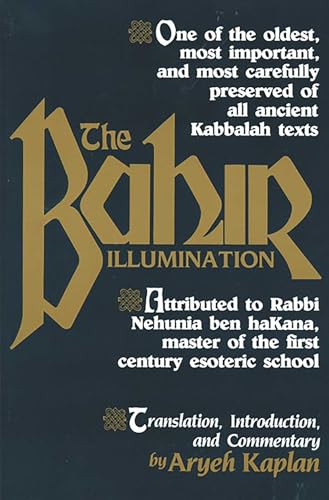
The Bahir: Illumination (Translation by Aryeh Kaplan)
The standard English translation with extensive commentary. Essential for anyone seriously studying the Kabbalistic tradition.
View on AmazonRead one section a day. The Bahir's 200 sections are short enough to read one per day, and this pace is much more productive than reading the text cover to cover. A single section, read slowly, will open questions and associations that take the rest of the day to settle. Return to the same section in the evening and notice what has shifted.
Notice the letters. The Bahir returns repeatedly to specific Hebrew letters. Even if you do not read Hebrew, learning the names of the letters (Alef, Bet, Gimel...) and their general associated qualities will significantly deepen your engagement with the text.
Sitting with the Cosmic Tree
Find a living tree and sit near it for twenty minutes. Look at the roots, the trunk, the branches. Now invert the image in your imagination: what if this tree's roots were above, drawing from a divine source that is the origin of all energy, light, and being? What if the branches reaching downward were the different qualities of that source, each expressing a different aspect of what is ultimately one life? The Bahir uses this image not as a metaphor to be understood intellectually but as a visual meditation to be inhabited. Sit with the inverted tree until you can feel it, not just think it.
Deepen Your Hermetic Practice
The Hermetic Synthesis Course guides you through all seven principles with structured daily practices.
Explore the CourseFrequently Asked Questions
What is the Sefer Bahir?
The Sefer Bahir (Book of Illumination) is the oldest systematic Kabbalistic text, first appearing in twelfth-century Provence. It introduced the sefirot as divine powers, the cosmic tree metaphor, soul transmigration, and the mystical significance of Hebrew letters. All later Kabbalistic literature builds on its symbolic vocabulary.
Who wrote it?
The Bahir is traditionally attributed to Rabbi Nehuniah ben haKana, a first-century Talmudic sage, but scholars are confident it was compiled in twelfth-century Provence. It draws on earlier Jewish mystical sources and possibly Gnostic and Neoplatonic influences from the Provencal environment.
What are the sefirot?
The sefirot are ten divine powers or attributes through which God acts in the world. The Bahir is the first Kabbalistic text to present them as dynamic living forces. They are often depicted as the branches of the cosmic tree, each expressing a different quality of divine life while drawing from the single divine source.
What is gilgul?
Gilgul is soul transmigration or reincarnation. The Bahir is the first major Jewish text to teach this concept, using the parable of a king's orchard to explain why some souls require multiple lifetimes to fulfill their purpose. This concept became central to Lurianic Kabbalah.
How does the Bahir relate to the Zohar?
The Bahir predates the Zohar by over a century and provides the foundational symbolic vocabulary the Zohar develops at great length. The Bahir is like a seed; the Zohar is the fully grown tree. The relationship is one of origin and elaboration rather than competition.
Is the Bahir Gnostic?
The Bahir has elements that parallel Gnostic thought, including the treatment of divine powers as emanations and the feminine divine principle. Scholars debate whether this reflects direct Gnostic influence or parallel development from common earlier sources. The Bahir is fundamentally rooted in Jewish tradition regardless of external influences.
What is the best English translation?
Aryeh Kaplan's "The Bahir" (Samuel Weiser, 1979) is the standard English translation with extensive commentary. It is the most accessible and reliable option for English-speaking readers without a background in Kabbalistic literature.
How does the Bahir relate to the Sefer Yetzirah?
Both texts are foundational to Kabbalah and both treat the Hebrew letters as the fundamental medium of divine creation. The Sefer Yetzirah predates the Bahir and is more abstract and systematic. The Bahir takes the Sefer Yetzirah's letter-cosmology and develops it within a midrashic framework, adding the sefirot as dynamic divine powers and expanding the symbolic vocabulary considerably.
What is the Sefer Bahir?
The Sefer Bahir (Book of Illumination) is the oldest systematic Kabbalistic text, first appearing in Provence in the twelfth century. It is organized as a series of approximately 200 short passages or sections that explore the mystical significance of Hebrew letters, the sefirot as divine powers, the concept of soul transmigration (gilgul), and the metaphor of the divine tree. It is the first Kabbalistic text to use the sefirot symbolically and was foundational for all subsequent Kabbalistic literature.
Who wrote the Sefer Bahir?
The Bahir is pseudepigraphically attributed to Rabbi Nehuniah ben haKana, a Talmudic sage of the first century CE, but scholars consider it to have been compiled or authored in Provence (southern France) in the twelfth century, around 1176 CE. It draws on earlier mystical traditions including the Hekhalot literature and the Sefer Yetzirah, as well as Gnostic and possibly Neoplatonic influences.
What does Bahir mean?
Bahir means 'brilliant' or 'illuminating' in Hebrew. The name comes from the first verse quoted in the text: 'Now they cannot see the light that is brilliant in the skies' (Job 37:21). The title reflects the text's purpose: to illuminate the hidden dimensions of Torah and divine reality through symbolic and mystical interpretation.
What are the sefirot in the Bahir?
The Bahir is the first Kabbalistic text to present the sefirot as ten dynamic divine powers or attributes through which God interacts with the world and through which creation unfolds. The Bahir describes the sefirot using the metaphor of a cosmic tree whose roots are above and whose branches extend downward into the world. The sefirot are not abstract philosophical concepts but living divine forces that mystics can engage with through meditation, prayer, and right action.
What is gilgul (soul transmigration) in the Bahir?
The Bahir is the first major Jewish text to explicitly discuss gilgul, the transmigration or reincarnation of souls. It uses the parable of a king who plants an orchard: some trees bear fruit in their lifetime, others need multiple generations to reach fruition. The Bahir applies this to souls: some fulfill their purpose in one lifetime, others require multiple incarnations. This concept became central to later Kabbalistic theology, especially in the Lurianic system.
How is the Bahir organized?
The Bahir is organized as approximately 200 short sections that lack systematic linear organization. It moves through a series of topics using midrashic method: taking a scriptural verse or a question and exploring its mystical dimensions through parable, dialogue, and symbolic analysis. This non-linear structure reflects the oral teaching context from which it emerged and makes it a text that rewards repeated reading rather than a single linear reading.
What is the divine tree in the Bahir?
The Bahir introduces the metaphor of the cosmic tree (Etz HaHayyim, Tree of Life) to describe the structure of the divine realm. Unlike the conventional image of a tree with roots below and branches above, the divine tree has its roots above in the divine source and its branches extending downward into the world. The sefirot are the branches of this tree, each drawing divine energy from the root and distributing it to the world. This image became the basis for the later Tree of Life diagram central to Kabbalistic teaching.
How does the Bahir treat the Hebrew letters?
The Bahir treats the Hebrew letters as more than linguistic symbols. Following the tradition of the Sefer Yetzirah, it sees each letter as a channel of divine creative power with its own shape, sound, and cosmic function. The Bahir explores the mystical significance of letter shapes, the positions of letters in the Torah, and the numerical values of letters (gematria) as keys to hidden layers of meaning in scripture and in the structure of reality.
Is the Bahir related to Gnosticism?
Some scholars, most notably Gershom Scholem, have argued that the Bahir shows influences from Gnostic traditions, particularly in its treatment of the divine powers as distinct emanations, its concept of the feminine divine principle (Shekhinah), and its account of how divine sparks become scattered in the world. However, the Bahir also draws heavily on earlier Jewish sources and the question of direct Gnostic influence remains debated.
What is the best translation of the Bahir?
Aryeh Kaplan's translation 'The Bahir: Illumination' (Samuel Weiser, 1979) is widely considered the most accessible and reliable English translation. Kaplan provides the complete text with extensive commentary explaining the Kabbalistic context of each section. A more recent partial translation with scholarly introduction by Geoffrey Dennis is also available.
How does the Bahir relate to the Zohar?
The Bahir predates the Zohar by over a century and is foundational to it. The Zohar, composed in thirteenth-century Spain (traditionally attributed to Rabbi Shimon bar Yochai but written by Moses de Leon), develops and greatly expands the symbolic vocabulary introduced in the Bahir: the sefirot, the divine tree, the feminine Shekhinah, and the mystical interpretation of Torah. The Bahir is the seed of which the Zohar is the flowering.
Sources and References
- Kaplan, Aryeh, trans. The Bahir: Illumination. Samuel Weiser, 1979. The standard English translation with extensive commentary.
- Scholem, Gershom. Major Trends in Jewish Mysticism. Schocken Books, 1941. The foundational academic study of Jewish mysticism; Chapter 3 covers the Bahir extensively.
- Scholem, Gershom. Origins of the Kabbalah. Jewish Publication Society / Princeton University Press, 1987. The most detailed academic analysis of the Bahir and the Provencal Kabbalistic origins.
- Idel, Moshe. Kabbalah: New Perspectives. Yale University Press, 1988. An important corrective and complement to Scholem's analysis of the Bahir's historical context.
- Dan, Joseph. The Early Kabbalah. Paulist Press, 1986. Provides excellent context for the Bahir's emergence in the twelfth century.