

Quick Answer
The Mustard Seed is Osho's commentary on the Gospel of Thomas - the Gnostic text suppressed by the early church, rediscovered at Nag Hammadi in 1945. Osho reads Jesus as a radical mystic pointing to direct inner experience, not a religious founder. He connects the Gospel of Thomas to Zen, Sufism, and Vedanta throughout his discourses.
Table of Contents
- What Is The Mustard Seed?
- The Gospel of Thomas: The Source Text
- The Nag Hammadi Discovery
- Osho's Portrait of Jesus
- Key Sayings and Osho's Interpretations
- The Kingdom Within: Osho's Central Theme
- Connections to Zen, Sufism, and Vedanta
- The Gnostic Jesus
- Is This Book for Christians?
- How to Read and Use This Book
- Frequently Asked Questions
Key Takeaways
- Gospel of Thomas as source: Osho works from the Gnostic Gospel of Thomas - 114 sayings of Jesus discovered in Egypt in 1945, excluded from the Bible and largely unknown to mainstream Christianity for 1,900 years.
- Mystical Jesus: Osho reads Jesus not as the founder of institutional religion but as a mystic pointing to direct inner recognition of the divine - more aligned with Zen and Vedanta than with orthodox Christian theology.
- Universal mystical language: The book draws parallels between Gospel of Thomas sayings and teachings from Zen, Sufism, Taoism, and Advaita throughout, arguing for a shared mystical core across traditions.
- Osho's favorite gospel: Osho explicitly stated that the Gospel of Thomas was his most loved Christian text, making The Mustard Seed his most personal and sustained engagement with the Jesus tradition.
- Best entry for Christian-background readers: Of all Osho's works, this one speaks most directly to readers coming from a Christian background who want to find a more experiential dimension in that tradition.
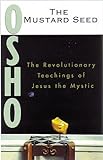
What Is The Mustard Seed?
The Mustard Seed is a series of discourses Osho delivered at his ashram in Pune, India, in August and September of 1974, taking as his text selected sayings from the Gospel of Thomas. The full title - The Mustard Seed: Commentaries on the Fifth Gospel of Saint Thomas - signals what made this project unusual: Osho was working from a gospel that most of his audience would have never heard of and that had been absent from Christian teaching for nearly two thousand years.
The Gospel of Thomas is not like the four canonical Gospels. It tells no story of Jesus's birth, ministry, or death. It is simply a list of 114 sayings - many of them paradoxical, some of them provocative, others deeply beautiful - attributed to "the living Jesus." Many of these sayings have no parallels in Matthew, Mark, Luke, or John. Others are versions of familiar sayings that reveal unexpected dimensions when compared with their canonical counterparts.
Osho called it "my most loved gospel on Jesus." This is significant: he was a prolific commentator on sacred texts from virtually every tradition, but he reserved this particular affection for the Gospel of Thomas. The Mustard Seed is therefore not just another entry in his long series of discourse books - it is the work where he felt most personally aligned with his subject.
Why This Book Matters
In 1974, when Osho delivered these discourses, the Gospel of Thomas had been available in scholarly translation for less than two decades. It was just beginning to enter broader public awareness. Osho brought it to his Indian and international audience at a time when most Christians had never heard of it and most Western spiritual seekers were only beginning to explore Gnostic Christianity. His commentary made this strange, challenging text accessible and demonstrated that it could be a living vehicle for spiritual exploration rather than merely a historical curiosity.
The Harper Collins edition is the standard version available at most booksellers. Multiple editions have been published under slightly different titles, including "The Mustard Seed: The Groundbreaking Teachings of Jesus" and "The Mustard Seed: My Most Loved Gospel on Jesus."
The Gospel of Thomas: The Source Text
To understand what Osho was working with, you need to understand what the Gospel of Thomas is and why it differs so dramatically from the canonical Gospels.
The text begins: "These are the secret sayings which the living Jesus spoke and which Didymos Judas Thomas wrote down." The word "secret" is important: this is not a public teaching for the masses but an inner teaching for those prepared to receive it. The phrase "living Jesus" - rather than "Lord" or "Christ" - suggests a different theological framework from the orthodox tradition.
What follows are 114 numbered sayings, most beginning with "Jesus said." Some are short - a single sentence. Others are brief parables. A few are dialogues. The style is aphoristic and demanding: these are not teachings you can passively absorb. They require active engagement, interpretation, and application to one's own experience.
Selected Gospel of Thomas Sayings (with Osho's Context)
- Saying 3: "If those who lead you say to you, 'See, the kingdom is in the sky,' then the birds of the sky will precede you. If they say to you, 'It is in the sea,' then the fish will precede you. Rather, the kingdom is inside of you, and it is outside of you."
- Saying 20: "The disciples said to Jesus, 'Tell us what the Kingdom of Heaven is like.' He said to them, 'It is like a mustard seed. It is the smallest of all seeds, but when it falls on tilled soil, it produces a great plant and becomes a shelter for birds of the sky.'"
- Saying 77: "It is I who am the light which is above them all. It is I who am the All. From Me did the All come forth, and unto Me did the All extend. Split a piece of wood, and I am there. Lift up the stone, and you will find Me there."
- Saying 108: "He who will drink from my mouth will become like me. I myself shall become he, and the things that are hidden shall be revealed to him."
Saying 77, with its identification of Jesus with the omnipresent light of consciousness - present in wood and stone as much as in the human soul - is distinctly non-dualistic. Osho found this saying particularly important as evidence that the Jesus of the Gospel of Thomas was teaching a non-dual recognition very similar to that of Vedanta and Zen.
The Gospel of Thomas shows clear affinities with the Gnostic tradition and with Jewish wisdom literature. It also shows surprising parallels with Buddhist and Hindu teaching. The Q source hypothesis in biblical scholarship - the proposed hypothetical source for sayings shared between Matthew and Luke - intersects with Thomas scholarship in complex ways. Thomas may preserve some of the earliest material about Jesus's actual teachings, before the narrative frameworks of the canonical gospels shaped that material for particular theological purposes.
The Nag Hammadi Discovery
The Gospel of Thomas would not exist as a widely accessible text without one of the most dramatic archaeological discoveries of the 20th century. In December 1945, a group of Egyptian farmers were digging near the cliffs at Jabal al-Tarif, close to the town of Nag Hammadi in Upper Egypt. One of the farmers, Muhammad al-Samman, struck a large sealed earthenware jar buried in the soil.
Inside the jar were thirteen leather-bound codices containing over fifty Coptic-language texts. These turned out to be a library of early Christian Gnostic writings, buried - scholars believe - by monks from a nearby monastery around 390 CE, possibly to protect them from destruction during the campaigns of the newly Christianized Roman Empire to eliminate heterodox texts.
The codices included the Gospel of Thomas, the Gospel of Philip, the Gospel of Truth, the Gospel of the Egyptians, and many other texts that had been suppressed by the emerging orthodox church from the 2nd century onward. Irenaeus of Lyon had already denounced many of these texts as heretical around 180 CE. The Nag Hammadi library proved that the early Christian movement had been far more theologically diverse than orthodox history had acknowledged.
Why the Gnostic Texts Were Suppressed
The early church's suppression of Gnostic Christianity was not simply irrational hostility. The Gnostic traditions generally emphasized direct personal gnosis (knowledge/experience) over institutional authority. If individuals could reach divine truth through their own inner experience, mediated by a teacher but not by a church hierarchy, then the institutional church's claim to be the sole mediator between humanity and God was undermined. Orthodoxy won the political struggle of the first three centuries. But the Nag Hammadi discovery shows that the tradition it suppressed was sophisticated, widespread, and in many ways theologically rich. Osho's commentary on the Gospel of Thomas participates in the modern rediscovery of this buried tradition.
English translations of the Nag Hammadi texts became available in the 1970s, with the complete Nag Hammadi Library in English published in 1977. Osho was working with earlier partial translations and scholarly publications when he delivered The Mustard Seed discourses in 1974 - showing how quickly he tracked emerging scholarly discoveries and brought them into living teaching contexts.
Osho's Portrait of Jesus
The Jesus of The Mustard Seed is a figure that most Christians would find surprising and many would find challenging. Osho presents him not as the second person of a divine Trinity, not as the sacrificial redeemer of humanity's sins, but as an awakened mystic in the same tradition as the Buddha, Lao Tzu, Bodhidharma, and Al-Hallaj.
This Jesus is not gentle. Osho consistently emphasizes the radical, demanding quality of the Gospel of Thomas's Jesus - the one who says "whoever does not hate his father and mother cannot become my disciple" (Saying 55) and "if you do not fast as regards the world, you will not find the Kingdom" (Saying 27). These are not the comfortable sayings of a moral teacher. They are the paradoxical challenges of a Zen master.
Osho argues that the institutional church domesticated Jesus - made him safe, palatable, and useful for social control. The real Jesus, visible in the Gospel of Thomas, was a figure who would have been deeply uncomfortable to institutional Christianity at any period of history. He was more likely to be an enemy of the church than its founder.
Osho's Core Arguments About Jesus
- Jesus was a mystic who had realized non-dual consciousness - the same recognition that Eastern traditions call enlightenment, samadhi, or moksha
- His teachings were deliberately paradoxical and koan-like, designed to break the habitual reasoning mind open rather than to provide comfortable beliefs
- The early church chose the parts of Jesus's teaching that supported institutional religion and authority while suppressing the mystical core
- Paul, not Jesus, was the real founder of Christianity as an institution - Jesus himself had no interest in founding a religion
- The Kingdom of Heaven Jesus described is the same inner state that all authentic mystical traditions point toward: consciousness recognizing itself
These arguments were not new in 1974 - German liberal theologians had been making versions of them for over a century. What Osho added was the perspective of someone who claimed his own direct experience of the awakened state, allowing him to read Jesus's mystical sayings not as historical puzzles but as practical pointers for contemporary seekers.
Key Sayings and Osho's Interpretations
The Mustard Seed does not systematically cover all 114 Gospel of Thomas sayings. Osho selected the ones he found most philosophically interesting and used them as launching points for extended discourses that often ranged widely beyond the immediate text. Several sayings receive particularly memorable treatment.
Saying 3 - "The Kingdom is inside you and outside you" - becomes the foundation for Osho's central argument about the nature of the divine. This saying, he argues, is a direct denial of the idea that God is somewhere else, reachable only through the mediation of a church, a priest, or a set of correct beliefs. The Kingdom is here, now, as the very ground of your being. The only question is whether you recognize it.
Saying 13, where Jesus asks the disciples who he is and Thomas responds "Master, my mouth is wholly incapable of saying whom you are like," receives extended treatment. For Osho, Thomas's silence is the correct answer - and Jesus's subsequent private transmission to Thomas of "three words" is a pointer to something that cannot be captured in doctrine or theology, only experienced directly.
On Saying 77: The Divine Everywhere
"Split a piece of wood, and I am there. Lift up the stone, and you will find me there." Osho describes this as one of the most extraordinary statements in all spiritual literature. It is a direct claim of pantheistic or panentheistic consciousness: the awareness that calls itself "I" is not limited to one human body but is the consciousness that pervades all of reality. He connects this directly to the Upanishadic teaching "Tat tvam asi" (That thou art) and to the Zen experience of sudden recognition that one's own nature and the nature of the universe are identical. This, Osho argues, is what Jesus was actually teaching - and why the orthodox church could not fully integrate it. A Jesus who is everywhere in wood and stone does not need a church to mediate his presence.
Saying 42 - "Become a passerby" - receives one of the most practically oriented treatments in the book. Osho reads this as a teaching about non-attachment: moving through life fully engaged but not grasping, not building identity from the accumulation of experiences and possessions. He connects it to the Buddhist concept of non-clinging, the Zen teaching about moving through the world "without leaving footprints," and the Sufi teaching about being in the world but not of it.
The Kingdom Within: Osho's Central Theme
If The Mustard Seed has a single central theme, it is the internality of the Kingdom - the consistent argument that what Jesus called "the Kingdom of Heaven" or "the Kingdom of God" is not a future state, not another world, not a reward for correct belief, but a present inner reality available through a transformation of awareness.
This reading aligns the Gospel of Thomas's Jesus with the non-dualistic mystical traditions of India and China in a way that orthodox Christianity has generally resisted. Orthodox theology requires the Kingdom to be other - a supernatural state achievable only through divine grace mediated by the church. If the Kingdom is within and always accessible, the mediating institution becomes irrelevant.
Osho is careful to note that "within" does not mean narcissistic self-absorption. The Kingdom is simultaneously within and beyond - "inside of you and outside of you," as Saying 3 puts it. When the boundary between inner and outer dissolves - when the sense of being a separate self enclosed within a skin drops away - what is recognized is simultaneously one's own deepest nature and the nature of all of reality. This is the recognition that all the great mystics have described, in their different languages, as the ultimate human possibility.
The Kingdom in Multiple Traditions
Osho's strategy in The Mustard Seed - repeatedly connecting Gospel of Thomas sayings to parallel teachings from other traditions - serves a specific philosophical purpose. He is arguing that the Kingdom Jesus described is not a Christian-specific concept but the universal recognition at the heart of every authentic mystical tradition. The Zen student's satori, the Vedantin's realization of Brahman, the Sufi's annihilation in God (fana), the Tantric's recognition of Shiva-Shakti unity - all of these are, in Osho's reading, different cultural expressions of the same fundamental inner recognition. The Gospel of Thomas's Jesus was participating in this universal mystical tradition, not founding a new religion.
Connections to Zen, Sufism, and Vedanta
One of the distinctive qualities of The Mustard Seed is the breadth of its comparative work. Osho was not content to read the Gospel of Thomas in isolation from other traditions. He continuously drew connections - to specific Zen masters and koans, to particular Sufi poets and their metaphors, to Upanishadic declarations and Advaitic formulations.
The connection to Zen is particularly illuminating. Several Gospel of Thomas sayings read like Zen koans: paradoxical, impossible to resolve through ordinary logic, demanding a different quality of mind. Saying 109 - "The Kingdom of the Father is like a man who had [a hidden treasure] in his field without knowing it. And after he died, he left it to his son. The son did not know (about the treasure). He inherited the field and sold it. And the one who bought it went plowing and found the treasure" - is exactly the kind of indirect teaching that Zen uses: pointing to something that cannot be directly stated, that must be discovered through one's own encounter with the right question.
Parallel Teachings Across Traditions
| Gospel of Thomas Saying | Parallel Tradition | Similar Teaching |
|---|---|---|
| Saying 3: Kingdom within and without | Advaita Vedanta | Tat tvam asi - That thou art; Brahman as the ground of all |
| Saying 42: Become a passerby | Zen Buddhism | Moving through the world without leaving traces; non-attachment |
| Saying 77: I am in the wood and stone | Taoism | The Tao that pervades all things; Te as the presence in every entity |
| Saying 108: Drink from my mouth, become like me | Sufism | Fana - dissolution of the disciple's identity into the master's awareness |
| Saying 22: Enter Kingdom as a child | Zen Buddhism | Beginner's mind; seeing freshly without conceptual overlay |
These connections are not mere academic exercises for Osho. His argument is that they demonstrate a shared underlying reality: the recognition that all traditions call by different names but that is the same across traditions. The Gospel of Thomas provides a Christian window into this universal experience, one that most Western readers can engage with more readily than Pali Buddhist texts or Sanskrit Upanishads.
The Gnostic Jesus
The Mustard Seed can be read in the context of the broader Gnostic tradition that the Nag Hammadi texts revealed. Gnosticism - the diverse family of early Christian movements emphasizing direct knowledge (gnosis) of the divine over faith and institutional mediation - shared with the Gospel of Thomas a focus on inner experience and a suspicion of external religious authority.
Osho was not a Gnostic in any technical sense - he worked from many traditions without committing to any one. But his reading of the Gospel of Thomas shares several key features with Gnostic interpretation: the emphasis on the Kingdom as an inner state, the reading of "light" language as referring to consciousness rather than supernatural brightness, the skepticism about institutional religion's ability to transmit genuine spiritual transformation.
Elaine Pagels's The Gnostic Gospels (published in 1979, after Osho's discourses but drawing on the same Nag Hammadi material) became the landmark popular scholarly treatment of these traditions. Her work demonstrated that the suppressed Gnostic texts were not mere heresies but sophisticated theological alternatives to what became orthodox Christianity. Reading Pagels alongside Osho's Mustard Seed provides a useful combination of scholarly rigor and practical meditation-oriented interpretation.
Is This Book for Christians?
This is one of the questions that comes up most often about The Mustard Seed. The answer is genuinely complex. Osho's reading of Jesus is deeply appreciative but also deeply challenging to orthodox Christian assumptions. He loves the Gospel of Thomas's Jesus while being withering about what he sees as the institutional church's distortion of that Jesus.
For Christians who hold the full doctrinal framework of orthodox theology - the Trinity, the atoning sacrifice, the authority of the church as mediator - this book will feel like an attack on what they cherish. Osho is not trying to reform Christianity from within; he is arguing that the authentic Jesus is more clearly visible outside the institutional tradition than inside it.
For Christians who feel that mainstream Christianity has missed something important - who sense that Jesus was pointing at a direct inner experience that doctrinal formulations have obscured - The Mustard Seed can be genuinely illuminating. Many Christian contemplatives, from the Desert Fathers through Meister Eckhart to Thomas Merton, have been describing the same inner Kingdom that Osho finds in the Gospel of Thomas. The book can function as a bridge between Eastern meditative traditions and the mystical undercurrent within Christianity itself.
Reading The Mustard Seed as a Christian
If you come from a Christian background and want to engage productively with The Mustard Seed:
- Read it alongside the Gospel of Thomas itself (available in James M. Robinson's Nag Hammadi Library translation or in the popular Marvin Meyer edition)
- Compare Osho's readings with Christian mystical writers like Meister Eckhart, Hildegard of Bingen, and Thomas Merton, who were often working toward similar understanding from within the tradition
- Hold his critiques of institutional Christianity separately from his positive readings of the Gospel of Thomas sayings - even if the criticisms feel unfair, the interpretations themselves are worth engaging
- Notice where his cross-traditional comparisons illuminate things in the Gospel of Thomas that traditional Christian commentary has not explained in a way that feels alive
How to Read and Use This Book
The Mustard Seed works well as an introduction to both Osho and the Gospel of Thomas for readers who have some background in Christian or Western spiritual tradition. It is more focused than most of Osho's books (because it has a specific text to work from) and more accessible to Western readers than his Indian-tradition works (because Jesus provides a familiar anchor).
A productive reading strategy is to alternate between Osho's commentary and the Gospel of Thomas sayings themselves. Read a Mustard Seed chapter, then read the relevant Thomas saying in the original translation, then return to Osho's commentary with fresh eyes. The movement between the compressed original and Osho's extended elaboration reveals more than either alone.
Pairing The Mustard Seed with Elaine Pagels's scholarly work provides useful calibration. Pagels is a historian, not a teacher - her interest is in what the texts meant historically and theologically, not in how to use them for practice. Osho is a teacher, not a historian - his interest is in how the texts can be used to support actual inner transformation. Together they offer complementary perspectives.
Explore Mystical Christianity and Beyond
Thalira's Hermetic Synthesis Course weaves together the mystical threads from Christianity, Hermeticism, and Eastern philosophy into a living practice.
Explore the CourseFrequently Asked Questions
What is The Mustard Seed by Osho?
A series of discourses delivered in Pune, India in 1974, commenting on selected sayings from the Gospel of Thomas. Osho reads Jesus as a radical mystic pointing to direct inner experience, drawing parallels with Zen, Sufism, and Vedanta throughout.
What is the Gospel of Thomas?
A collection of 114 sayings attributed to Jesus, discovered at Nag Hammadi, Egypt in 1945. Unlike the canonical Gospels, it contains no narrative - only sayings and parables. Many have no parallels in the New Testament. It was excluded from the biblical canon and suppressed by the early church.
How does Osho's reading of Jesus differ from traditional Christianity?
Osho reads Jesus as an enlightened mystic pointing to direct inner recognition of the divine, not as a religious founder or atoning savior. He argues the institutional church suppressed this mystical Jesus in favor of a more controllable doctrinal version, and that the Gospel of Thomas preserves the authentic teaching better than the canonical Gospels.
Is The Mustard Seed suitable for Christians?
It depends. Christians open to mystical and non-dualistic readings of their tradition often find it deeply enriching. Those who hold orthodox doctrinal authority as non-negotiable will find it challenges fundamental beliefs. It is better suited to those who feel something is missing in mainstream Christianity than those who are fully satisfied by it.
Why is it called The Mustard Seed?
From Gospel of Thomas Saying 20, where Jesus compares the Kingdom of Heaven to a mustard seed - the smallest seed that grows into the greatest tree. Osho uses this as a teaching about spiritual potential: the awakened consciousness is already present within, however tiny its current manifestation appears.
What is the Nag Hammadi discovery?
In 1945, Egyptian farmers near Nag Hammadi discovered 13 leather-bound codices containing over 50 early Christian Gnostic texts, including the Gospel of Thomas. These texts had been suppressed by the orthodox church for nearly 1,700 years. Their rediscovery transformed understanding of early Christian diversity.
Where can I get The Mustard Seed?
Available on Amazon in multiple editions. The Harper Collins paperback (ISBN 1852304987) is the most widely available. The Osho International Foundation shop also sells it directly.
What is The Mustard Seed by Osho?
The Mustard Seed is a series of discourses Osho delivered at his Pune ashram in 1974 commenting on selected sayings from the Gospel of Thomas - the Gnostic text discovered at Nag Hammadi in 1945 that was suppressed by the early church. Osho presents Jesus as a radical mystic in the tradition of non-dual awakening rather than as the founder of a religious institution, drawing parallels with Zen, Sufism, and Vedanta throughout.
What is the Gospel of Thomas?
The Gospel of Thomas is a collection of 114 sayings attributed to Jesus, discovered among the Nag Hammadi library of Gnostic texts in Egypt in 1945. Unlike the canonical Gospels, it contains no narrative of Jesus's life, death, or resurrection - only sayings, many of which have no parallels in the New Testament. Scholars date its composition to the 1st or 2nd century CE. It was excluded from the biblical canon and was largely unknown until the 1945 discovery.
How does Osho's interpretation of Jesus differ from traditional Christianity?
Osho reads Jesus as a mystic pointing to direct inner experience of the divine rather than as the founder of a religion requiring faith and obedience. He emphasizes the psychological and meditative dimensions of Jesus's sayings - particularly in the Gospel of Thomas - over their theological or doctrinal content. He argues that the institutional church suppressed the mystical Jesus and replaced him with a moralistic figure more useful for social control. He finds more authentic Christianity in the Gnostic tradition than in orthodox doctrine.
Why is The Mustard Seed considered Osho's best book on Jesus?
Osho explicitly said that the Gospel of Thomas was his favorite gospel and that the Jesus found there was the most authentic and interesting. The Mustard Seed is considered his most focused and sustained engagement with Christian mysticism. The sayings of the Gospel of Thomas - with their paradoxical, koan-like quality - suited Osho's interpretive style particularly well, allowing him to connect Christian mysticism with Zen, Sufism, and Vedanta in ways that illuminate all four traditions.
What is the significance of the mustard seed title?
The title refers to a saying in the Gospel of Thomas (Saying 20) and in the canonical Gospels where Jesus compares the Kingdom of Heaven to a mustard seed - the smallest of seeds that grows into a great tree. Osho uses this image as a teaching about the nature of spiritual potential: the awakening consciousness is already present within, however tiny it may seem. What appears small and insignificant contains within it the entirety of divine possibility.
Is The Mustard Seed suitable for Christians?
It depends on the reader. Christians who value intellectual engagement and are open to mystical and non-dualistic readings of the tradition often find Osho's commentary deeply enriching - a way of recovering dimensions of Jesus's teaching that mainstream Christianity has underemphasized. Those who hold the institutional church's doctrinal authority as non-negotiable will likely find his approach too radical. It is not a book that tries to be acceptable to everyone.
How does the Gospel of Thomas differ from the canonical Gospels?
The canonical Gospels (Matthew, Mark, Luke, John) are narrative accounts of Jesus's life, death, and resurrection, with theological arguments woven throughout. The Gospel of Thomas contains only sayings - no narrative, no crucifixion, no resurrection theology. Its Jesus speaks in paradoxes and riddles that demand inner work from the listener rather than doctrinal assent. Many scholars see it as preserving an early, possibly more historically authentic tradition of Jesus's teachings than the narrative Gospels.
What does Osho say about the Kingdom of Heaven in The Mustard Seed?
Osho reads the Kingdom of Heaven in the Gospel of Thomas not as a future state or an otherworldly realm but as a present inner reality - the state of consciousness that is already present when the mind is still and the sense of separate selfhood dissolves. He argues that Jesus was describing the same inner recognition that Zen calls satori, that Vedanta calls Brahman-realization, and that Sufism calls fana. The kingdom is not arrived at by following rules but by a transformation of awareness.
What other traditions does Osho connect to the Gospel of Thomas?
Throughout The Mustard Seed, Osho draws parallels with Zen Buddhism (particularly the koan tradition), Sufism (especially the poetry of Rumi and Omar Khayyam), Advaita Vedanta (particularly the teachings of Ramakrishna and Ramana Maharshi), and Taoism (Lao Tzu's concept of wu wei). These comparisons are not incidental - Osho's core argument is that all authentic mystical traditions point to the same inner recognition of consciousness, and that Jesus in the Gospel of Thomas was part of this universal mystical tradition.
Where can I get The Mustard Seed by Osho?
The book is available on Amazon in multiple editions. The standard Harper Collins edition (ISBN 1852304987) is widely available. The Rebel Publishing House edition is also available. The Osho International Foundation shop also sells it directly. Ebook versions are available through standard digital retailers.
How does The Mustard Seed relate to Osho's other works?
The Mustard Seed belongs to Osho's series of cross-traditional commentaries - books where he uses a primary sacred text from one tradition as a lens for exploring universal mystical themes. Other books in this vein include his Zen series (on various Zen masters), his Sufi series (on Hafiz, Rumi, and Omar Khayyam), and his extensive Yoga series on Patanjali. The Mustard Seed is widely considered the best of his Christian-tradition works.
What is the Nag Hammadi library and why does it matter for this book?
The Nag Hammadi library is a collection of early Christian Gnostic texts discovered by a farmer in Upper Egypt in 1945. The cache contained 13 leather-bound codices with over 52 texts, including the Gospel of Thomas. These texts, written in Coptic, preserved versions of early Christian teaching that had been systematically suppressed by the emerging orthodox church from the 2nd century onward. Their rediscovery transformed scholarship on early Christianity and provided texts like the Gospel of Thomas that Osho and others have used to argue for a more mystical, non-institutional version of Jesus's original teaching.
Sources and References
- Osho. The Mustard Seed: Commentaries on the Fifth Gospel of Saint Thomas. Harper Collins, 1993.
- Robinson, James M., ed. The Nag Hammadi Library in English. Harper and Row, 1977.
- Pagels, Elaine. The Gnostic Gospels. Random House, 1979.
- Meyer, Marvin. The Gospel of Thomas: The Hidden Sayings of Jesus. Harper Collins, 1992.
- Patterson, Stephen J. The Gospel of Thomas and Jesus. Polebridge Press, 1993.
- DeConick, April D. The Original Gospel of Thomas in Translation. T&T Clark, 2006.
- Leloup, Jean-Yves. The Gospel of Thomas: The Gnostic Wisdom of Jesus. Inner Traditions, 2005.