

Quick Answer
High Magic: Theory and Practice by Frater U.D. (Llewellyn, 2005) is a comprehensive and philosophically sophisticated introduction to Western ceremonial magic. It covers magical theory from ancient Egyptian to contemporary chaos magic, practical techniques including the LBRP, sigil magic, planetary magic, and talisman work, and introduces Frater U.D.'s own paradigm-based approach to magic. It sits between beginner textbooks and advanced theoretical works, offering depth and nuance to intermediate practitioners.
Table of Contents
- Who Is Frater U.D.
- What Is High Magic: Theory and Practice
- The Foundations of High Magic
- The LBRP and the Hexagram
- Sigil Magic and Austin Osman Spare
- Planetary Magic
- Talisman Work
- Magical Paradigms
- Chaos Magic and Cyber Shamanism
- Pragmatic Magic: Frater U.D.'s Philosophy
- High Magic in Historical Context
- How to Study High Magic
- Frequently Asked Questions
Key Takeaways
- Broad theoretical scope: High Magic covers magical theory from ancient Egypt through contemporary chaos magic, giving practitioners a panoramic view of the Western magical tradition that more narrowly focused books lack.
- Non-dogmatic framework: Frater U.D.'s paradigm approach allows practitioners to work within multiple magical systems without doctrinal commitment to any single one - a practically useful flexibility for contemporary practitioners.
- Sigil magic integration: The book's treatment of Austin Osman Spare's sigil technique alongside classical ritual magic makes High Magic one of the few books that successfully bridges the chaos magic and Golden Dawn streams.
- Planetary magic depth: The planetary magic system presented is thorough and practical, drawing on both traditional grimoire sources and modern Golden Dawn approaches to give practitioners a complete working system.
- European perspective: Frater U.D.'s Belgian background and European occult context gives High Magic a distinctive perspective that complements the more predominantly American context of Llewellyn's other magical publications.
Who Is Frater U.D.
Frater U.D. is the magical name of a Belgian ceremonial magician who has chosen not to publish under his legal name - a decision consistent with a longstanding tradition in Western occultism where serious practitioners sometimes prefer to keep their legal and magical identities separate. He is widely considered Europe's most prominent contemporary practical magician and has written more than twenty-five books on magic, many translated into multiple languages.
Born in the 1950s in Belgium, Frater U.D. began his magical studies in the 1970s and has practiced and taught ceremonial magic for over four decades. His background spans the full range of Western magical traditions: Golden Dawn ceremonial magic, Thelema, traditional folk magic, chaos magic, and the modern current he developed called Pragmatic Magic or Ice Magic. He has taught workshops and given lectures throughout Europe and North America, and his books have introduced thousands of practitioners to both classical and contemporary magical techniques.
What distinguishes Frater U.D. from many magical authors is his philosophical sophistication and his willingness to engage seriously with questions about how and why magic works rather than simply describing techniques. His engagement with chaos magic theory, cybernetics, and information science gives his work a contemporary relevance that more traditionally oriented magical writers sometimes lack. He is also notable for his insistence on practical results as the ultimate measure of any magical system's value - a stance that defines his Pragmatic Magic approach.
His major works include High Magic: Theory and Practice (2005), High Magic II: Expanded Theory and Practice (2008), Practical Sigil Magic (1990), Money Magic (2011), and Shortcuts to Initiation. Each work reflects his characteristic combination of respect for traditional sources and openness to contemporary innovations.
The European Ceremonial Magic Scene
Frater U.D. emerges from a European ceremonial magic tradition that has developed somewhat differently from the American tradition represented by Kraig and Llewellyn's other publications. European magical groups, particularly in Germany, France, and the Low Countries, have maintained closer contact with the continental Hermetic and Rosicrucian traditions that preceded the Golden Dawn, and have been more influenced by chaos magic currents coming from the UK. Frater U.D. synthesizes these European streams with the Golden Dawn tradition, producing a perspective that adds depth to the predominantly American magical literature of the late 20th century.
What Is High Magic: Theory and Practice
High Magic: Theory and Practice, published by Llewellyn in 2005 and translated from Frater U.D.'s original German, is simultaneously an introduction to classical ceremonial magic and a theoretical overview of the entire Western magical tradition. The book succeeds at both levels: it provides enough practical instruction for a motivated student to begin practicing, while offering enough theoretical depth to engage practitioners who already have significant experience.
The title's use of the term "high magic" deliberately invokes the Renaissance distinction between high magic (magia) and low magic (goetia or goety). High magic in this traditional sense is the elevation of consciousness toward divine principles through systematic ritual and contemplative practice. It is distinguished from folk magic (which works with local spirits and natural forces) and from black magic (which works through coercion of spirits). Frater U.D. uses the term in this classical sense while updating it for contemporary practitioners.
The book's structure moves from foundations to practice. Early chapters address the history and theory of magical thought, covering Egyptian, Greek, medieval, and Renaissance magical traditions and showing how they flow into the modern synthesis. Later chapters provide practical instruction in specific techniques. The final sections introduce Frater U.D.'s own theoretical contributions, particularly his analysis of magical paradigms and his Pragmatic Magic philosophy.
The writing is clear and intellectually serious without being academic. Frater U.D. writes as a practitioner who has spent decades working with these systems and wants to share what he has found most valuable, not as a scholar collecting and organizing historical data. This gives High Magic a different quality than either a scholarly survey or a purely practical how-to guide - it reads like the work of someone who genuinely understands the material from the inside.
The Foundations of High Magic
Frater U.D. situates Western ceremonial magic within a broad historical lineage that begins in ancient Egypt. Egyptian magic (Heka) was the most sophisticated pre-classical magical system and contributed several key concepts to the Western tradition: the idea of divine names as sources of power, the use of sympathetic correspondences, the complex afterlife geography that informed later astral magic, and the model of the trained magician as a specialized priest who works with divine forces on behalf of the community.
Greek and Hellenistic magic inherited and transformed these Egyptian contributions. The Greek Magical Papyri (PGM), a collection of magical texts from Greco-Roman Egypt (1st-5th centuries CE), represent the most complete surviving record of Hellenistic magical practice and are a primary source that Frater U.D. draws on throughout High Magic. The PGM contains spells, rituals, and invocations that blend Egyptian, Greek, Jewish, and early Christian elements - a syncretism that foreshadows the later Renaissance Hermeticism that gave Western magic most of its current form.
Medieval magic developed within a primarily Christian context, which meant it had to negotiate carefully with ecclesiastical authority. The grimoire tradition (books of magic including the Lesser Key of Solomon, the Greater Key of Solomon, the Picatrix, and dozens of others) developed systems of demon and angel invocation that were formally condemned by the Church but widely practiced among educated clergy and laity. Frater U.D. engages seriously with this grimoire tradition, noting both its practical value and its cultural limitations.
The Renaissance synthesis - particularly the Hermetic philosophy of Ficino, the Kabbalistic magic of Pico della Mirandola and Agrippa, and the natural magic of della Porta and Paracelsus - is the immediate ancestor of modern ceremonial magic. It provided the philosophical framework (macrocosm-microcosm correspondence, the dignity of humanity, magic as the highest science) and much of the practical content (planetary correspondences, elemental systems, divine names) that the Golden Dawn later organized into its elaborate synthesis.
The LBRP and the Hexagram
High Magic devotes detailed attention to the Lesser Banishing Ritual of the Pentagram (LBRP) and the Banishing and Invoking Rituals of the Hexagram. Frater U.D. presents these Golden Dawn rituals in a way that is both practically clear and theoretically illuminating, explaining not just how to perform them but what each element means within the broader Kabbalistic and Hermetic framework.
His treatment of the LBRP is particularly valuable for intermediate practitioners who have already learned the ritual from Modern Magick or another source and want to understand it more deeply. He explains why the specific divine names are assigned to specific directions, why the pentagrams are traced as they are, and how the archangelic invocations function within a complete cosmological model. This level of explanation transforms the LBRP from a memorized sequence into a genuinely understood practice.
The Hexagram rituals are covered in a depth unusual in introductory magical literature. The Lesser Hexagram Ritual (for banishing or invoking planetary and zodiacal forces) and the Greater Hexagram Ritual (for more specific planetary work) are typically taught only in intermediate or advanced Golden Dawn curricula. Frater U.D. makes them accessible while maintaining the complexity that makes them effective for serious practitioners.
Sigil Magic and Austin Osman Spare
One of High Magic's most valuable contributions is its thorough treatment of sigil magic in the tradition of Austin Osman Spare (1886-1956). Spare was an English artist and occultist who developed a system of magical practice based on the creation of abstract symbols (sigils) representing magical intentions, charging them through focused emotional and sexual energy, and then forgetting them - allowing the charged symbol to work through the unconscious mind without interference from the conscious ego.
Spare's approach was largely ignored during his lifetime but became enormously influential in the chaos magic movement that emerged in the late 1970s and 1980s through figures like Peter Carroll and Ray Sherwin. Chaos magic brought Spare's sigil technique into mainstream Western occultism, where it has remained one of the most widely practiced magical methods.
Frater U.D. was himself involved in the early chaos magic current and brings genuine practical experience with Spare's techniques to his presentation in High Magic. He explains the complete sigilization process: formulating the statement of intent, creating the sigil (most commonly by writing the statement, removing repeated letters, and combining the remaining letters into an abstract symbol), charging it through gnosis (an altered state achieved through intense concentration, physical pleasure, or physical discomfort), and then releasing it through forgetting.
His treatment of sigil magic goes beyond mere technique to address the philosophical questions the technique raises. Why does forgetting enhance magical effectiveness? What is the relationship between the conscious and unconscious mind in magical operations? How does the sigil work - through the practitioner's own unconscious, through the astral plane, or through some combination? Frater U.D.'s engagement with these questions makes High Magic more intellectually satisfying than books that present the technique without addressing its theoretical underpinnings.
Creating Your First Sigil
Following Frater U.D.'s method: Write your intention as a positive present-tense statement (e.g., "I have clarity and focus in my daily work"). Remove all repeated letters, leaving only first occurrences. Arrange the remaining letters into an abstract symbol that doesn't immediately suggest the original words. Draw the symbol on a small piece of paper. During a period of intense focused emotion or pleasure (Frater U.D. describes several methods), gaze at the sigil with focused attention, then let it go from your mind entirely. Store the physical sigil somewhere you won't encounter it regularly. Return to ordinary life without thinking about the working.
Planetary Magic
High Magic presents a thorough practical system of planetary magic - the use of the seven classical planets as organizing principles for magical operations. This tradition, which has roots in Babylonian astrology, Hellenistic theurgy, and medieval Arabic and Latin magical texts, was systematized by the Golden Dawn into the form that contemporary ceremonial magicians use.
Each planet is associated with a comprehensive set of correspondences: a sephirah on the Tree of Life, a divine name, an archangel, an angelic choir, a planetary intelligence, a planetary spirit (for more coercive workings), specific colors, metals, plants, animals, perfumes, stones, and types of human activity. Saturn rules matters of limitation, time, death, and deep spiritual attainment. Jupiter rules expansion, prosperity, law, and benevolence. Mars rules courage, conflict, surgery, and transformation through force. The Sun rules leadership, vitality, success, and illumination. Venus rules love, beauty, art, and pleasure. Mercury rules communication, travel, commerce, and intellect. The Moon rules the unconscious, dreams, fertility, and cyclic processes.
Frater U.D. explains the practical use of these correspondences for timing and constructing magical operations. A working intended to attract prosperity is most effectively performed on a Thursday (Jupiter's day) during the planetary hour of Jupiter, using golden or purple objects, invoking Jupiter's divine name and archangel, and focusing on Jupiter's specific qualities. This alignment of multiple correspondences amplifies the effectiveness of the working.
The Greater Ritual of the Hexagram is the primary vehicle for planetary work in the Golden Dawn tradition. Frater U.D. explains how each planet has a specific hexagram variant associated with it, how the ritual is performed for invoking and banishing planetary forces, and how it is combined with other ritual elements to create complete planetary workings for specific purposes.
Talisman Work
Frater U.D. devotes substantial attention to talismans - physical objects charged with specific magical intentions that continue to operate after the initial ritual is complete. His treatment draws on both the classical grimoire tradition (the Solomonic pentacles and planetary kameas) and the modern Golden Dawn approach to talisman creation.
A talisman's effectiveness depends on three factors: the quality of its symbolic design (how precisely the symbols chosen correspond to the intended purpose), the strength of the charging ritual (how effectively the practitioner raises and directs magical energy), and the ongoing maintenance of the working (keeping the talisman appropriately and refreshing its charge as needed). Frater U.D. addresses all three aspects in practical detail.
The planetary kameas (magic squares) are a particularly important element of Frater U.D.'s talisman work. Each planet has a magic square of specific dimensions: Saturn's is a 3x3 square, Jupiter's is 4x4, Mars's is 5x5, the Sun's is 6x6, Venus's is 7x7, Mercury's is 8x8, and the Moon's is 9x9. These squares are used to derive sigils (in a different sense from Spare's sigils) for planetary intelligences and spirits by tracing the letters of their names across the kamea. These kamea-derived sigils are used on talismans for planetary workings.
Magical Paradigms
One of Frater U.D.'s most significant theoretical contributions is his analysis of magical paradigms - the conceptual frameworks within which magical operations are understood to work. He identifies four primary paradigms in use in contemporary Western magic:
The Spirit Paradigm understands magic as interaction with independent spiritual entities: gods, angels, demons, elemental spirits, ancestors, and other non-human intelligences. The magician's task is to contact, invoke, or evoke these beings and work with them toward specific ends. This is the oldest paradigm in Western magic, dominant in the grimoire tradition and in most pre-modern magical systems.
The Energy Paradigm understands magic as the direction of subtle energies through trained will and imagination. The astral light of Eliphas Levi, the orgone of Reich, the prana of Hindu tradition, and the chi of Chinese practice are all expressions of this paradigm. Magic works by building, directing, and releasing these energies in patterns that produce specific effects in the physical world.
The Psychological Paradigm understands magic primarily as the re-programming of the unconscious mind. Magical rituals work by bypassing the critical conscious mind and impressing new patterns directly on the unconscious, which then manifests these patterns in behavior and perception. This paradigm was developed primarily in the 20th century under the influence of depth psychology.
The Information Paradigm understands magic as the transmission of information through channels that operate outside the normal electromagnetic spectrum - through quantum entanglement, morphic fields, or other poorly understood mechanisms. This is the most contemporary paradigm and the one Frater U.D. has developed most extensively in his Ice Magic system.
Frater U.D.'s key insight is that sophisticated practitioners can work within multiple paradigms simultaneously or sequentially, choosing the most useful framework for each situation. A ritual working might be understood as spirit communication, energy direction, psychological reprogramming, and information transmission all at once. The paradigm is a tool for understanding and directing attention, not an absolute description of what is happening.
Paradigm Flexibility as Magical Skill
The ability to work fluidly across paradigms is one of the marks of an advanced magical practitioner. Beginners often feel they need to commit to one model before they can proceed. Frater U.D.'s framework liberates practitioners from this false necessity. You can use the spirit paradigm when it produces the best results (often in evocation and ancestor work), the energy paradigm when working with elemental and planetary forces, the psychological paradigm when doing shadow work and personal transformation, and the information paradigm when doing distant influence and morphic field work. The map is not the territory, and different maps are useful for different terrains.
Chaos Magic and Cyber Shamanism
High Magic gives significant attention to chaos magic - the most influential magical current of the late 20th century, which emerged from the work of Peter Carroll, Ray Sherwin, and Austin Osman Spare in Britain in the late 1970s and early 1980s. Frater U.D. was involved in early chaos magic networks and brings both insider knowledge and critical perspective to his treatment of this material.
Chaos magic's core contributions to Western magical thought are two: the meta-paradigm concept (the idea that magic works by shifting between different belief frameworks depending on what the task requires), and the emphasis on results over doctrine (the idea that a magical system should be evaluated by whether it works rather than whether it conforms to a particular theology or cosmology). These contributions are incorporated into Frater U.D.'s broader Pragmatic Magic philosophy.
Frater U.D.'s original contribution to contemporary magic is his development of what he calls Ice Magic or Cybershaman - a magical system that draws on cybernetics (the science of communication and control in complex systems) and information theory to model how magical operations work. In this model, the magician is a system that processes and transmits information, the ritual is a programming operation that changes the system's behavior, and magical effects are the system's adjusted outputs. This model is particularly useful for understanding magical operations that influence distant systems without physical contact.
His Cybershaman concept also draws on the shamanic practice of working with information-processing entities in non-physical realms - spirits understood not as ancient personified forces but as information patterns that can be engaged with and redirected. This integration of shamanic and cybernetic perspectives is genuinely original and reflects the kind of synthetic thinking that characterizes Frater U.D.'s best work.
Pragmatic Magic: Frater U.D.'s Philosophy
The most distinctive aspect of High Magic is Frater U.D.'s Pragmatic Magic philosophy, which runs throughout the book as an organizing principle. Pragmatic Magic is not a specific system of ritual but a philosophical stance toward all magical systems: they are evaluated by their results, used where they work best, and modified or replaced where they do not.
This approach has several practical implications. It means that Frater U.D. can draw on Golden Dawn rituals, grimoire spirits, chaos sigils, shamanic techniques, and cybernetic models without being inconsistent - they are all tools in the same toolkit, deployed according to their appropriateness for the task. It also means that he can be honest about what works and what does not in his own experience, rather than defending a doctrinal position.
Pragmatic Magic also implies a certain kind of epistemological humility. Frater U.D. is not making strong metaphysical claims about the ultimate nature of magical forces - whether spirits are objectively real beings or projections of the practitioner's unconscious, whether the astral light is a real physical substance or a useful metaphor. He is making the more modest claim that certain practices produce certain results, and that the most useful magical theory is one that explains and predicts these results as accurately as possible.
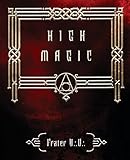
High Magic: Theory and Practice
Frater U.D. - Llewellyn Publications
View on AmazonHigh Magic in Historical Context
High Magic situates itself within a broad historical narrative of Western magical tradition that Frater U.D. traces with genuine scholarly care. His historical sections are not mere background but essential context for understanding why the practices he teaches take the forms they do. The LBRP is not an arbitrary sequence of gestures and words - it emerged from a specific historical tradition with specific philosophical assumptions, and understanding those assumptions makes the ritual both more comprehensible and more effective.
Frater U.D. is particularly good on the Renaissance period, when the synthesis of Kabbalah, Hermeticism, and natural magic produced the framework that the Golden Dawn later formalized. He discusses Ficino's translation of the Corpus Hermeticum (1463), Pico della Mirandola's synthesis of Platonic and Kabbalistic philosophy, Agrippa's Three Books of Occult Philosophy (1531), and John Dee's Enochian system as successive layers in the development of the modern Western magical tradition. This historical grounding distinguishes High Magic from books that present magical techniques as if they emerged from nowhere.
His treatment of the 19th-century occult revival - Eliphas Levi, the Golden Dawn, Aleister Crowley - is similarly thorough and historically precise. He acknowledges Levi's enormous influence while noting the significant ways in which Levi's historical claims (particularly about a continuous transmission of magical knowledge from ancient times) were mythological rather than historical. This kind of critical engagement with the tradition's own self-mythology is rare in practical magical literature and reflects Frater U.D.'s intellectual honesty.
How to Study High Magic
High Magic works best as a companion text rather than a sole guide for beginners. Practitioners who have already worked through Modern Magick or a similar practical course will find High Magic invaluable for deepening their theoretical understanding and broadening their practical repertoire. The theoretical sections in particular will make more sense to someone who has some practical experience with the rituals being discussed.
The sigil magic sections and the chaos magic material can be profitably studied independently by anyone curious about those approaches, regardless of their background in classical ceremonial magic. Frater U.D.'s presentation of sigil magic is one of the clearest and most practical in the literature, and the paradigm analysis is useful for any practitioner who wants to think clearly about what they are doing and why.
For those who want to go deeper into Frater U.D.'s work, High Magic II: Expanded Theory and Practice extends the coverage to include mirror magic, shamanism, magical orders, folk magic, and divination. Reading the two volumes together gives a comprehensive picture of his magical philosophy and practical approach.
Explore the Western Magical Tradition
The Hermetic Synthesis Course integrates the full Western esoteric lineage into a structured daily practice framework.
Explore the CourseFrequently Asked Questions
What is High Magic: Theory and Practice by Frater U.D.?
High Magic (Llewellyn, 2005) is a comprehensive introduction to Western ceremonial magic covering theory from ancient Egypt to chaos magic, and practice including the LBRP, sigil magic, planetary magic, and talisman work. Frater U.D.'s non-dogmatic, results-focused approach makes it valuable for intermediate practitioners wanting deeper theoretical grounding alongside practical technique.
Who is Frater U.D.?
Frater U.D. is a Belgian ceremonial magician and author considered Europe's most widely known contemporary practical magician. He has written more than twenty-five books and founded two magical currents: Pragmatic Magic and Ice Magic (Cybershaman). His work bridges Golden Dawn ceremonial tradition with chaos magic and contemporary magical philosophy.
What is Frater U.D.'s Pragmatic Magic approach?
Pragmatic Magic evaluates magical systems by practical results rather than doctrinal claims. A pragmatic magician uses whatever symbolic system works best for each task, drawing on multiple traditions without exclusive commitment to any one. This approach draws on chaos magic's insight that belief is a tool, applying it to the full range of Western ceremonial magic traditions.
What are the four magical paradigms in High Magic?
Frater U.D. describes four paradigms: the Spirit Paradigm (magic through interaction with independent beings), the Energy Paradigm (magic through subtle energy direction), the Psychological Paradigm (magic as unconscious reprogramming), and the Information Paradigm (magic as information transmission). Advanced practitioners work fluidly across paradigms, choosing the most useful for each situation.
Is High Magic suitable for beginners?
High Magic suits advanced beginners and intermediate practitioners. It assumes some familiarity with basic ceremonial concepts. Complete beginners are better served starting with Kraig's Modern Magick (a step-by-step course), then using High Magic for theoretical depth and alternative perspectives once they have practical experience with the core rituals.
How does High Magic treat sigil magic?
Frater U.D. presents Austin Osman Spare's sigil technique thoroughly: formulating the statement of intent, creating the abstract symbol, charging it through gnosis, and releasing it through forgetting. His treatment is both practically clear and philosophically informed, addressing why forgetting enhances effectiveness and how sigils work within different magical paradigms.
What is Ice Magic developed by Frater U.D.?
Ice Magic (Cybershaman) is Frater U.D.'s original magical system applying cybernetics and information theory to magical practice. It treats the magician's consciousness as a programmable system and magic as information transmission. It is his most theoretical contribution and shows the influence of contemporary science on his approach to magical practice.
How does High Magic compare to Modern Magick by Kraig?
Modern Magick is a structured step-by-step course specifically designed for beginners. High Magic covers more theoretical ground and includes chaos magic, cyber magic, and paradigm analysis that Kraig's more tradition-focused approach lacks. Frater U.D. brings a European perspective and deeper philosophical treatment. Many practitioners recommend working through both books at different stages.
What is High Magic: Theory & Practice by Frater U.D.?
High Magic: Theory & Practice (Llewellyn, 2005) by Frater U.D. is a comprehensive and contemporary introduction to ceremonial or ritual magic. It covers the theoretical foundations of high magic drawn from ancient Egypt, Greece, Rome, medieval Judaism, and Renaissance Hermeticism, alongside practical exercises including the LBRP, sigil magic, planetary magic, talisman work, and mantra magic. Frater U.D. presents the material in a modern, non-dogmatic framework that incorporates insights from chaos magic and contemporary magical philosophy.
Who is Frater U.D.?
Frater U.D. is the magical name of a Belgian ceremonial magician and author who prefers not to publish under his legal name. He is considered Europe's most widely known contemporary practical magician and has written more than twenty-five books on magic. He founded two currents of contemporary magic: Pragmatic Magic and Ice Magic (also called Cybershaman). His work is characterized by a non-dogmatic, results-oriented approach that draws on diverse traditions while remaining philosophically sophisticated.
What traditions does High Magic by Frater U.D. draw from?
High Magic draws from several Western esoteric traditions: the Golden Dawn ceremonial system (LBRP, elemental magic, planetary magic), Eliphas Levi's theoretical framework (astral light, will and imagination), chaos magic (sigil work, paradigm shifting), the Hermetic-Kabbalistic synthesis of the Renaissance, and ancient Egyptian magical practices. Frater U.D.'s approach is notably eclectic and non-sectarian, treating different magical systems as complementary tools rather than competing absolutes.
What is Frater U.D.'s Pragmatic Magic approach?
Pragmatic Magic is a magical philosophy developed by Frater U.D. that evaluates magical systems by their practical results rather than their doctrinal claims. A pragmatic magician uses whatever symbolic system produces the best results for a given purpose, rather than committing exclusively to one tradition. This approach draws on chaos magic's insight that belief itself is a tool - that a magician who believes in a system while using it produces better results than one who approaches it skeptically - but applies this insight to the full range of Western ceremonial magic traditions.
How does High Magic compare to Modern Magick by Kraig?
Both books provide practical introductions to Western ceremonial magic, but with different emphases. Modern Magick is more structured as a step-by-step course with twelve sequential lessons. High Magic by Frater U.D. covers more theoretical ground and includes material on chaos magic, cyber magic, and contemporary magical paradigms that Kraig's more tradition-focused approach does not. Frater U.D. also brings a distinctively European (rather than American) perspective and a more philosophical treatment of magical theory. Many practitioners recommend both books.
What is sigil magic as taught in High Magic?
Sigil magic, a technique popularized by chaos magician Austin Osman Spare, involves creating a symbolic representation of a magical intention, charging it with focused will and visualization, and then releasing it from conscious attention to allow it to work in the unconscious and astral planes. Frater U.D.'s presentation of sigil magic in High Magic draws both on Spare's approach and on the broader tradition of talismanic magic from medieval grimoires and Golden Dawn practice.
What is Ice Magic developed by Frater U.D.?
Ice Magic (also called Cybershaman) is a magical system developed by Frater U.D. that applies cybernetic and systems-theory concepts to magical practice. It treats the magician's consciousness as a system that can be programmed and reprogrammed through ritual and intention, drawing on information theory and computer science as metaphors for how magical operations work. It represents Frater U.D.'s most original theoretical contribution and shows the influence of contemporary science on his thinking.
Is High Magic suitable for beginners?
High Magic is suitable for advanced beginners and intermediate practitioners. It assumes some familiarity with basic concepts (LBRP, Kabbalah, elemental attributions) and is more philosophical and theoretical than a pure beginner text like Modern Magick. First-time students of ceremonial magic often do better starting with Kraig's Modern Magick, which is specifically designed as a step-by-step course for complete beginners, and then moving to Frater U.D. for deeper theoretical background and alternative perspectives.
What does Frater U.D. say about magical paradigms?
Frater U.D. introduces the concept of magical paradigms - coherent world-view frameworks within which magical operations are understood to work. Different magical traditions operate within different paradigms: the spirit model (magic works through interaction with independent spiritual beings), the energy model (magic works through subtle energies directed by will), the psychological model (magic works by altering the practitioner's own consciousness), and the information model (magic works by transmitting information through quantum or cybernetic channels). He argues that a sophisticated magician can work within multiple paradigms, choosing the most useful one for each situation.
How does High Magic treat planetary magic?
Frater U.D. devotes substantial attention to planetary magic - the use of the seven classical planets (Saturn, Jupiter, Mars, Sun, Venus, Mercury, Moon) as organizing principles for magical operations. Each planet is associated with a sephirah on the Tree of Life, specific divine names and angelic beings, colors, metals, plants, days of the week, and types of magical intent. Planetary magic works by aligning a ritual operation with the planetary force appropriate to its purpose. Frater U.D. draws on both traditional grimoire sources and modern Golden Dawn approaches to present a working system.
Sources and References
- Frater U.D. High Magic: Theory and Practice. Llewellyn Publications, 2005.
- Carroll, Peter J. Liber Null and Psychonaut. Weiser Books, 1987.
- Spare, Austin Osman. The Book of Pleasure (Self-Love): The Psychology of Ecstasy. 1913.
- Agrippa, Heinrich Cornelius. Three Books of Occult Philosophy. Trans. James Freake. Llewellyn Publications, 1993.
- Regardie, Israel. The Golden Dawn: The Original Account of the Teachings, Rites, and Ceremonies of the Hermetic Order. Llewellyn Publications, 2002.
- Hanegraaff, Wouter J. Esotericism and the Academy: Rejected Knowledge in Western Culture. Cambridge University Press, 2012.