
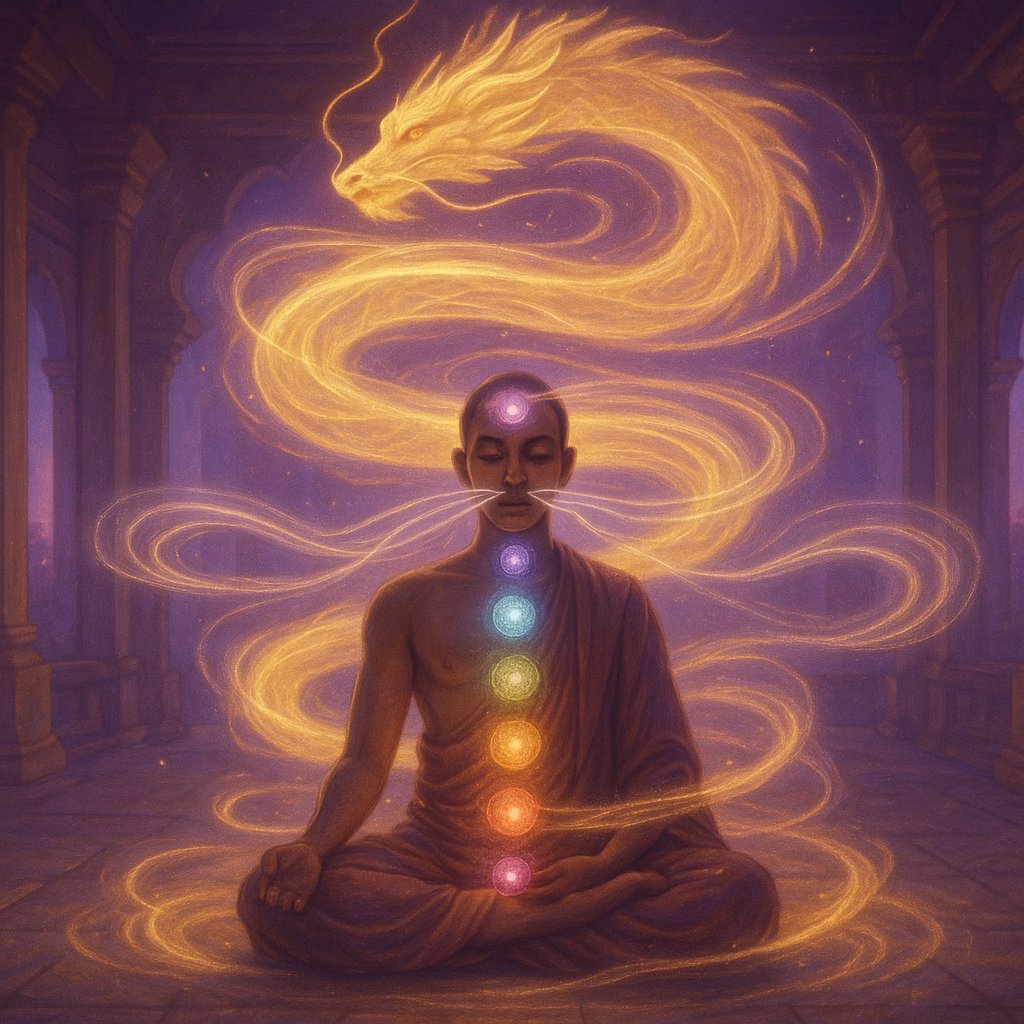
Dragon energy meditation encompasses a family of practices drawn from Taoist neigong, Tibetan Vajrayana, Jungian active imagination, and contemporary symbolic work - all using the dragon as an archetypal vehicle for accessing expanded states of awareness, moving stagnant energy, and engaging the deeper layers of the psyche. This guide provides step-by-step instructions for several distinct approaches, from beginners to advanced practitioners, with cultural context and safety guidance throughout.
Last updated: March 15, 2026
What Is Dragon Energy in Meditation?
The phrase "dragon energy" is used in several distinct ways across different traditions, and it is worth distinguishing them before beginning practice.
In Taoist internal cultivation (neigong), dragon energy refers literally to a quality of qi movement in the body - a spiralling, ascending, and penetrating energy associated with the Wood element, spring, and the liver-gallbladder organ system. The Dragon is one of the four directional animals of Chinese cosmology (along with the Tiger, Phoenix, and Tortoise), associated with the East, the rising sun, and the quality of purposeful, upward-moving vitality. Working with "dragon energy" in this context means directing qi to move in specific spiralling patterns through the body's meridian system.
In Tibetan Vajrayana, the druk (dragon) is one of four dignities - fundamental qualities of awakened mind expressed through natural imagery. The druk represents all-pervasive awareness, the quality of mind that is simultaneously everywhere and nowhere, filling space without resistance. Dragon meditation in this context involves recognising and embodying this quality of awareness rather than directing energy through the body.
In Jungian depth psychology, dragon energy means the power of the psyche's unconscious layer - the same force that manifests as threat in unintegrated form and as vitality, creativity, and wisdom in integrated form. Active imagination with dragon figures in this framework means deliberately entering a dialogue with the unconscious dragon rather than avoiding or suppressing it.
In contemporary symbolic and shamanic work, dragon energy meditation draws from all of the above, combining them with practitioners' individual experience and creative engagement with the archetype. This synthesis tradition is less doctrinally precise but often genuinely effective, provided practitioners maintain appropriate discernment about what they are actually doing.
- Dragon energy meditation draws from Taoist, Tibetan, Jungian, and contemporary traditions - each with different goals and methods
- Taoist approaches work with actual qi movement in the body; Vajrayana approaches work with awareness qualities; Jungian approaches work with archetypal dialogue
- Grounding practices and stable daily routine provide essential safety context for intense dragon energy work
- Crystals amplify specific qualities of dragon work - dragon's blood jasper for integration, obsidian for shadow work, labradorite for expanded awareness
Taoist Neigong: Dragon Currents in the Body
Taoist internal cultivation has worked with dragon symbolism for at least two thousand years, drawing on classical Chinese cosmological thought to map the movement of vital energy through the body. The Dragon (Qing Long, the Azure Dragon) governs the East, the liver-gallbladder system, the season of spring, the Wood element, and the quality of clear, purposeful vision and decisiveness.
In neigong practice, the Dragon current is associated with the ascending pathway of energy from the perineum up the spine and out through the crown - a spiralling, penetrating movement analogous to the Taoist image of a dragon ascending from deep water into the sky. This corresponds to what yogic traditions call the Sushumna pathway and what contemporary energy work calls the central channel. The Dragon quality of this ascending energy is specific: it is not the passive, feminine, descending energy of yin, but the active, penetrating, clarifying energy that seeks the light.
The White Tiger governs the West, the lung-large intestine system, and the descending, consolidating movement of energy through the body's front. Dragon (ascending/rising) and Tiger (descending/settling) together describe the fundamental yin-yang rhythm of breath and circulation. Many Taoist neigong practices involve working with both simultaneously - the Dragon rising while the Tiger grounds, creating a functional energy circuit rather than a one-directional movement.
For practitioners without formal Taoist training, the principle can be approached directly: cultivating awareness of an upward-spiralling, penetrating quality of energy moving along the spine during inhalation, and a settling, distributing quality moving through the front of the body during exhalation. Over time, this develops into a tangible kinesthetic awareness rather than a purely imaginative exercise.
Tibetan Vajrayana: The Druk and the Dignities
The four dignities of Tibetan Vajrayana - Garuda (wind, space), Snow Lion (earth, clarity), Tiger (water, discriminating awareness), and Druk/Dragon (fire, all-pervasive awareness) - are not primarily mythological creatures in this context but personifications of fundamental qualities of awakened mind. They appear in thangka paintings and are worked with through deity yoga practices transmitted within specific lineages.
The Druk represents the quality of mind that is simultaneously present everywhere without being anywhere in particular - all-pervasive awareness that does not exclude anything from its embrace. This quality of the dragon's awareness corresponds in Dzogchen terms to rigpa: the natural state of mind before conceptual elaboration, primordially awake and undistracted.
Working with the Druk in Vajrayana context requires proper empowerment and instruction from a qualified teacher. However, the quality the dragon represents - all-pervasive, non-excluding, simultaneously present and unlocated awareness - can be pointed to through direct instruction and is recognisable in moments of genuine meditative openness without specifically requiring dragon visualisation. When the practitioner's awareness expands to include the full sensory field without preference, without a centre that is "here" and a periphery that is "there," the quality of Druk awareness is present.
Jungian Active Imagination with Dragon Archetypes
Marie-Louise von Franz described active imagination as "the royal road to the unconscious" - the technique through which Jung himself did much of his most intensive inner work. Applied to dragon archetypes, it offers a direct method for engaging the shadow material the dragon guards.
The preconditions for productive active imagination with a dragon figure: a relatively stable ego (not in acute crisis); some capacity to tolerate ambiguity and surprising material; a private, undisturbed space; and a way to record what emerges (written journal, voice recording, drawing).
The process differs from ordinary meditation in a specific way: the meditator is not seeking stillness or the dissolution of thought, but active engagement with what arises. The dragon figure is approached as a real presence with its own perspective, not as a object of contemplation. This relational quality is what distinguishes active imagination from visualisation and from ordinary fantasy.
Five Practical Dragon Meditation Techniques
The following five techniques move from gentler to more intensive, covering the main modalities of dragon energy work accessible to independent practitioners.
Dragon Fire Breath Practice
Tradition: Taoist / yogic hybrid
Duration: 10-20 minutes
Preparation: Sit cross-legged or in a chair, spine upright. Spend 3-5 minutes in natural breath awareness to establish a stable baseline.
Practice: Begin with three long, slow complete breaths - full inhalation expanding the belly and chest, full exhalation contracting from the belly upward. Then begin Dragon Fire Breath: inhale through the nose (approximately 2 seconds), exhale forcefully through the mouth in a "HAH" sound (approximately 1 second). The exhalation is powered by the abdominal muscles pressing in and up. Maintain a strong, rhythmic quality - not rushed, but decisive. Complete 10 cycles, then rest in natural breath for a full minute.
During the active rounds, hold the image of a dragon exhaling fire - not destructive fire but clarifying, illuminating fire. The breath is the dragon's breath; you are the dragon breathing, not the practitioner visualising a dragon. This identification is part of what distinguishes this practice from simple pranayama.
Complete 3 rounds of 10 with 1-minute rest intervals. After the final round, sit in complete silence for 10 minutes, noting what qualities of awareness are present.
Contraindications: Not suitable for people with cardiovascular conditions, high blood pressure, epilepsy, or pregnancy. If dizziness occurs, stop and return to natural breath immediately.
Dragon Spine Activation
Tradition: Taoist neigong
Duration: 20-30 minutes
Preparation: Begin lying on your back, knees bent, feet flat on the floor. Allow the natural weight of the spine to settle fully on the ground. Take 5 minutes in body scanning from feet to crown, releasing any held tension.
Practice: Bring attention to the base of the spine - the sacrum, the coccyx, the root. Begin to breathe into this area, imagining the breath descending all the way to the root on each inhalation. On each exhalation, imagine a slight upward movement of energy from the root, like a small ascending spiral.
Gradually extend the ascending spiral upward on each breath - first to the lower back, then the mid-back, then the thoracic spine, then the neck and finally the crown. This ascent takes approximately 10-12 minutes when done without rushing. Imagine the spiral as a dragon ascending - not threatening but purposeful, moving with the quality of clear water finding its natural course upward.
At the crown, allow the energy to fountain outward and descend along the front of the body, returning to the root. This creates the complete circuit: Dragon ascending the spine, distributing down through the front. Hold the complete circuit in awareness for 5 minutes.
Close by bringing hands to the lower belly and resting attention there for 2-3 minutes, consolidating the activated energy at its root before returning to ordinary activity.
Shadow Dragon Encounter
Tradition: Jungian active imagination
Duration: 30-45 minutes
Preparation: Journal briefly (5 minutes) before the session: what is most triggering you in your life right now? What quality in others most provokes your strongest reactions? This material may be related to what the shadow dragon is guarding.
Practice: Sit comfortably with eyes closed. Allow the room to fade and instead bring to mind a cave entrance - the setting is not important, but it should feel genuinely dark and enclosed, with the sense of depth behind the entrance. Allow yourself to be present at the entrance without entering for several minutes. Notice any feelings of fear, reluctance, or resistance. These are information about what lies within.
When ready, step inside. Allow the cave to define itself - its size, the quality of the darkness, the temperature, any sounds. Move deeper, not rushing. At some point, you will encounter a presence - it may be a dragon explicitly, or it may be a large animal, a dark figure, or simply a sense of enormous power in the darkness.
Do not flee and do not attack. Stand still. Acknowledge the presence directly: "I see you. I am here." Then ask: "What is your name?" and "What are you guarding?" Allow the responses to arise without directing them. Record the entire dialogue as accurately as possible in your journal immediately after the session.
The quality of the encounter is more important than its content. A shadow dragon encounter that produces fear, resistance, and unexpected material is probably more productive than one that produces comfortable, predictable imagery.
The Protective Dragon Meditation
Tradition: East Asian / contemporary synthesis
Duration: 15-20 minutes
Use context: Before situations requiring courage, clarity, or self-protection
Practice: Sit with spine upright. Bring awareness to the field around your body - the space extending approximately an arm's length in all directions. Imagine this space inhabited by a dragon presence: not threatening but attendant, coiled around your energetic field with its gaze directed outward.
The protective dragon does not attack on your behalf; it is present as a guardian quality - a clarity and power that is simply there, undeniable, requiring no aggressive assertion. As you hold this sense, notice any places where your ordinary sense of self-protection feels weak or anxious. Allow the dragon's steadiness to occupy those places.
This practice is less about summoning an external entity than about accessing an inner quality - the aspect of the self that is genuinely powerful, that does not need to prove itself, that is simply and clearly present. The dragon is a symbol for this quality; working with the symbol develops access to the actual quality.
Dragon Dream Incubation
Tradition: Jungian / shamanic synthesis
Duration: Ongoing (pre-sleep practice)
Dream incubation is the ancient practice of intentionally directing the dream toward a specific question or encounter. Applied to dragon work, it involves setting a clear intention before sleep to encounter a dragon figure and pay close attention to what the encounter reveals.
Pre-sleep ritual: Before lying down, spend 5 minutes in quiet sitting. State your intention clearly - either aloud or in writing in your dream journal: "Tonight I am open to encountering a dragon in my dream. I am willing to face what it shows me." Place a dragon image, a piece of dragon's blood jasper, or another resonant object on your bedside table as a physical anchor for the intention.
Upon waking: Record any dream content immediately, before moving or speaking. Even fragments are valuable. Pay particular attention to the qualities of any large, powerful, or threatening figures - including those that are not literally dragons but carry a similar energetic quality.
Over time, a series of dragon dream encounters builds a narrative of inner development that is often more revealing than any single session of deliberate active imagination. The unconscious, invited to show its dragon, will do so in its own time and in its own way.
Safety and Grounding Considerations
Dragon energy work, particularly shadow dragon encounter and fire breath practices, can produce strong physiological and psychological effects. The following grounding practices provide essential support:
Before intense sessions: Eat a small grounding meal (root vegetables, protein, dense grain) 1-2 hours before practice. Avoid these practices when significantly sleep-deprived, emotionally destabilised, or in active life crisis.
After intense sessions: Physical grounding activities - walking barefoot on earth or grass, pressing hands firmly against a solid surface, slow deliberate eating, or a brief cold water splash on face and hands - help consolidate and settle activated energy. Journaling what was experienced anchors the material in conscious awareness rather than leaving it floating unintegrated.
Signs to pause or stop: Persistent visual disturbance, tingling that does not resolve within minutes of completing practice, strong anxiety that does not settle after grounding, or material arising that feels overwhelming or destabilising beyond what ordinary self-care can address. In any of these cases, consulting with an experienced practitioner (Jungian therapist, experienced meditation teacher, or integrative health practitioner) is appropriate.
Crystal Support for Dragon Meditation
Specific crystals serve as tangible anchors for different qualities of dragon energy work:
Dragon's Blood Jasper: The most directly resonant stone for dragon energy work. Its deep green base (Dragon's colour in the East Asian tradition) with red veining (fire, vital energy) encodes both the body and the fire of the dragon. Place in the meditation space or hold during protective dragon practice.
Obsidian: For shadow dragon encounter work. Obsidian's mirror quality supports honest self-reflection; its protective properties provide safety during engagement with shadow material. Particularly useful as a focal point before entering the cave in the shadow dragon meditation.
Labradorite: For dream dragon work and active imagination. Its shifting colour play mirrors the quality of inner vision - the way archetypal images present unexpected dimensions when viewed from different angles. Labradorite supports the expanded perception required for genuine active imagination.
Ruby or Garnet: For dragon fire breath and any practice requiring courage and vital energy. The deep red of these stones resonates with the fire element and supports the willingness to engage that intense dragon practices require.
Clear Quartz: For amplifying and clarifying any of the above practices. A clear quartz point placed in front of the meditation position amplifies whatever energy is being worked with and supports mental clarity during complex inner experiences.
Thalira's crystal collections include dragon's blood jasper, obsidian, labradorite, and all the stones described above. The Sacred Geometry Collection offers crystal spheres and merkaba forms that serve as powerful anchors for meditation work, including dragon energy practices where the sphere's all-directional presence mirrors the dragon's all-pervasive awareness.
Awaken Healing Energy Through The Tao: The Taoist Secret of Circulating Internal Power by Mantak Chia
View on AmazonAffiliate link, your purchase supports Thalira at no extra cost.
Frequently Asked Questions
What is dragon energy meditation?
Dragon energy meditation is a broad term covering a range of practices that work with the dragon as an archetypal symbol and energetic presence in meditation. These include Taoist practices that work with the dragon as a metaphor for qi (life force) moving through the body, Tibetan Vajrayana practices working with dragon deities, Jungian active imagination engaging dragon figures from the unconscious, and contemporary energy work that uses dragon symbolism as a vehicle for accessing expanded states.
Is dragon energy meditation safe?
Dragon energy meditation practices, like all deep meditation work, should be approached with appropriate preparation and care. Beginning practitioners should start with gentler practices (breath awareness, body scanning) before moving to intense visualisation work. Practices involving intense fire breathing or kundalini-style energy activation can produce strong physiological effects and are best learned with experienced guidance. Grounding practices and a stable daily routine provide important safety context.
How does Taoist dragon energy practice differ from visualisation meditation?
Taoist neigong (inner cultivation) practices working with dragon symbolism are not purely visualisation - they involve actual movement of qi through the meridian system, with dragon imagery serving as a guide for directing internal energy. The dragon is felt as a quality of energy movement in the body, not merely imagined as an external image. This embodied quality distinguishes genuine neigong from purely imaginative visualisation.
What is the Tibetan dragon in Vajrayana practice?
In Tibetan Buddhism and Bon, the druk (dragon) is one of the four dignities - powerful archetypal qualities associated with natural elements and states of awakening. The dragon represents the quality of all-pervasive awareness and the indestructible nature of mind. Working with the dragon in Vajrayana context typically occurs within the framework of empowerment, deity yoga, and the specific visualisation practices transmitted from teacher to student.
How can I use active imagination to work with a dragon figure?
Active imagination with a dragon figure involves: relaxing in a meditative state, allowing a dragon image to form without directing it consciously, then engaging the figure as if it were real - asking its name, its purpose, what it guards, what it wants. The conscious ego remains present and observing, but does not control the figure's responses. Recording the dialogue in a journal afterward helps integrate what emerges.
What is the dragon fire breath practice?
Dragon fire breath is a practice derived from Taoist and yogic traditions that uses forceful exhalation through the mouth to generate heat, clear stagnant energy, and activate the body's vital force. Unlike aggressive hyperventilation, it is performed in controlled rounds with recovery periods. It should not be practised by people with cardiovascular conditions, during pregnancy, or without grounding support nearby.
Can dragon energy meditation help with shadow work?
Yes - dragon energy meditation and shadow work are deeply complementary. The dragon as an archetype naturally carries the qualities of the psychological shadow: ancient, powerful, guarding hidden treasure, requiring direct engagement rather than avoidance. Active imagination with dragon figures often surfaces shadow material that is difficult to access through verbal or conceptual approaches alone. Many Jungian practitioners incorporate dragon imagery explicitly into shadow work.
What is the best time of day for dragon energy meditation?
Traditional Taoist teaching associates the dragon with the Wood element and with spring and dawn - times of upward-moving, expanding energy. Early morning practice (between 5:00 and 7:00 AM in the Taoist horary system) is considered optimal for working with the ascending, clarifying quality of dragon energy. Evening practice before sleep can be used for the dream-catalysing dimension of dragon work, but grounding practice afterward is recommended.
How do I know if I am working with a genuine inner dragon archetype or just imagination?
The distinction between 'genuine archetype' and 'just imagination' is less clear than it might seem - Jung's view was that the distinction is not between real and imaginary but between autonomous (arising with its own character and unpredictability) and directed (controlled by the conscious mind). If your dragon figure consistently surprises you, shows qualities you did not consciously choose, and produces genuine learning, you are working with genuine archetypal material.
What crystals amplify dragon energy meditation?
Crystals that amplify dragon energy work include: dragon's blood jasper (direct dragon energy resonance), labradorite (interdimensional awareness and archetypal access), obsidian (shadow dragon engagement), ruby or garnet (the fire element and courage), and clear quartz (amplification of whatever energy is present). Black tourmaline provides grounding support during intense practices.
Sources and Further Reading
- Jung, C.G. (1997). Visions: Notes of the Seminar Given in 1930-1934. Princeton University Press.
- Von Franz, M-L. (1980). On Active Imagination. Inner City Books.
- Chia, M. (1983). Taoist Ways to Transform Stress into Vitality. Healing Tao Books.
- Norbu, N. (1993). The Crystal and the Way of Light. Snow Lion Publications.
- Trungpa, C. (1984). Shambhala: The Sacred Path of the Warrior. Shambhala Publications.
- Johnson, R.A. (1986). Inner Work: Using Dreams and Active Imagination for Personal Growth. HarperCollins.