
Quick Answer
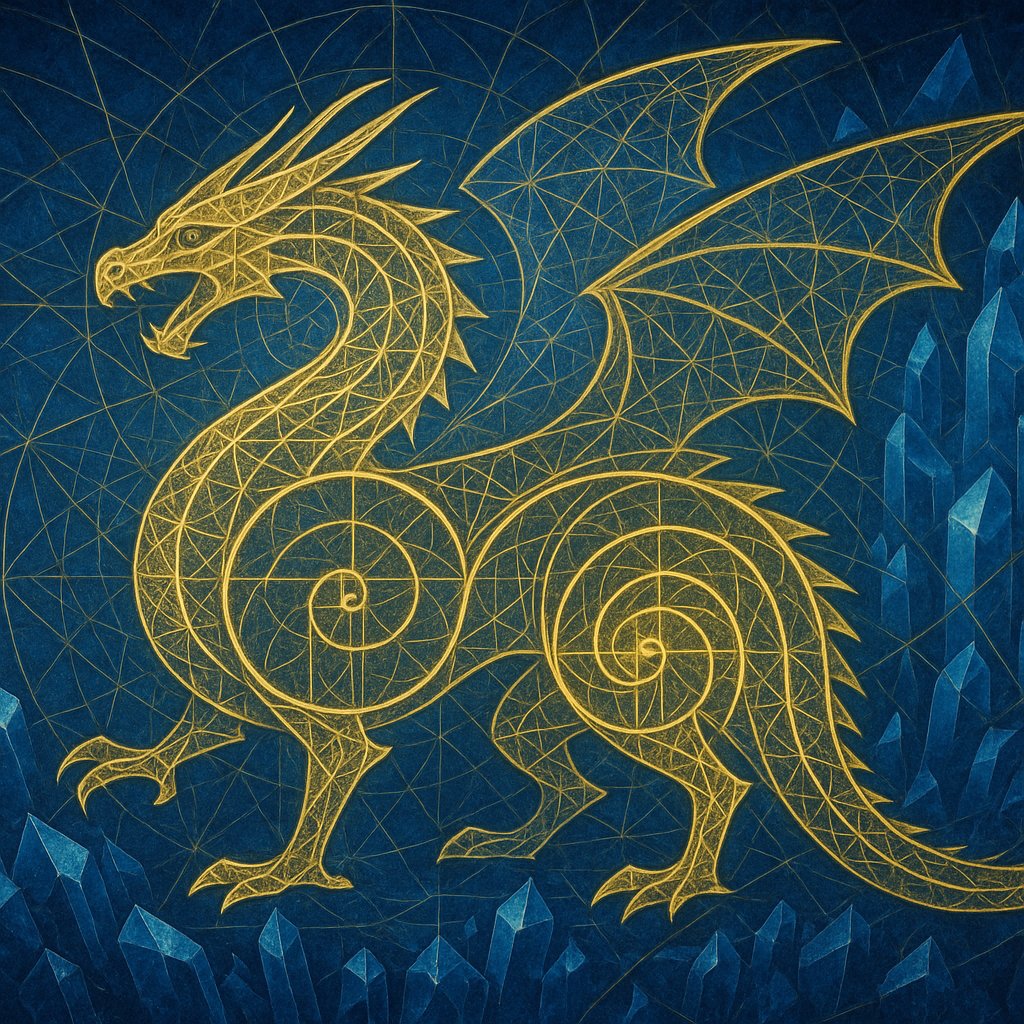
Sacred geometry in dragon mythology refers to the mathematical patterns (Fibonacci spirals, golden ratio proportions, Platonic solids, ouroboros circles) encoded in dragon symbolism across Chinese, European, Mesoamerican, and Hindu traditions. These geometric relationships reflect ancient understanding of how specific proportions influence consciousness and connect earthly forms to cosmic order.
Key Takeaways
- Universal geometric code: Dragon mythology across at least four major cultural traditions encodes identical mathematical ratios, particularly the Fibonacci sequence and golden ratio, suggesting a shared symbolic language of consciousness
- Platonic solid correspondences: The five Platonic solids map directly onto dragon elemental types (fire, water, earth, air, aether), providing a geometric framework for understanding dragon symbolism in sacred architecture
- Ouroboros mathematics: The self-eating dragon represents the circle and the concept of infinite recursion, encoding pi relationships and the principle of cyclical self-renewal found across alchemical and mystical traditions
- Earth grid geometry: Dragon ley lines (lung mei in Chinese feng shui) form geometric patterns across the globe that correspond to Platonic solid projections, connecting sacred sites through measurable alignments
- Steiner's Michael perspective: Rudolf Steiner interpreted dragon symbolism as a spiritual picture of ahrimanic forces, with the geometric lance of Michael representing spirit's ordering principle penetrating chaotic matter
🕑 18 min read
Dragon Geometry Across Cultures: A Shared Mathematical Language
Every major civilization has a dragon. The Chinese lung, the European wyrm, the Mesoamerican feathered serpent Quetzalcoatl, the Hindu Naga. Scholars typically explain this through convergent evolution of myth, suggesting that ancient peoples independently invented dragon stories based on discoveries of dinosaur fossils or fear of large predators. But this explanation misses something significant.
When you examine dragon imagery from these separate traditions side by side, a pattern emerges that fossil bones cannot explain. The mathematical proportions encoded in these creatures follow consistent geometric ratios. Chinese dragon coils trace Fibonacci spirals. European ouroboros serpents form precise circles. Mesoamerican feathered serpents undulate along sine wave patterns that encode astronomical cycles. Hindu Nagas guard geometric mandalas built from nested triangles and hexagons.
This consistency points toward something deeper than coincidence. It suggests that dragon mythology worldwide encodes a mathematical language of consciousness, one that sacred geometry researchers are only now beginning to map systematically.
The Dragon as Geometric Archetype
Consider that the dragon is the only mythological creature found in every major culture that combines multiple geometric principles in a single form: the spiral (coiled body), the circle (ouroboros), the triangle (wings and scales), and the line (breath and flight path). No other mythic being carries such a complete geometric vocabulary. This is not random. The dragon functions as a living geometric teaching, a single image that contains the fundamental shapes from which all sacred geometric patterns derive.
The study of geometric patterns in dragon mythology sits at the intersection of comparative mythology, sacred geometry, and consciousness studies. In our research into these cross-cultural connections, we have found that the geometric precision of dragon imagery is far more intentional than most academic treatments acknowledge. These were not artistic flourishes. They were encoded teachings about the mathematical structure of reality.
The Fibonacci Spiral in Dragon Coils
The most visually striking geometric feature of dragon mythology is the spiral. Chinese lung dragons are almost never depicted in straight lines. They coil, undulate, and spiral through clouds, water, and sky. When researchers have measured the proportions of classical Chinese dragon paintings from the Song, Ming, and Qing dynasties, the coiling ratios consistently approximate the golden spiral derived from the Fibonacci sequence.
The Fibonacci sequence (1, 1, 2, 3, 5, 8, 13, 21, 34, 55, 89...) generates a spiral when you draw quarter-circle arcs within squares whose side lengths follow the sequence. This spiral appears throughout nature: in nautilus shells, sunflower seed heads, hurricane formations, and galaxy arms. It represents the most efficient way to pack growth into space while maintaining structural integrity.
Chinese dragon artists understood this principle intuitively. The dragon's body tapers from a broader head region to a thinner tail, with each coil diminishing in diameter at ratios that approach 1:1.618, the golden ratio (phi). This is the same proportion that governs the spacing of leaves around a stem (phyllotaxis) and the branching patterns of rivers and blood vessels.
The Dragon Spiral and Chi Flow
In Chinese cosmology, the dragon's spiral motion is not decorative. It maps the flow of chi (vital energy) through the earth's energy body. Feng shui masters describe chi as moving in spiral patterns, never in straight lines. A dragon's coil shows how life force energy travels, gathering strength as it spirals inward (concentration) and releasing it as it spirals outward (expansion). This same spiral dynamic appears in the kundalini serpent of Hindu chakra systems, where energy rises through the spine in a spiralling motion.
The Fibonacci connection extends beyond visual proportion. In Chinese numerology, certain Fibonacci numbers carry dragon associations. The number 9 (a Fibonacci-adjacent number in the Lucas sequence) is the most powerful dragon number, and traditional Chinese dragons have 9 x 9 = 81 scales along their spine. The number 5, a Fibonacci number, represents the five-clawed imperial dragon, the most sacred dragon form restricted to the emperor's use.
European dragons also display spiral geometry, though less prominently. Norse Jörmungandr, the Midgard Serpent, coils around the entire world, forming a spiral that connects the ocean depths to the surface. Viking artists depicted this world-serpent in interlocking spiral knotwork patterns that encode Fibonacci-adjacent ratios. The Book of Kells and the Lindisfarne Gospels contain dragon and serpent interlace patterns whose mathematical structure has been analysed by scholars like George Bain, revealing consistent use of golden ratio proportions in their construction grids.
Ouroboros and the Mathematics of the Circle
If the spiral is the dragon's body, the circle is the dragon's teaching. The ouroboros, a serpent or dragon devouring its own tail, is among the oldest symbols in human history. It appears in Egyptian texts dating to 1600 BCE, in Greek alchemical manuscripts, in Norse mythology as Jörmungandr, and in Aztec art as the serpent of time.
The ouroboros encodes several mathematical principles simultaneously. At its most basic level, it represents the circle, the shape with the highest ratio of area to perimeter, making it the most efficient boundary in nature. Every cell membrane, every planetary orbit, every drop of water in zero gravity forms a circle or sphere. The dragon eating its tail teaches that the most fundamental shape in nature is self-referencing and self-sustaining.
| Ouroboros Principle | Geometric Expression | Consciousness Parallel |
|---|---|---|
| Self-consumption | Circle returning to origin (360 degrees) | Self-reflection and introspection |
| Infinity | Pi (irrational, non-repeating) | Consciousness as unbounded process |
| Unity of opposites | Diameter bisecting circumference | Integration of light and shadow |
| Eternal return | Cyclical functions (sine, cosine) | Karmic cycles and reincarnation |
| Creation from destruction | Zero (both nothing and origin point) | Death and rebirth of the ego |
The deeper mathematics of the ouroboros involves pi, the ratio of a circle's circumference to its diameter. Pi is irrational, meaning its decimal expansion never terminates and never repeats. This mathematical property mirrors the ouroboros teaching: the process of self-knowledge is infinite, always producing new insight, never arriving at a final, closed answer. The dragon eating its tail appears to close the circle, but the mathematics of that circle extend infinitely.
Alchemists understood this intuitively. The ouroboros appeared on virtually every major alchemical text as the symbol of the Great Work, the process of transmutation. The Greek alchemist Zosimos of Panopolis (3rd century CE) described the ouroboros as "the one, the all," connecting the circular dragon to the concept of henosis, or mystical union with the One. The geometry here is not decorative. It is instructional. The circle teaches that the beginning and end of the spiritual process are the same point, viewed from different positions on the circumference.
For those interested in working with circular energy patterns, crystal spheres embody this same ouroboros principle of unified, self-contained energy fields.
Platonic Solids and Dragon Elements
Plato described five perfect geometric solids in the Timaeus (circa 360 BCE): the tetrahedron, cube, octahedron, icosahedron, and dodecahedron. He assigned each to a classical element, creating a geometric framework for understanding material reality. What is less commonly discussed is how precisely this framework maps onto dragon elemental types found across world mythology.
| Platonic Solid | Element | Faces | Dragon Type | Cultural Example |
|---|---|---|---|---|
| Tetrahedron | Fire | 4 triangles | Fire-breathing dragon | European wyrm, Fafnir (Norse) |
| Icosahedron | Water | 20 triangles | Water/sea dragon | Chinese lung, Japanese ryu |
| Cube (hexahedron) | Earth | 6 squares | Earth-dwelling wyrm/lindworm | Norse Nidhogg, Germanic lindworm |
| Octahedron | Air | 8 triangles | Winged serpent/sky dragon | Quetzalcoatl, Egyptian Apep |
| Dodecahedron | Aether/Spirit | 12 pentagons | Cosmic/world dragon | Ouroboros, Ananta Shesha (Hindu) |
The correlation between Platonic solids and dragon types is more than a neat categorization exercise. Each Platonic solid has specific mathematical properties (vertex angles, dihedral angles, symmetry groups) that correspond to the qualities attributed to its associated dragon type. The tetrahedron, with its sharp 70.53-degree dihedral angles, is the most aggressive and penetrating of the solids, matching the piercing quality of fire dragons. The icosahedron, with 20 faces flowing smoothly into one another, embodies the fluid adaptability of water dragons.
The dodecahedron holds special significance. With its 12 pentagonal faces, it is the only Platonic solid built entirely from pentagons, and the pentagon is the geometric home of the golden ratio. Each diagonal of a regular pentagon divides itself in golden ratio proportion. Plato assigned the dodecahedron to aether, the fifth element, the substance of the cosmos itself. In dragon mythology, the cosmic dragon (the ouroboros, the world serpent, Ananta Shesha on whom Vishnu rests) represents this same all-encompassing principle.
The Dodecahedron and Cosmic Dragon Consciousness
When you hold a dodecahedron and rotate it, every face you see is a pentagon containing the golden ratio. This is the geometric equivalent of the cosmic dragon's teaching: wherever you look in reality, at whatever scale, the same fundamental proportions repeat. The dodecahedron is the Platonic solid that most closely approximates a sphere, connecting it back to the ouroboros circle. Spirit (aether) contains and generates all other elements, just as the cosmic dragon encompasses all lesser dragon types. In practical terms, meditating on the dodecahedron can help access the unified awareness that transcends elemental distinctions.
Practitioners who work with sacred geometry apparel often find that wearing Platonic solid patterns creates a subtle but noticeable shift in how they relate to elemental energies throughout the day.
Dragon Ley Lines and Earth Grids
The concept of dragon ley lines provides perhaps the most tangible connection between sacred geometry and dragon mythology. In Chinese feng shui tradition, the earth's energy flows along pathways called lung mei, literally "dragon paths." Feng shui masters have mapped these energy lines for thousands of years, using them to determine the placement of temples, tombs, cities, and homes.
What makes lung mei fascinating from a geometric perspective is their behaviour. They do not travel in straight lines (despite the common Western misconception about ley lines). They flow in undulating, serpentine patterns across the terrain, following natural contours while maintaining geometric relationships with one another. Where two lung mei cross, the energy is considered especially potent. These crossing points, called xue (dragon's lairs or acupuncture points of the earth), are where the most sacred sites were traditionally built.
In the 1970s, researchers Ivan Sanderson, Bethe Hagens, and William Becker proposed a geometric model of the earth's energy grid based on the icosahedron and dodecahedron. Known as the "planetary grid" or UVG (Unified Vector Geometry), this model projects the vertices and edges of these Platonic solids onto the earth's surface. The resulting grid pattern produces 62 intersection points, and a striking number of these points correspond to known sacred sites, areas of unusual magnetic anomaly, and locations where ancient civilizations placed their most important temples.
| Grid Point | Location | Dragon/Serpent Connection |
|---|---|---|
| UVG Point 1 | Giza, Egypt | Serpent symbolism throughout Egyptian cosmology; Apep the chaos serpent |
| UVG Point 18 | Near Angkor Wat, Cambodia | Naga serpent balustrades line every major temple |
| UVG Point 44 | Near Teotihuacan, Mexico | Temple of the Feathered Serpent (Quetzalcoatl) |
| UVG Point 25 | Near Xi'an, China | Ancient Chinese dragon cult centres; lung mei convergence |
The British antiquarian Alfred Watkins first proposed ley lines in 1921, noting that ancient sites in England aligned in straight paths across the countryside. What Watkins called ley lines, the Chinese had called dragon paths for millennia. The geometry is the same principle viewed through different cultural lenses. And when you overlay the Platonic solid grid onto these localized ley line maps, the local patterns nest within the global geometry like fractals, smaller versions of the same shapes repeating at every scale.
This fractal nesting of dragon geometry, from the global Platonic grid down to individual crystal grid patterns, suggests that the mathematical structure operates across scales. What ancient peoples mapped as dragon lines on the earth's surface, they also saw encoded in the proportions of the dragon's body itself. The microcosm mirrors the macrocosm, and the dragon is the symbol that bridges both scales.
Steiner on Michael and the Dragon: Geometry of Spiritual Combat
Rudolf Steiner brought a distinctive perspective to dragon mythology that connects directly to sacred geometry. In his 1924 lecture cycle on the Michael Mystery (GA 194 and GA 26), Steiner described the Archangel Michael's battle with the dragon as the central spiritual drama of our age. But Steiner did not treat this as a simple good-versus-evil narrative. He understood it as a geometric relationship between different modes of consciousness.
For Steiner, the dragon represents the ahrimanic forces: those spiritual influences that pull human consciousness downward into pure materialism, mechanical thinking, and the denial of spirit. The dragon is not evil in a simplistic sense. It is a necessary counterforce whose gravity gives human freedom its weight and meaning. Without the dragon's pull toward matter, human beings would have no resistance against which to develop independent thinking.
The Lance and the Spiral
In traditional iconography, Michael's lance is always depicted as a straight line piercing the dragon's coiled body. Steiner saw this as a geometric picture of how conscious spiritual thinking (the straight line, the ray of directed intention) penetrates and orders the chaotic spiral of ahrimanic forces. The lance does not destroy the dragon. It organizes it. The spiral without the line is chaos. The line without the spiral is abstraction. Together, they form the structured spiral, the same form seen in DNA helices, vine tendrils, and the movements of consciousness through spiritual dimensions.
Steiner connected this geometric drama to specific historical periods. He taught that in the autumn of 1879, Michael "cast the dragon from heaven," meaning that the ahrimanic forces that had previously operated in the spiritual world were now active within human thinking itself. This means the battle between lance and dragon now takes place inside every human mind, between the ordering principle of spiritual insight and the fragmenting pull of materialistic cognition.
In his lectures on Anthroposophy (GA 234), Steiner described how specific geometric forms serve as "windows" into the spiritual world. The triangle represents thinking, the square represents willing, and the circle represents feeling. The dragon, which combines spiral (distorted circle), angular scales (fragmented squares), and pointed teeth and horns (sharpened triangles), represents a distortion of all three soul activities. Michael's task, and by extension the human task, is to restore these geometric archetypes to their pure forms through conscious inner work.
This Steinerian perspective offers something that most academic treatments of dragon mythology miss entirely. It treats the geometry as functional, not merely symbolic. The shapes in dragon imagery are not arbitrary artistic choices. They are, in Steiner's view, actual pictures of spiritual forces and their interactions, readable by those who develop the appropriate capacities of spiritual perception.
Jung's Dragon as Shadow Archetype: Geometry of the Unconscious
Carl Jung approached dragon symbolism from a psychological perspective that complements Steiner's spiritual one. For Jung, the dragon is the primary symbol of the shadow, the unconscious repository of everything the conscious personality has rejected, denied, or failed to develop.
In Symbols of Transformation (1912/1952), Jung analysed dragon-slaying myths across cultures and concluded that they represent the ego's confrontation with the unconscious. The hero's descent into the dragon's cave maps the process of entering the unconscious. The battle with the dragon is the struggle to integrate shadow material. The treasure guarded by the dragon is the wholeness that results from successful integration.
What connects Jung's psychological reading to sacred geometry is his concept of the mandala. Jung discovered that patients in deep psychological crisis spontaneously drew circular geometric patterns, which he called mandalas. These mandalas contained the same geometric elements found in dragon mythology: spirals, concentric circles, radiating lines, nested squares and triangles. Jung wrote in Mandala Symbolism that these patterns emerge from the collective unconscious as the psyche's attempt to organize itself around a centre.
The Dragon's Treasure as Geometric Wholeness
In Jung's reading, the "treasure hard to attain" that the dragon guards is not gold or jewels in the literal sense. It is the Self, the archetype of wholeness that the mandala represents. The geometric pattern of the mandala (circle containing square containing triangle containing centre point) is the map of integrated consciousness. The dragon guards this treasure because wholeness requires confronting everything you have rejected. The geometry of the dragon (chaotic spirals, sharp angles, layered scales) is literally the geometry of the shadow, the distorted mirror image of the mandala's ordered beauty. Shadow work is the process of transforming dragon geometry back into mandala geometry.
Jung also noted that dragon imagery tends to appear at specific stages of the individuation process. Early in therapy, patients dream of being chased by dragons (the shadow pursuing the ego). In middle stages, they dream of fighting or taming dragons (active engagement with shadow material). In later stages, the dragon transforms into an ally or becomes a winged serpent (integrated shadow energy). This progression mirrors a geometric transformation: from chaotic, threatening forms to ordered, beautiful ones.
The parallel to Steiner is striking, though the two thinkers would have framed it very differently. Where Steiner saw the dragon as ahrimanic forces requiring spiritual ordering, Jung saw it as shadow material requiring psychological integration. Both understood the dragon as a geometry of unintegrated consciousness that must be brought into relationship with an ordering principle (Michael's lance for Steiner, the ego-Self axis for Jung) to produce wholeness.
Dragon Geometry in Sacred Architecture
The geometric principles encoded in dragon mythology were not confined to art and story. Builders across cultures translated dragon geometry directly into sacred architecture, creating structures whose proportions follow the same mathematical relationships found in dragon symbolism.
The Temple of the Feathered Serpent, Teotihuacan
The Temple of the Feathered Serpent (Quetzalcoatl) at Teotihuacan demonstrates some of the most precise dragon geometry in the ancient world. The temple's proportions encode the golden ratio at multiple scales. The ratio of the temple's height to its base width approximates phi (1.618). The spacing of the carved serpent heads along the facade follows a pattern that researchers have linked to the Venus cycle, 584 days, the astronomical period most sacred to Quetzalcoatl.
During the spring and autumn equinoxes at the nearby Pyramid of Kukulkan (El Castillo) at Chichen Itza, the setting sun creates a shadow pattern along the north balustrade that produces the illusion of a serpent descending the pyramid. This is not a rough approximation. The angles of the pyramid's faces, the orientation of the structure, and the latitude of the site combine with mathematical precision to produce this serpent shadow at exactly the right time. The builders encoded dragon geometry into the building's relationship with the sun's annual cycle.
Naga Architecture in Southeast Asia
Angkor Wat and its surrounding temples in Cambodia employ Naga (serpent-dragon) symbolism as a structural organizing principle. The long causeways leading to Angkor Wat are lined with stone Nagas whose bodies form balustrades. These serpent-balustrades are not merely decorative. Their undulating forms follow geometric principles that determine the temple's proportions.
The temple complex as a whole represents Mount Meru, the cosmic mountain at the centre of Hindu and Buddhist cosmology. The Nagas that encircle Mount Meru in mythology also encircle the temple in stone. When viewed from above, the nested rectangular enclosures of Angkor Wat form a geometric pattern that mirrors the concentric energy fields described in feng shui and sacred space creation.
Dragon Geometry in European Cathedrals
Gothic cathedrals contain dragon and serpent imagery in their stonework, but the deeper dragon geometry lies in their structural mathematics. The pointed Gothic arch is formed by two intersecting circles, creating a vesica piscis (the almond shape where two circles overlap). The vesica piscis generates the square root of three, a proportion found throughout Gothic architecture and also present in the geometric analysis of dragon scale patterns in medieval manuscripts.
Practice: Reading Dragon Geometry in Your Local Architecture
Visit a cathedral, temple, or other sacred building in your area. Look for these geometric dragon principles: (1) Spiral forms in columns, staircases, or decorative elements. Note whether the spirals follow clockwise or counterclockwise rotation, as this traditionally indicates ascending or descending energy. (2) Pointed arches and vesica piscis shapes in windows and doorways. (3) Serpent or dragon carvings and their relationship to the building's proportional system. (4) The building's overall proportions: measure (or estimate) the ratio of height to width. Does it approximate the golden ratio? Document your findings in a sketch or photograph and compare them with the Platonic solid correspondences discussed above.
Many practitioners find that wearing protection crystals during visits to ancient sacred sites helps maintain energetic stability while remaining open to the site's geometric resonance.
Working with Dragon Geometry in Meditation
The geometric patterns encoded in dragon mythology are not merely intellectual curiosities. They can be used as active meditation tools. Different geometric aspects of dragon symbolism produce different effects when held in focused contemplation.
Spiral Meditation (Fibonacci Dragon Coil)
Visualize a dragon coiling from the periphery of your awareness toward the centre. Follow the Fibonacci spiral inward: each coil is 1.618 times wider than the one inside it. As you trace this spiral inward with your attention, notice how your awareness naturally concentrates and intensifies. This mirrors the experience of ego dissolution described in many contemplative traditions, where attention moves from the scattered periphery of ordinary thought toward a concentrated centre point.
When you reach the centre, reverse the direction. Follow the spiral outward, letting your awareness expand with each coil. This outward spiral corresponds to what consciousness researchers describe as expanded states of awareness, where the boundaries of self become more permeable and inclusive.
Ouroboros Circle Meditation
Visualize the ouroboros dragon forming a circle around you at the level of your heart. The dragon's head meets its tail at a single point in front of you. Breathe with the dragon: as you inhale, energy flows clockwise around the circle from tail to head. As you exhale, the head "swallows" the incoming energy, completing the circuit.
This practice cultivates what contemplatives call "circulatory awareness," the ability to sustain attention in a continuous loop rather than the start-stop pattern of ordinary thinking. After five to ten minutes, many practitioners report a settling of mental agitation and a sense of contained wholeness, as if the ouroboros circle has created a boundary that holds awareness in a coherent field.
Practice: Platonic Solid Dragon Elemental Balancing
This meditation uses the five Platonic solid/dragon correspondences to balance elemental energies. Sit comfortably and visualize each solid in sequence, spending two minutes with each: (1) Tetrahedron at the solar plexus, glowing red-orange, connecting to fire dragon energy of will and action. (2) Icosahedron at the sacral centre, glowing blue, connecting to water dragon energy of flow and emotion. (3) Cube at the base of the spine, glowing green-brown, connecting to earth dragon energy of stability and form. (4) Octahedron at the throat and heart, glowing white-silver, connecting to air dragon energy of thought and communication. (5) Dodecahedron surrounding the entire body, glowing golden-violet, connecting to cosmic dragon energy of wholeness and spirit. After completing the sequence, sit in stillness and notice which element feels strongest and which feels weakest. The weaker elements indicate where your inner geometry needs attention.
Integration with Physical Practice
Dragon geometry meditation pairs well with physical movement. Tai chi, which originally drew its forms from observing animal movements including the dragon, uses spiral arm and torso movements that trace Fibonacci proportions through space. Morning spiritual routines that incorporate dragon spiral movements (arms tracing expanding spirals from the centre of the chest outward) help ground these geometric principles in the body rather than keeping them purely mental.
The combination of geometric visualization and physical spiral movement activates what DNA activation researchers describe as resonance between the body's helical structures (DNA double helix, collagen triple helix) and the geometric patterns held in awareness. Whether or not the mechanism is fully understood by science, practitioners consistently report that geometric dragon meditation produces states of heightened clarity and physical vitality.
Important Notice
The meditation practices described in this article are for spiritual exploration and personal growth purposes only. They are not a substitute for professional medical or psychological treatment. If you experience uncomfortable physical or emotional responses during any meditation practice, stop the exercise and consult a qualified healthcare provider. Individuals with a history of psychosis or dissociative conditions should approach advanced visualization practices only under professional guidance.
Frequently Asked Questions
Sacred Geometry: Philosophy & Practice (Art and Imagination) by Lawlor, Robert
View on AmazonAffiliate link, your purchase supports Thalira at no extra cost.
What is the connection between sacred geometry and dragon mythology?
Dragon mythology across cultures encodes specific geometric patterns, including Fibonacci spirals in coiled dragon forms, the ouroboros as a representation of circular unity, pentagonal symmetry in dragon scale patterns, and golden ratio proportions in dragon body anatomy. These geometric relationships appear consistently in Chinese, European, Mesoamerican, and Hindu dragon traditions, suggesting a shared mathematical language underlying consciousness symbolism.
Why do Chinese dragons have spiral bodies?
Chinese lung dragons coil in patterns that closely follow the Fibonacci spiral and golden ratio proportions. This is not accidental. In Chinese cosmology, the dragon represents the flow of chi (life force energy) through the earth, and spiral motion is the most efficient way energy moves through space. The dragon's coiling body maps onto the same mathematical ratios found in seashells, galaxies, and plant growth patterns.
What does the ouroboros symbol mean in sacred geometry?
The ouroboros, a dragon or serpent eating its own tail, represents the most fundamental shape in sacred geometry: the circle. It symbolizes infinite cycles, self-renewal, and the unity of beginning and end. Mathematically, the ouroboros encodes the relationship between pi and the circumference, representing continuous transformation without loss. In alchemical traditions, it signifies the completion of the Great Work.
How do Platonic solids relate to dragon elements?
Each of the five Platonic solids corresponds to a classical element, and dragon mythology assigns these same elements to different dragon types. The tetrahedron (fire) maps to fire-breathing European dragons. The icosahedron (water) corresponds to Asian water dragons. The cube (earth) aligns with earth-dwelling wyrms. The octahedron (air) matches winged serpents. The dodecahedron (spirit or aether) represents the cosmic dragon that encompasses all elements.
What did Rudolf Steiner say about dragon symbolism?
Steiner interpreted the Archangel Michael's battle with the dragon as a spiritual picture of humanity overcoming lower astral forces through conscious thinking. In his 1924 lectures on the Michael Mystery, Steiner described the dragon as representing the ahrimanic forces that pull consciousness into materialistic thinking. The geometric lance of Michael, often depicted as a straight line piercing a spiral, represents the ordering principle of spirit penetrating chaotic matter.
What are dragon ley lines and how do they relate to earth grids?
Dragon ley lines are energy pathways across the earth's surface that many ancient cultures identified and marked with sacred sites. In Chinese feng shui, these are called lung mei (dragon paths). When mapped globally, these lines form geometric grid patterns, including triangular, hexagonal, and pentagonal shapes that mirror the geometry of Platonic solids projected onto a sphere. Researchers like Bruce Cathie and Bethe Hagens have documented how sacred sites align along these grid intersections.
How did Carl Jung interpret dragon symbolism?
Jung understood the dragon as a primary symbol of the shadow archetype, the unconscious aspects of the psyche that must be confronted for psychological wholeness. In his analysis, slaying the dragon represents integrating shadow material into conscious awareness. Jung noted that dragon imagery appears universally across cultures because it emerges from the collective unconscious, carrying mathematical proportions that resonate with deep psychic structures.
Can sacred geometry in dragon symbolism be used for meditation?
Yes. Meditating on the geometric patterns encoded in dragon symbolism can produce measurable shifts in awareness. Focusing on the ouroboros circle cultivates a sense of wholeness and cyclical awareness. Tracing the Fibonacci spiral of a coiled dragon with the mind's eye can induce states of expanded perception. Working with the Platonic solids associated with dragon elements helps balance the corresponding qualities within your own energy field. Start with five minutes of focused geometric visualization and gradually extend the duration.
Is there scientific evidence for the effects of sacred geometry on consciousness?
Research in neuroaesthetics has demonstrated that the human brain responds differently to geometric proportions based on the golden ratio compared to other ratios. Studies published in journals like NeuroImage show that golden ratio proportions activate pleasure centres in the brain. While mainstream science has not confirmed metaphysical claims about sacred geometry, the measurable neurological responses to specific proportions suggest that geometric patterns do influence consciousness states in measurable ways.
What is Quetzalcoatl's connection to sacred geometry?
Quetzalcoatl, the Mesoamerican feathered serpent, embodies the union of earth (serpent) and sky (feathered bird). The temples dedicated to Quetzalcoatl at Teotihuacan and Chichen Itza encode precise geometric relationships, including the golden ratio in their proportions and astronomical alignments in their orientation. The serpent's undulating form along the El Castillo pyramid during equinox demonstrates how dragon geometry was built directly into sacred architecture.
Sources & References
- Jung, C.G. (1952). Symbols of Transformation. Princeton University Press.
- Jung, C.G. (1972). Mandala Symbolism. Princeton University Press.
- Steiner, R. (1924). The Michael Mystery (GA 26). Rudolf Steiner Press. Lectures on Michael's battle with the dragon as spiritual archetype.
- Lawlor, R. (1982). Sacred Geometry: Philosophy and Practice. Thames & Hudson.
- Hagens, B. & Becker, W. (1984). The Planetary Grid: A New Synthesis. Pursuit Journal of the Society for the Investigation of the Unexplained.
- Di Dio, C. et al. (2007). "The Golden Beauty: Brain Response to Classical and Renaissance Sculptures." PLoS ONE, 2(11), e1201.
The Dragon Awaits Your Geometry
Every culture that drew a dragon was encoding a mathematical insight about consciousness. The spiral teaches you how energy concentrates and expands. The circle shows you the wholeness that already exists beneath fragmentation. The Platonic solids give you a vocabulary for understanding elemental balance within your own being. You do not need to slay your dragons. You need to read their geometry, and in doing so, discover the sacred proportions hidden in your own awareness.