
Key Takeaways
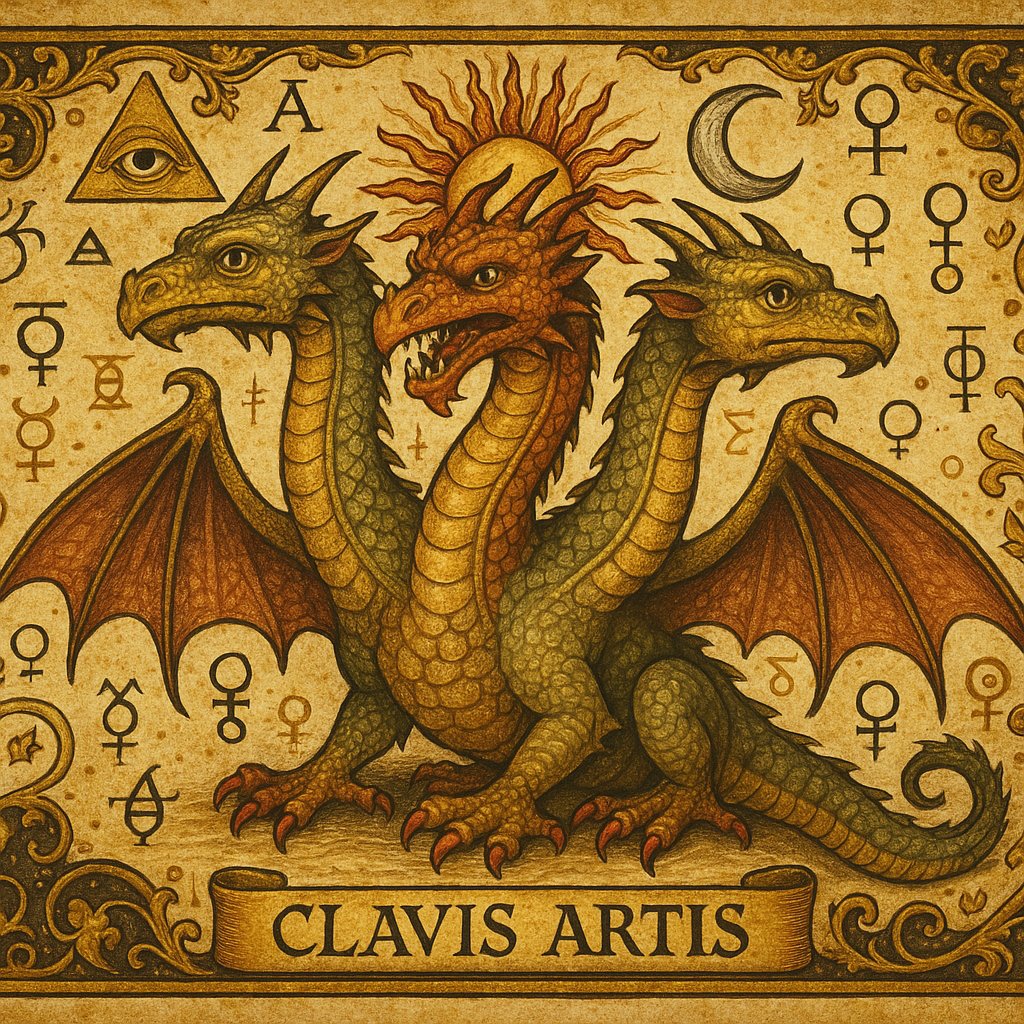
- Three-headed dragons appear across Slavic folklore (Zmey Gorynych), Greek myth (Hydra), and alchemical iconography as symbols of multiplied power and tripartite forces.
- In alchemy, three-headed serpent imagery represents Paracelsus's tria prima: sulphur, mercury, and salt, whose integration produces the philosopher's stone.
- In esoteric traditions influenced by Steiner's anthroposophy, the three heads represent unintegrated thinking, feeling, and willing in their shadow state.
- Jungian psychology interprets the dragon-fight as the ego's confrontation with unconscious complexes, with the Hydra's regenerating heads teaching that avoidance multiplies shadow material.
- Practical shadow integration work uses this archetype contemplatively, approaching each head with curiosity rather than combat.
The Dragon as Symbol
The dragon is one of the most geographically widespread mythological creatures, appearing in traditions as culturally distant as Norse Scandinavia, Imperial China, Mesoamerican civilisations, and sub-Saharan Africa. This cross-cultural prevalence has fascinated mythologists, psychologists, and religious scholars for generations. Carl Gustav Jung saw in it evidence of a shared archetype in the collective unconscious, while comparative mythologists like Joseph Campbell traced recurring narrative patterns: the dragon-fight, the guarded treasure, the hero's ordeal, across nearly every human civilisation.
The three-headed dragon is a specific and significant variant within this broader archetype. Adding heads multiplies power in mythological logic: the Cerberus of Hades had three heads to prevent escape from the underworld; the Indian god Brahma has four faces to observe all directions simultaneously. Three heads in particular invoke the symbolic weight of triadic structure that appears throughout sacred tradition: the Christian Trinity, the Hindu Trimurti (Brahma-Vishnu-Shiva), the Hermetic tria prima, the Platonic tripartite soul (reason-spirit-appetite).
What makes this archetype particularly relevant to consciousness development is precisely that triadic structure. A single-headed monster can be met with a single faculty: brute strength, cunning, or courage. A three-headed creature presents three distinct challenges that must each be met on its own terms, making it a symbol not of power to be defeated but of a developmental task to be completed.
Zmey Gorynych: The Slavic Three-Headed Dragon
The most culturally specific three-headed dragon in European tradition is the Zmey Gorynych of Slavic folklore, most prominent in Russian, Ukrainian, Serbian, and Polish traditions. The name combines zmey (serpent or dragon) with gorynych, derived from gora (mountain) or related to the root meaning "burning." The creature is fire-breathing, typically depicted with three heads on long necks (sometimes six or twelve in later variants), wings capable of flight, and regenerating heads: in many versions, cut off one head and it grows back, sometimes multiplying.
The Zmey Gorynych appears most often in byliny (heroic epic poems) and fairy tales as an abductor of women, demanding tribute, terrorising villages, and defying ordinary combat. The hero (bogatyr) who confronts it typically requires unusual means: a specific weapon, a ritual condition, or the help of magical allies. Ilya Muromets, Dobrynya Nikitich, and Ivan Tsarevich are among the heroes associated with defeating the creature in different narrative traditions.
Scholars of Slavic mythology have interpreted Zmey Gorynych as representing natural catastrophe (drought, wildfire, plague), the existential threat of foreign invasion from the steppe, and the deep psychological challenges that heroic development requires. The three heads have been interpreted as raw appetite or greed, unexamined fear, and unconscious pride or territorial aggression. In this reading, the dragon is not an external enemy but a set of internal forces that the hero must name and engage consciously before transformation can occur.
The Greek Hydra and Regenerating Shadow
The Lernaean Hydra of Greek mythology is not strictly three-headed: its head count varies by source, from five to nine to a hundred. But it embodies the same symbolic logic as the Zmey Gorynych's regenerating heads. The Hydra was the second of the twelve labours of Heracles, placing it early in his developmental sequence and suggesting it represents a fundamental challenge of self-mastery.
The Hydra dwelt in the springs of Lerna, a marshland associated with the entrance to the underworld in some traditions, giving it a chthonic (underworld) character. Heracles initially attacked with club and sword, but each head he severed regenerated as two. Only with the assistance of his nephew Iolaus, who cauterised each neck with a torch immediately after severing, could the regeneration be stopped. The one immortal central head was buried under a rock.
In psychological terms, the Hydra labour has proven enormously generative for depth psychologists and spiritual teachers. The regeneration logic maps precisely onto the phenomenology of shadow suppression described in Jungian psychology. When an unconscious complex is cut off from consciousness through repression, it does not disappear but returns in a more entrenched form. The solution the myth offers is not less confrontation but more complete confrontation: cutting precisely, then cauterising immediately, bringing the full heat of conscious awareness to the freshly exposed wound. The buried immortal head suggests that some shadow aspects are not resolved but acknowledged, consciously held and contained, rather than destroyed.
The Dragon in Alchemy: Tria Prima
European alchemical iconography makes extensive use of dragon and serpent imagery, and the three-headed form specifically. Alchemical emblems from the 15th through 17th centuries frequently show three-headed serpents or dragons in relation to the alchemical stages of nigredo (blackening), albedo (whitening), and rubedo (reddening), the three great colour stages of the Great Work.
Most directly relevant is the connection between the three-headed dragon and Paracelsus's tria prima, proposed in the early 16th century. Sulphur, the combustible principle, corresponds to the soul and its passionate, motivating quality; it is the principle that drives and burns. Mercury, the volatile principle, corresponds to the spirit and its mediating, dissolving quality. Salt, the fixed principle, corresponds to the body and its structuring, crystallising nature.
In this framework, the three-headed dragon represents sulphur, mercury, and salt in their unintegrated, unrefined state. The raw dragon: fierce, divided, consuming: must be tamed and then dissolved, calcined, and reunited through the alchemical process. Alchemical manuscripts such as the Rosarium Philosophorum (15th century) and the emblematic works of Michael Maier use dragon imagery throughout to indicate stages of unconscious material that must be consciously processed. The dragon is never simply slain; it is cooked, dissolved, purified, and eventually reconstituted in a perfected form, paralleling the transformation of raw psychological material into conscious wisdom.
Steiner's Threefold Soul and the Dragon
Rudolf Steiner (1861-1925) developed a detailed account of the human soul as a threefold entity: thinking (Denken), feeling (Fuhlen), and willing (Wollen). This tripartite structure maps onto Plato's tripartite soul (reason, spirit, appetite), Paracelsus's tria prima, and the anthroposophical account of the higher bodies.
Within the Waldorf educational tradition and esoteric anthroposophy, the three-headed dragon has been used as an imaginative representation of the three soul forces in their shadow or unintegrated state. Thinking that has become purely analytical and materialistic, severed from its connection to living wisdom; feeling governed by unexamined reaction and self-referential emotion; willing directed by immediate self-interest or unconscious habit: these are the three heads that must each be met and transformed.
Steiner taught that spiritual development required not the denial of these soul forces but their transformation. Thinking must become imaginative, inspired, and intuitive (a development he mapped in How to Know Higher Worlds); feeling must become compassionate and purified; willing must become selfless and aligned with spiritual purpose. Each transformation involves a kind of confrontation with the shadow version of the faculty, a meeting with the relevant head, before the transformation can occur.
This framework makes the three-headed dragon a developmental map as much as a mythological image. The three challenges are not sequential but simultaneous and mutually conditioning: progress in one area supports progress in the others, and avoidance in one area limits all three.
The Eastern Dragon: A Different Archetype
Any account of dragon symbolism must note the profound difference between Western dragon traditions and the dragons of East Asia. The Chinese long and its Japanese counterpart ryu are not fire-breathing, hoarding, adversarial creatures but primarily auspicious, cosmic forces associated with water, weather, fertility, and the harmonious regulation of natural and social order.
Chinese dragons are typically depicted without wings, associated with rain and rivers, and serve as symbols of imperial authority. The emperor was the Son of the Dragon; the five-toed dragon was reserved for imperial use. The dragon is one of the four cardinal symbols alongside the phoenix (south), tiger (west), and tortoise (north), with the dragon occupying the east and spring, positions of auspicious beginning and growth.
Multi-headed dragons in East Asian traditions, such as the eight-headed Yamata no Orochi of Japanese mythology, tend more toward the adversarial type: chaos and excess disrupting right order. The hero Susanoo defeats the Yamata no Orochi using sake to intoxicate the beast, then destroys it, finding the divine sword Kusanagi in its tail. This follows the same symbolic logic as the Western tradition: the treasure within the body of the defeated chaos-dragon, the gift within the ordeal.
Understanding this distinction matters for spiritual practice. Drawing on dragon imagery requires knowing which archetype is relevant: a Chinese dragon invocation calls on cosmic abundance and imperial clarity, while a Western dragon confrontation works with shadow integration and the transformation of difficult inner forces.
The Dragon in Depth Psychology
C.G. Jung identified the dragon as an archetype of the collective unconscious: a recurring symbolic pattern in dreams, fantasies, fairy tales, and mythology that corresponds to fundamental patterns of psychological structure and development.
In Jung's reading, the dragon guards a treasure: typically gold, a princess, or a sacred object. This treasure represents the Self (the totality of the psyche) or the contrasexual soul image (anima in men, animus in women). The dragon's role is to prevent premature or unconscious access to this deep material, ensuring that only a sufficiently developed ego can approach it safely. From this perspective, the dragon is not simply an obstacle but a guardian, performing a protective function.
The dragon-fight is therefore a developmental encounter: the ego confronting the unconscious in its most daunting form. Success does not mean the dragon is destroyed but that it is faced, understood, and in some sense incorporated. In Jungian clinical practice, dreams of dragons often signal a significant encounter with unconscious material: a crisis of development that, if met consciously, produces substantial psychological growth.
The three-headed variant suggests three distinct complexes presenting simultaneously, the more demanding developmental task. The practitioner must differentiate among them: understanding what each head represents, what fear or need drives it, and what gift lies within it, before genuine transformation can occur.
Working with Dragon Energy in Practice
For practitioners who work with symbolic archetypes as tools for inner development, the three-headed dragon offers a structured framework for shadow integration work. The following approaches draw on the mythological and psychological traditions reviewed in this article.
Contemplative Identification
A useful starting practice involves identifying your three heads. Using journal work, meditation, or guided visualisation, the practitioner identifies three specific challenges, recurring patterns, or unresolved tensions that consistently obstruct inner growth. These might correspond to the alchemical heads (sulphur: what burns and consumes; mercury: what evades and transforms without grounding; salt: what rigidifies and resists) or to Steiner's three soul forces in their shadow forms.
Meeting Rather Than Fighting
The mythological evidence consistently suggests that attempting to suppress or ignore the three heads produces regeneration and multiplication of the problem. Practices that support genuine meeting include compassionate inquiry (approaching each pattern with curiosity about what it wants or what wound it arises from), somatic awareness (noticing where each pattern lives in the body), and dialogue work (speaking with the dragon figure as an inner voice in imaginative space).
Crystal Support for Shadow Work
Several crystals are traditionally associated with the kind of deep inner work represented by the three-headed dragon encounter. Labradorite supports seeing through illusion and working in liminal states; its iridescent quality is a fitting emblem for shadow work. Smoky quartz grounds the practitioner during intense inner work and helps transmute difficult energies. Mystic Merlinite (Indigo Gabbro), associated with shadow integration and bringing unconscious patterns into awareness, is particularly relevant. For the integrative phase, rose quartz supports meeting shadow material with compassion rather than judgment.
The Gift Within Each Head
Every mythological tradition engaging seriously with the three-headed dragon notes that there is a gift within the encounter. The hero who defeats the Zmey Gorynych frees the captive and restores the kingdom. Heracles who survives the Hydra gains the Hydra's blood, which he uses to tip his arrows: the poison of the shadow becoming the precision instrument of later work. The alchemist who works through the tria prima produces the philosopher's stone. The psychological task is identifying what gift lies within each head: what capacity, what understanding, what quality of being becomes available when the shadow aspect is met and transformed.
The Hero with a Thousand Faces (The Collected Works of Joseph Campbell) by Campbell, Joseph
View on AmazonAffiliate link, your purchase supports Thalira at no extra cost.
Frequently Asked Questions
What does the three-headed dragon symbolise in mythology?
The three-headed dragon appears across world mythologies as a symbol of multiplied power and tripartite forces that must be confronted and integrated. In Slavic folklore, the Zmey Gorynych embodies destructive appetites requiring heroic courage to overcome. In Greek tradition, the multi-headed Hydra represents the regenerative nature of shadow. In alchemical texts, three-headed serpents represent the tria prima: sulphur, mercury, and salt, whose integration produces the philosopher's stone.
What is the three-headed dragon in alchemy?
In European alchemical iconography, the three-headed dragon represents Paracelsus's tria prima: sulphur, mercury, and salt. Sulphur corresponds to the soul and its combustible passions; mercury to the spirit and its volatile, mediating quality; salt to the body and its fixed, crystallising nature. The alchemical Work requires bringing these three principles into harmony, symbolised by taming the dragon or solving the riddle of its three heads.
How does Steiner's threefold soul relate to the three-headed dragon?
Rudolf Steiner described the human soul as having three capacities: thinking, feeling, and willing. In esoteric traditions influenced by Steiner's anthroposophy, the three-headed dragon represents these same three forces in their unintegrated, shadow form. Thinking dominated by materialism, feeling governed by unexamined emotion, and will directed by self-interest are the three heads the spiritual aspirant must transform. The dragon is not slain but consciously engaged.
What is the Zmey Gorynych in Slavic mythology?
Zmey Gorynych is a fire-breathing, three-headed dragon from Slavic folklore, particularly prominent in Russian, Ukrainian, and Serbian traditions. The name combines zmey (serpent or dragon) with gorynych (of the mountain or burning). The creature typically abducts heroes, demands tribute, and must be defeated by a bogatyr (hero). Its three heads regenerate when cut, paralleling the Hydra, and can only be defeated under specific ritual conditions.
What is the symbolic difference between a dragon and a serpent?
In Western symbolic traditions, the dragon and serpent share origins but acquired different emphases. The serpent became associated with wisdom, temptation, regeneration, and chthonic forces. The dragon developed associations with hoarding, territorial domination, fire, and challenge to heroic aspiration. In Eastern traditions, particularly Chinese and Japanese, the dragon is predominantly auspicious, associated with imperial power and cosmic harmony. The three-headed form emphasises multiplied power.
How is the dragon used in Jungian psychology?
C.G. Jung interpreted the dragon as an archetype of the collective unconscious representing the devouring, territorial, and shadow aspects of the psyche. The dragon-fight motif symbolises the ego's encounter with unconscious complexes. The dragon guards a treasure representing the Self, which can only be accessed by confronting rather than avoiding the unconscious forces. A three-headed dragon in Jungian reading represents three distinct complexes that must each be met consciously on the path to individuation.
What role does the dragon play in Chinese and Eastern spiritual traditions?
In Chinese tradition, the dragon (long) is a beneficent cosmic force associated with the emperor, rain, fertility, and the harmony between heaven and earth. Unlike Western dragons, Chinese dragons are typically benevolent, associated with water and atmospheric forces that sustain life. The dragon is one of the four cardinal symbols and represents transformation and power. Multi-headed dragons in East Asian traditions such as the eight-headed Yamata no Orochi more often represent chaos that must be brought into order.
What crystals support shadow integration work?
Shadow integration work is traditionally supported by grounding and protective stones. Black tourmaline and smoky quartz are used for psychic protection and grounding during deep inner work. Labradorite, associated with working between worlds and seeing through illusion, is particularly relevant for shadow work. Obsidian is a traditional stone of deep truth-seeing, used in scrying and introspection. For the integrative stage, rose quartz supports the heart-opening required to receive shadow aspects with compassion.
What is the Hydra and how does it relate to consciousness?
The Lernaean Hydra of Greek mythology is a multi-headed water serpent whose heads regenerate when cut off, two growing in place of each one removed. Heracles could only defeat it by cauterising each neck after severing the head. Psychologically, the Hydra represents the nature of shadow avoidance: suppressing a problem without addressing its root causes multiplies it. The Hydra labour teaches that confrontation must be paired with integration, not mere suppression.
How can dragon symbolism be used in spiritual practice?
Dragon symbolism in spiritual practice functions as a focusing device for shadow integration work. Contemplative practices involve visualising the three-headed dragon as representing three specific challenges, fears, or unresolved shadow aspects. The practitioner approaches each head with curiosity rather than combat, seeking to understand what need or truth each represents. Journal work, dream analysis, and guided visualisation are all supported by this framework, alongside protective crystal arrangements.
Sources
- Jung, C. G. (1968). Psychology and Alchemy (R. F. C. Hull, Trans.). Princeton University Press. (Collected Works, Vol. 12)
- Campbell, J. (1949). The Hero with a Thousand Faces. Pantheon Books.
- Steiner, R. (1904). How to Know Higher Worlds. Anthroposophic Press.
- Maier, M. (1617). Atalanta Fugiens. (Alchemical emblem book featuring dragon iconography.)
- Ivanits, L. J. (1989). Russian Folk Belief. M.E. Sharpe. (On Zmey Gorynych and Slavic mythology.)
- Stein, M. (1998). Jung's Map of the Soul. Open Court Publishing.
Continue with Thalira
The free 7-day practice gives you a foundation. The full course gives you the tradition behind it.