

Quick Answer
The Master and His Emissary argues that the brain's two hemispheres attend to the world differently: the right hemisphere (the Master) sees things whole, alive, and in context; the left (the Emissary) abstracts and mechanizes. McGilchrist argues Western civilization has allowed the Emissary to displace the Master, producing technical brilliance at the cost of meaning, depth, and genuine spiritual contact with existence.
Table of Contents
- What Is The Master and His Emissary?
- The Two Modes of Attention
- The Right Hemisphere: The Master
- The Left Hemisphere: The Emissary
- The Parable and Its Meaning
- The History of the Western World Through Two Hemispheres
- The Crisis of Modernity
- Implications for Spiritual Practice
- Critical Reception
- Practical Takeaways
- Get the Book
- Frequently Asked Questions
Key Takeaways
- Two Modes of Attention: The hemispheres differ not in which functions they perform but in the quality of attention they bring, broad and contextual (right) versus narrow and analytical (left).
- The Master Is Primary: New experience always arrives through the right hemisphere first. The left hemisphere processes what the right has already apprehended, and should return its output to the right for integration.
- The Emissary's Usurpation: McGilchrist traces a long cultural history in which the left hemisphere's mode of attending has come to dominate Western thought, displacing the contextual richness of the right.
- The Cost of Imbalance: A culture dominated by left-hemisphere attention becomes mechanistic, unable to tolerate ambiguity, spiritually impoverished, and prone to treating persons and nature as resources to be exploited.
- Contemplative Practice Restores Balance: Meditation, art, music, and attention to nature all cultivate the right hemisphere's mode of knowing, the Master's open, contextual engagement with lived experience.
What Is The Master and His Emissary?
Published in 2009 after twenty years of research, The Master and His Emissary: The Divided Brain and the Making of the Western World is psychiatrist and literary scholar Iain McGilchrist's attempt to connect neuroscience with philosophy, history, and the question of what has gone wrong with Western civilization. The book runs to over 600 pages in two distinct parts: a detailed examination of how the brain's hemispheres differ in their modes of attention, and a sweeping cultural history of the West read through that lens.
McGilchrist is careful to distinguish his argument from the pop-psychology reduction of "left brain equals logical, right brain equals creative." That reduction, he says, is largely false as neuroscience. What is true, and what is supported by decades of research in neuropsychology, is that the two hemispheres pay attention to the world in fundamentally different ways, and that those different modes of attention produce, in effect, different versions of reality.
The consequences of this difference, McGilchrist argues, extend well beyond individual psychology into the structure of cultures and civilizations. When one mode of attention comes to dominate, the entire character of a society changes. His claim is that the modern West has allowed the emissary, the left hemisphere's narrow, analytical, mechanical attention, to displace the master, the right hemisphere's broad, contextual, living engagement with experience. The result is a civilization of extraordinary technical competence and diminishing meaning.
Why This Book Matters for Spiritual Seekers
Most spiritual traditions describe a mode of awareness that cannot be reached through analysis alone: a direct, open, non-grasping attention to experience as it arises. McGilchrist provides a neuroscientific framework for why this distinction between modes of knowing is real and important. The Master's mode of attention, broad, contextual, comfortable with ambiguity, maps closely onto what contemplative traditions call presence, beginner's mind, or samadhi. His book is, among other things, a scientific case for the value of the contemplative path.
The Two Modes of Attention
The first and most important correction McGilchrist makes is about what the hemispheric difference actually consists of. The popular model, left brain does language and logic, right brain does art and emotion, is a caricature that bears little relationship to the neuroscientific evidence. Both hemispheres are involved in language, emotion, creativity, and reasoning. The difference is not in what they do but in how they do it.
McGilchrist's key concept is attention. The hemispheres differ in the quality of attention they bring to the world, and this difference has profound consequences for what their bearer experiences as real.
He draws an analogy from bird behavior that neurologist John Cutting first described. A bird must use two incompatible modes of attention simultaneously: one eye scans broadly for predators and context; the other focuses narrowly on the grain it is picking up. These two modes, the broad vigilant attention and the narrow focused attention, are incompatible and cannot be run simultaneously through the same neural architecture. Evolution solved this by splitting them between the two hemispheres.
Humans, McGilchrist argues, retain this fundamental split. The right hemisphere pays broad, open attention, noticing the whole scene, sensitive to context and relationship, comfortable with the implicit and ambiguous. The left hemisphere pays narrow, focused attention, precise, analytical, manipulative of objects, oriented toward the explicit and predictable.
The Right Hemisphere: The Master
McGilchrist describes the right hemisphere as primary, the "master" of the title, for several reasons.
First, new experience always arrives through the right hemisphere. When something genuinely novel is encountered, it is the right hemisphere that first apprehends it. The left hemisphere can only process what has already been categorized; it works with what is familiar, not with what is fresh. This means the right hemisphere is the hemisphere of authentic encounter with the world as it actually is, rather than as our mental models predict it should be.
Second, the right hemisphere's mode of attention is closer to the reality it perceives. Things in the world are not isolated objects with fixed properties, they are processes embedded in relationship with other processes, changing over time, meaningful in context. The right hemisphere's broad, contextual, relational mode of attending is more faithful to this reality than the left hemisphere's abstracting, isolating mode.
Third, the right hemisphere is the hemisphere of the body, of emotion, of music, of metaphor, and of the implicit. It holds the awareness that cannot be fully articulated, the knowledge that precedes language and the wisdom that exceeds it. Phenomenologically, the right hemisphere's mode of knowing corresponds closely to what philosophers from Merleau-Ponty to Heidegger have described as pre-reflective bodily experience: the ground of all conscious life.
The right hemisphere is also more honest about uncertainty. It can hold ambiguity without resolving it prematurely. It knows that it does not know everything. This epistemic humility, McGilchrist argues, is a feature rather than a limitation, it keeps the right hemisphere in contact with a reality that exceeds its current models.
The Left Hemisphere: The Emissary
The left hemisphere is, in McGilchrist's account, brilliantly useful and dangerously prone to overreaching. Its narrow, focused, analytical attention is exactly what is needed for tasks requiring precision: using tools, constructing arguments, performing calculations, following procedures. The emissary is an excellent emissary when it knows its role.
The problem arises when the left hemisphere begins to mistake its map for the territory. The left hemisphere works with abstractions, categories, concepts, representations, rather than with the living reality those abstractions are supposed to represent. It is oriented toward the predictable and the explicit; when it encounters something genuinely novel, it tends to assimilate it to an existing category rather than update the category to fit the novel experience.
McGilchrist describes several characteristic features of left-hemisphere dominance that become pathological when unchecked:
Overconfidence: The left hemisphere tends to be certain of its conclusions and resistant to evidence that disconfirms them. In neurological patients with right-hemisphere damage (and therefore left-hemisphere dominance), this can produce confabulation, the invention of plausible-sounding explanations for experiences the patient cannot actually account for.
Mechanization: The left hemisphere's mode of attention reduces the living to the mechanical. Persons become functions; relationships become transactions; the body becomes a machine; nature becomes a resource. This is useful when you need to repair an engine; it is catastrophic when applied to human relationships or ecological systems.
Closure: The left hemisphere prefers a tidy answer to an honest acknowledgment of complexity. It would rather have a complete system, even a wrong one, than an open question. This tendency toward premature closure is the psychological mechanism behind ideological thinking, bureaucratic rigidity, and scientific dogmatism.
Recognizing Left-Hemisphere Dominance in Daily Life
You can observe left-hemisphere overreach in concrete ways: the meeting that turns a nuanced human problem into a metrics dashboard; the relationship reduced to a transaction; the inability to tolerate uncertainty without reaching for an explanation; the experience of beauty or presence being immediately displaced by the thought "I should photograph this." McGilchrist does not argue that the left hemisphere is bad, it is essential. He argues that it needs the right hemisphere's broader vision to keep it grounded in what is actually real.
The Parable and Its Meaning
The title of the book comes from a parable that McGilchrist traces to Nietzsche, though he adapts it for his own purposes. In the story, a powerful and wealthy master rules a large territory. Because he cannot be everywhere himself, he sends out an emissary, a trusted, intelligent servant, to manage distant parts of the kingdom and report back. The emissary is diligent and clever. He learns everything the master teaches him. Over time, he comes to believe that his knowledge of the details of the kingdom exceeds the master's, and eventually he begins to act as though he were the master himself.
The master's broad wisdom, his sense of the whole, his feel for the land and the people, his understanding of what the kingdom is actually for, is displaced by the emissary's detailed competence. The kingdom continues to function, even improves in certain measurable ways. But something essential has been lost. The emissary runs the kingdom with great efficiency in service of goals he has set himself, which are not the master's goals.
This is McGilchrist's diagnosis of modern Western civilization. The left hemisphere's emissary competence has produced extraordinary technical achievement: medicine, engineering, information technology, global trade. But it has done so at the cost of the right hemisphere's broader wisdom, the sense of what a human life, a community, or a civilization is actually for.
The History of the Western World Through Two Hemispheres
The second half of the book applies McGilchrist's framework to the history of Western culture from ancient Greece to the present. This is the most ambitious and controversial part of the work, but also the most illuminating.
Ancient Greece represents, for McGilchrist, a period of relative balance. The pre-Socratic philosophers combined mythological and rational modes of knowing. Greek tragedy held irresolvable tensions without forcing resolution. Even Plato, who McGilchrist sees as the beginning of left-hemisphere philosophy's ascendancy, wrote in dialogues that allow multiple perspectives to remain in play.
The Roman period shows the left hemisphere gaining ground: the shift from the Greek emphasis on the quality of individual lives to the Roman emphasis on law, administration, and empire-as-machine. Roman engineering and legal thought are masterpieces of left-hemisphere competence.
The Renaissance brought a renewal of right-hemisphere engagement: the recovery of embodied perspective in painting, the exploration of emotional depth in music, the integration of reason and imagination in the work of Leonardo, Raphael, and Michelangelo. McGilchrist sees this as a period when the Master temporarily reasserted itself.
The Reformation and the Scientific Revolution represent, in his reading, the Emissary striking back: the iconoclasm of Protestant theology (stripping churches of images, reducing religious experience to doctrinal propositions), and the Cartesian reduction of the world to matter in motion. Descartes' famous split between mind and body is, for McGilchrist, the philosophical crystallization of left-hemisphere dominance.
The Enlightenment intensifies this trend: universal reason as the arbiter of all truth; tradition, embodied wisdom, and religious experience dismissed as superstition; the person reconceived as a rational agent with interests rather than a creature embedded in relationships, place, and time.
Romanticism was, McGilchrist argues, the right hemisphere's counter-revolution, an attempt to restore the claims of feeling, imagination, nature, and organic growth against Enlightenment mechanism. It failed, ultimately, to reverse the dominant trend.
Modernism and after brought what McGilchrist calls the most severe left-hemisphere dominance in Western history: the fragmentation of the arts, the triumph of bureaucracy, the commodification of everything, the disappearance of shared meaning.
The Crisis of Modernity
McGilchrist is not a nostalgist. He is not arguing that we should return to any previous era. His diagnosis is more specific: that a particular mode of attention has become structurally dominant in Western institutions, education, and culture, and that this imbalance has costs that are becoming increasingly visible.
He identifies a cluster of features that characterize a left-hemisphere-dominated culture:
The reduction of persons to functions. When the left hemisphere's analytic gaze dominates, other persons are primarily seen as sources of utility, customers, employees, voters, patients, rather than as unique, irreducible individuals embedded in living relationships.
The loss of the implicit. Left-hemisphere culture demands that everything be made explicit, measurable, and accountable. This destroys the implicit wisdom that cannot survive being made explicit: the trust between colleagues that evaporates when replaced by formal performance metrics; the sense of purpose that dissolves when reduced to a mission statement.
The preference for the map over the territory. Bureaucratic and institutional thinking increasingly treats its own models of reality as more real than the reality the models are supposed to represent. The healthcare system optimizes for measurable outcomes that may have little relationship to actual patient wellbeing. The educational system optimizes for test scores that may have little relationship to genuine learning.
The intolerance of ambiguity. Left-hemisphere culture prefers an answer, any answer, to an open question. This produces a culture of premature certainty, ideological rigidity, and the dismissal of complexity as weakness.
McGilchrist and the Hermetic Tradition
McGilchrist's framework illuminates a distinction that runs through the entire Western esoteric tradition: between ratio (discursive, analytical reason) and intellectus (direct, intuitive apprehension of the whole). The Hermetic and Platonic traditions consistently identified intellectus as the higher faculty, the faculty through which genuine wisdom, rather than mere information, is obtained. McGilchrist's neuroscience provides a grounding for this ancient distinction in the observable architecture of the brain. The Master's mode of attention is intellectus; the Emissary's is ratio. Both are necessary; neither can replace the other.
Implications for Spiritual Practice
McGilchrist does not write primarily as a spiritual teacher, but the implications of his framework for spiritual practice are substantial.
Almost every major contemplative tradition distinguishes between two modes of knowing: the conceptual, analytical mind that constructs maps of reality, and the direct, open awareness that perceives reality itself. In Zen, this is the distinction between satori and the conceptualizing mind. In the Hindu tradition, it corresponds to the distinction between vijnana (discursive knowledge) and prajna (direct wisdom). In the Christian mystical tradition, it maps onto the distinction between the active and contemplative modes.
McGilchrist's framework suggests that the contemplative mode, the open, non-grasping, contextual attention, is not opposed to reason but is a different mode of reason, one grounded in the right hemisphere's broader engagement with reality. Meditation and contemplative practice, on this reading, are not escapes from reality but disciplines for cultivating the mode of attention that most faithfully encounters it.
Practically, this means that the practices that restore right-hemisphere primacy, meditation, extended time in nature, engagement with music and art, genuine conversation (not debate), and the cultivation of silence, are not luxuries or self-indulgences. They are the means by which the Master reasserts its proper relationship to the Emissary. They are the neurological equivalent of what the spiritual traditions call returning to source.
Critical Reception
The Master and His Emissary received wide and largely favorable attention from scholars in multiple fields. W.F. Bynum, writing for the Times Literary Supplement, called it "a veritable tour de force" and "the best exposition of current functional brain neuroscience I know of." The poet and critic Kathleen Raine praised the book as the most important work of its kind since William Blake.
The main critical challenge comes from philosophers and scientists who argue that McGilchrist's cultural conclusions outrun his neuroscientific evidence. A.C. Grayling, while praising the book's erudition, argued that neuroscience is "nowhere near fine-grained enough to support the large psychological and cultural conclusions" McGilchrist draws. This is a fair challenge, the leap from neuropsychological findings to a theory of Western civilization is large, and McGilchrist acknowledges it in the book, arguing that the cultural evidence is intended to be read alongside the neuroscience, not derived from it.
McGilchrist's follow-up book, The Matter with Things (2021), extends and deepens the argument of The Master and His Emissary, addressing consciousness, the nature of reality, and the epistemological implications of the hemispheric divide across two volumes and over 1,500 pages.
Practical Takeaways for Readers
Notice the quality of your attention. McGilchrist's most direct practical teaching is about attention itself. Are you engaging broadly, openly, contextually, or narrowly, analytically, mechanically? Both modes are necessary; the question is which is serving the other.
Protect time for right-hemisphere activities. Music, extended nature walks, genuine (non-instrumental) conversation, meditation, and engagement with art are not recreational supplements to a productive life. They are the practices that keep the Emissary in right relationship with the Master. Treating them as optional luxuries is itself a symptom of left-hemisphere dominance.
Be suspicious of complete explanations. The left hemisphere loves a tidy account that explains everything. That tidiness is often the sign that something important has been excluded. The right hemisphere's comfort with ambiguity is not a weakness to be overcome but a form of epistemic honesty.
Resist the reduction of persons. The most immediate application of McGilchrist's framework is in how you attend to the people around you. Seeing another person as a function, as what they produce or consume or represent, is the left hemisphere's mode. Seeing them as a unique, irreducible individual embedded in a life context is the Master's mode. The second kind of seeing is more accurate and more humane.
Affiliate Disclaimer
This article contains Amazon affiliate links. If you purchase through these links, Thalira earns a small commission at no extra cost to you. We only link to books we have reviewed directly.
Get the Book
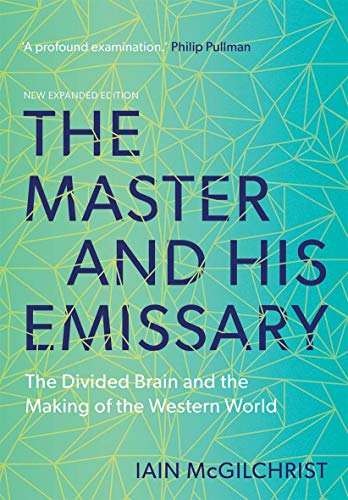
The Master and His Emissary: The Divided Brain and the Making of the Western World
Iain McGilchrist | Yale University Press, 2009 (expanded edition 2019)
Twenty years of research on the hemispheric divide and its consequences for Western culture. Dense, rewarding, and genuinely original, essential reading for anyone interested in consciousness, culture, and the spiritual crisis of modernity.
View on AmazonDeepen Your Hermetic Practice
The Hermetic Synthesis Course connects the wisdom McGilchrist describes, the Master's mode of direct, contextual knowing, to structured daily contemplative practice.
Explore the CourseFrequently Asked Questions
What is The Master and His Emissary about?
It argues that the brain's two hemispheres produce fundamentally different modes of attending to the world, and that Western civilization has allowed the left hemisphere's analytical, mechanical mode to displace the right hemisphere's contextual, living engagement, with spiritual and cultural consequences.
What does 'master and emissary' mean?
In a parable McGilchrist adapts from Nietzsche, a wise master sends a trusted emissary to manage his kingdom. The emissary eventually usurps the master, believing his detailed competence is superior to the master's wisdom. This describes the left hemisphere displacing the right.
Is the left brain-right brain distinction real in McGilchrist?
McGilchrist rejects the pop-psychology version. His argument is about the quality of attention each hemisphere pays, broad and contextual (right) versus narrow and analytical (left), not about which functions are lateralized.
What is the right hemisphere's mode of attention?
Broad, open, contextual, seeing things as unique, alive, embedded in relationship. Comfortable with ambiguity and metaphor. The hemisphere through which new experience first arrives.
What is the left hemisphere's mode of attention?
Narrow, focused, analytical, abstracting, categorizing, and manipulating objects. Brilliant for precise tasks but prone to mistaking its maps for the reality they represent.
How does McGilchrist explain the spiritual crisis of the West?
He traces a long historical arc in which left-hemisphere dominance has reduced persons to functions, nature to resources, and culture to machinery, producing technical achievement without meaning.
What historical periods does McGilchrist analyze?
Ancient Greece, Rome, Renaissance, Reformation, Scientific Revolution, Enlightenment, Romanticism, and Modernism, tracking how each reflects the balance between the hemispheric modes.
How does the book relate to spiritual development?
The right hemisphere's mode of attention corresponds to what contemplative traditions call direct experience or presence. Meditation, art, and time in nature cultivate this mode, restoring the Master's primacy over the Emissary.
How long did McGilchrist write the book?
Approximately 20 years of research, published in 2009 and expanded in 2019.
What did critics say?
W.F. Bynum called it a "tour de force" of neuroscience exposition. A.C. Grayling praised the writing but questioned whether neuroscience currently supports McGilchrist's cultural conclusions.
Is it difficult to read?
The neuroscience section is demanding. The cultural history section is more accessible. McGilchrist's talks and interviews on YouTube provide excellent entry points before tackling the full book.
What is McGilchrist's follow-up book?
The Matter with Things (2021) extends the argument into consciousness, the nature of reality, and epistemology across two volumes and over 1,500 pages.
What is The Master and His Emissary by Iain McGilchrist about?
The Master and His Emissary argues that the two hemispheres of the human brain produce fundamentally different ways of attending to the world. The right hemisphere (the Master) sees things in context, as whole and alive. The left hemisphere (the Emissary) abstracts, categorizes, and mechanizes. McGilchrist argues that Western culture has allowed the Emissary to usurp the Master, producing a civilization that is technically brilliant but spiritually impoverished.
What does 'master and emissary' mean in the title?
The title comes from a parable by Nietzsche: a wise ruler sends out a trusted emissary to manage his territory, but the emissary eventually comes to believe he is wiser than the master and attempts to take over. McGilchrist uses this as a metaphor for the left hemisphere (the emissary) gradually displacing the right hemisphere (the master) in Western civilization.
Is the left brain-right brain distinction real in McGilchrist's work?
McGilchrist distinguishes his argument from the pop-psychology myth of 'left brain logical, right brain creative.' His argument is about the quality of attention each hemisphere pays to the world, not about which hemisphere 'does' specific tasks. Both hemispheres are involved in almost all cognition; what differs is how they engage with experience.
What is the right hemisphere's mode of attention according to McGilchrist?
The right hemisphere pays broad, open, contextual attention. It sees things as unique, alive, and embedded in relationship with their environment. It is comfortable with ambiguity, metaphor, and the implicit. It is the hemisphere through which new experience first arrives.
What is the left hemisphere's mode of attention according to McGilchrist?
The left hemisphere pays narrow, focused, analytical attention. It abstracts, categorizes, and manipulates. It is brilliant at tasks requiring precision and explicit analysis but tends to mistake its map for the territory. It prefers the predictable, the familiar, and the mechanical — and is prone to overconfidence.
How does McGilchrist explain the spiritual crisis of the modern West?
McGilchrist traces a long historical arc in which the left hemisphere's mode of attention has gradually come to dominate Western culture: the rise of rationalism, mechanism, bureaucracy, and the reduction of everything — including persons, nature, and art — to manipulable resources. He sees this as a form of collective pathology, a civilization that has lost contact with the richness of direct experience.
What is the parable of the master and the emissary?
In Nietzsche's parable (which McGilchrist adapts), a wise king rules through his own judgment but uses a trusted emissary to communicate with distant parts of his kingdom. Over time the emissary becomes convinced he understands better than the king and begins to act autonomously. McGilchrist uses this to describe what happens when the analytical left hemisphere stops serving the contextual right and begins to dominate it.
What historical periods does McGilchrist analyze in the book?
McGilchrist surveys ancient Greece, the Roman period, the Renaissance, the Reformation, the Scientific Revolution, the Enlightenment, Romanticism, the Industrial Revolution, and Modernism, tracking how each era reflects the relative balance or imbalance between the hemispheric modes of attention.
How does The Master and His Emissary relate to spiritual development?
McGilchrist's right hemisphere corresponds closely to what spiritual traditions call direct experience, presence, or contemplative attention. The meditator's task — to quiet the analytical, categorizing mind and attend openly to experience — maps onto the project of restoring the Master's primacy. The book provides neuroscientific grounding for the value of contemplative practice.
How long did McGilchrist take to write The Master and His Emissary?
McGilchrist spent approximately 20 years researching and writing the book, published in 2009. He drew on neuroscience, philosophy, literary theory, art history, and music to build his argument.
What did critics say about The Master and His Emissary?
W.F. Bynum called it 'a veritable tour de force' and 'the best exposition of current functional brain neuroscience I know of.' A.C. Grayling called it 'beautifully written, erudite, fascinating,' but questioned whether neuroscience currently supports the large cultural conclusions McGilchrist draws.
Is The Master and His Emissary difficult to read?
The first part, on neuroscience, requires patience and some familiarity with the field. The second part, on Western cultural history, reads more accessibly. Many readers find the book life-changing despite its density, and McGilchrist's YouTube talks and interviews provide useful entry points.
Sources and References
- McGilchrist, Iain. The Master and His Emissary: The Divided Brain and the Making of the Western World. Yale University Press, 2009 (expanded 2019).
- McGilchrist, Iain. The Matter with Things: Our Brains, Our Delusions, and the Unmaking of the World. Perspectiva Press, 2021.
- Bynum, W.F. Review of The Master and His Emissary. Times Literary Supplement, 2010.
- Grayling, A.C. Review of The Master and His Emissary. Literary Review, 2009.
- Neumann, Erich. The Origins and History of Consciousness. Princeton University Press, 1954.
- Merleau-Ponty, Maurice. Phenomenology of Perception. Routledge, 1945.
- Heidegger, Martin. Being and Time. Harper and Row, 1962.