
Quick Answer
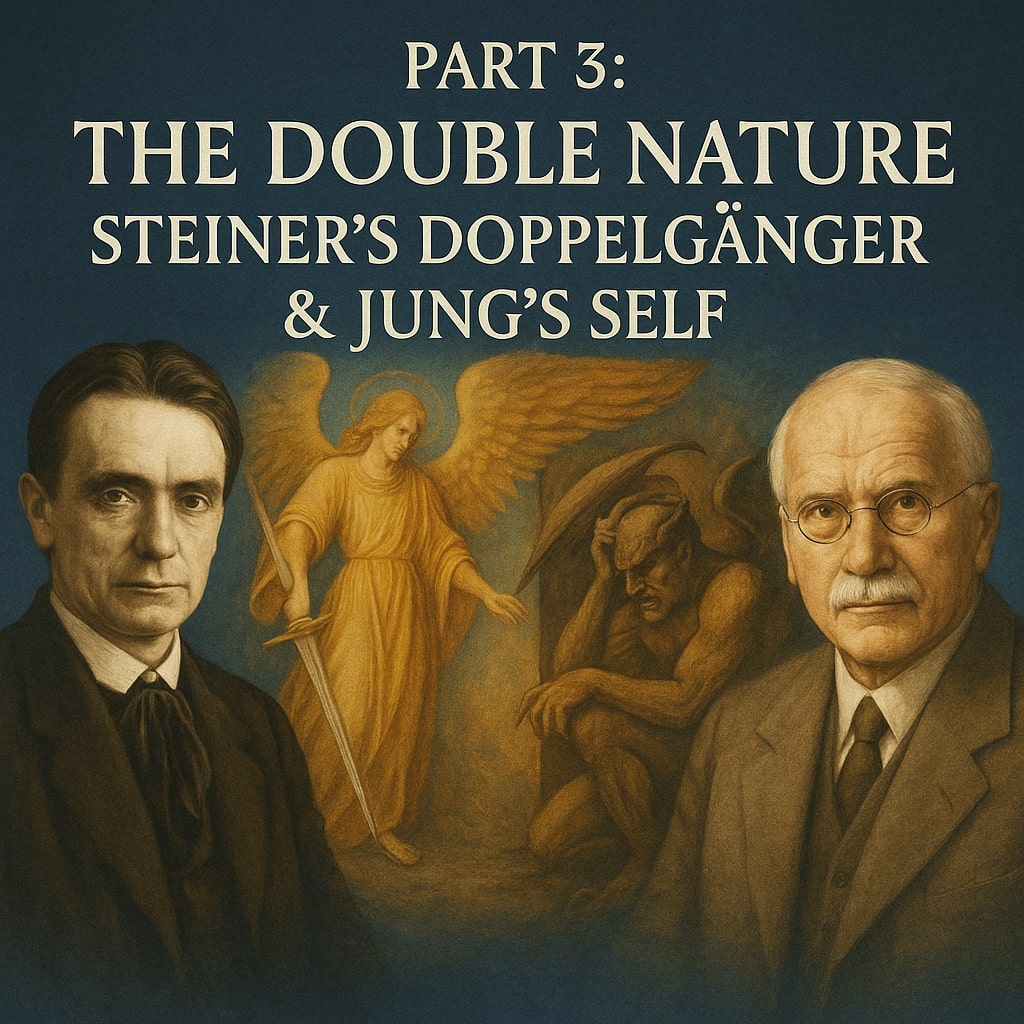
Steiner's Doppelganger is an Ahrimanic being that inhabits the human nervous system from birth to death, working through instinct, fear, and destructive impulse from within. It has a specific connection to electricity and grows stronger in electrically saturated environments. Jung's Self is the psyche's totality, the union of conscious and unconscious that individuation works toward. Both frameworks identify an inner antagonist whose proper integration is the condition of genuine development.
Table of Contents
- Beyond the Shadow: The Double Within
- Steiner's Doppelganger: Structure and Function
- The Doppelganger, Electricity, and Modern Technology
- Ahriman and the Doppelganger's Cosmic Context
- Jung's Self: The Totality Beyond the Shadow
- The Coniunctio: Union of Opposites
- Anima, Animus, and the Layers Beyond Shadow
- Mythological Doubles: Gilgamesh, Osiris, Jacob
- Convergence: Where Steiner and Jung Agree
- Frequently Asked Questions
Key Takeaways
- Internal vs. External: The Doppelganger inhabits the individual from within, working through the nervous system. The Guardian stands at the threshold externally. Understanding both as distinct gives a more precise map of the inner antagonist's territory.
- Electricity Connection: Steiner's 1917 lectures describe the Doppelganger as having an affinity for artificial electrical forces, a claim with striking implications for the smartphone and social media era that Steiner could not have anticipated directly.
- The Self as Goal: Jung's individuation is not simply shadow integration but the development of a relationship between the conscious ego and the Self, the psyche's totality. Shadow integration is the first stage of a larger process.
- Mythology as Map: Gilgamesh and Enkidu, Osiris and Set, Jacob and the angel: the mythological double encounter is a cross-cultural pattern encoding the same developmental reality that Steiner and Jung described in their respective frameworks.
- Integration not Elimination: Both frameworks insist that the Doppelganger and shadow cannot and should not be eliminated. They are the resistance that makes development possible. The goal is conscious relationship with them, not victory over them.
Beyond the Shadow: The Double Within
Part 1 of this series introduced the Guardian of the Threshold and Jung's concept of the shadow as two complementary frameworks for understanding the inner antagonist encountered in genuine development. This third article goes deeper into a distinction that Part 1 only touched on: the difference between the shadow, understood as accumulated personal unconscious material, and what Steiner called the Doppelganger, the Double that inhabits the human being from birth and works against the ego's development from within.
This distinction matters practically. The shadow, in the Jungian sense, is shaped by the individual's personal history: the rejections and suppressions of the early environment, the accumulated projections of a lifetime, the specific contours of one person's particular adaptation to their specific circumstances. It is personal material. Working through it with appropriate tools, whether in psychotherapy, through dream analysis, or through careful self-observation, is genuinely possible within a relatively normal developmental trajectory.
The Doppelganger is something more fundamental. In Steiner's account, it is not the product of the individual's personal history but a being that enters the human constitution at birth and works through the very structure of the nervous system itself. It is not accidentally there as a result of what happened to this particular person. It is present in every human being as a condition of physical embodiment in the current phase of Earth evolution.
Understanding both the personal shadow and the Doppelganger, and their relationship to each other, gives a considerably more complete picture of the inner developmental challenge than either concept alone provides.
The Doppelganger in Literature
The literary tradition of the double, the mysterious figure that mirrors the protagonist while embodying their suppressed or destructive aspects, emerged as a prominent theme in Romantic and early modern literature at precisely the time when Steiner and Jung were developing their frameworks. E.T.A. Hoffmann's The Devil's Elixir, Poe's William Wilson, Dostoyevsky's The Double, Oscar Wilde's The Picture of Dorian Gray, Robert Louis Stevenson's Dr. Jekyll and Mr. Hyde, and Joseph Conrad's The Secret Sharer all preoccupy themselves with the double. The convergence of this literary theme with the esoteric and psychological frameworks of the same era suggests that the double was forcing itself into cultural consciousness through multiple channels simultaneously.
Steiner's Doppelganger: Structure and Function
Steiner described the Doppelganger most extensively in a series of lectures given in 1917, collected under the title Secret Brotherhoods and the Mystery of the Human Double. The context was the First World War, and Steiner's argument was that the catastrophic collective violence of the war was partly explainable by the actions of the Double operating at a collective scale through the nervous systems of millions of individuals who had not developed the inner strength to resist its influence.
The Doppelganger, according to Steiner, is a being of the Ahrimanic spiritual hierarchy that enters the human organism before or at birth and inhabits the physical-etheric constitution, particularly the nervous system, for the duration of the physical life. At death it departs, but in the opposite direction from the human ego: rather than ascending to the spiritual world for the post-mortem review of the life and preparation of the next incarnation, the Doppelganger descends into the earth and continues its activities there before finding its way into another human nervous system.
Its mode of operation within the individual is specifically through the nervous system and its electrical processes. Steiner described the Doppelganger as a being for whom the electrical currents of the nervous system are native habitat: it lives in these currents and can direct them in ways that influence the individual's instinctive reactions, fears, and destructive impulses. It is not capable of directing conceptual thinking, which requires the activity of the ego; but it can distort the will impulses that arise from the metabolic-limb system and the feeling reactions that arise from the rhythmic system, bending them in directions that serve its own nature rather than the individual's development.
This means that the Doppelganger operates most powerfully in precisely the areas of human life where ordinary waking consciousness is least present: in the will impulses that drive behaviour without conscious reflection, in the instinctive emotional reactions that arise before the ego has had time to consider them, and in the habitual patterns of thought and behaviour that run on autopilot below the level of deliberate attention.
Recognising the Doppelganger's Activity
A practical indicator of the Doppelganger's activity is the experience of acting "against oneself": doing something one genuinely does not want to do, driven by an impulse that feels foreign to one's deeper nature, and then observing the behaviour with puzzlement or self-reproach. The alcoholic who knows intellectually that drinking damages them but finds themselves drinking anyway; the person who resolves to be kinder and then finds themselves being harsh without understanding why; the practitioner who commits to a meditation schedule and then finds themselves repeatedly unable to maintain it against mysterious resistance: in all these cases, Steiner's framework points to the Doppelganger as a factor, operating through the will and undermining the ego's stated intentions.
The Doppelganger, Electricity, and Modern Technology
Steiner's 1917 lectures contain a claim that becomes more striking with each passing decade of technological development. He argued that the Doppelganger has a specific affinity for artificial electricity, for the electrical forces that humans have learned to generate and direct through wires and across the atmosphere. In Steiner's era, the relevant technologies were telegraph, telephone, and early radio. He argued that these technologies, by saturating the human environment with artificial electrical forces, created conditions in which the Doppelganger's influence over human nervous systems was amplified.
The logic of the claim, in Steiner's framework, is coherent. If the Doppelganger inhabits the electrical processes of the nervous system, and if the environment is saturated with artificial electrical signals of similar character, then the Doppelganger has more material to work with and more pathways through which to operate. The boundary between the Doppelganger's domain (the electrical nervous system) and the external environment becomes more permeable when the environment itself is heavily electrically active.
The implications that contemporary readers draw from this claim vary considerably. Some apply it straightforwardly to the digital technology environment of the 21st century: smartphones, social media, wireless networks, and the continuous stream of electrical stimulation that characterises modern life. In this reading, the anxiety, distraction, addictive engagement patterns, and difficulty maintaining sustained attention that characterise the smartphone era are at least partly attributable to the Doppelganger finding exceptionally hospitable conditions in the electrically saturated modern environment.
Others read Steiner's claim more cautiously, noting that he was extrapolating from the physics of his era (which did not yet distinguish clearly between different forms of electromagnetic radiation) and that not all "artificial electrical forces" are likely to have the same effects. The relevant question is not whether one accepts Steiner's 1917 formulation verbatim but whether there is a meaningful connection between the kind of consciousness degradation that Living Thinking article in this series describes (the colonisation of thought by algorithms, the destruction of sustained attention, the flattening of genuine inner life) and the Ahrimanic principles that Steiner associated with the Doppelganger.
On that question, the convergence between Steiner's framework and contemporary research on digital technology's effects on cognition and wellbeing is worth taking seriously. The specific mechanisms differ, but the overall pattern, that artificial electrical information environments have strong tendencies to amplify the instinctive, reactive, fear-driven, and addictive dimensions of human behaviour while weakening the capacity for sustained reflective attention, is documented in substantial empirical research.
Steiner and the Information Age
In the same 1917 lectures, Steiner made a prediction that reads as prescient in the context of 21st-century platform capitalism: he described the possibility of secret brotherhoods, groups with esoteric knowledge of the Doppelganger's nature, using that knowledge to manufacture and direct public opinion through media and information technologies. The scenario he described was one in which the Doppelganger's amplification through electrical media could be deliberately exploited to produce mass manipulation of populations who were not equipped to recognise that their reactions were being steered by something other than their own genuine judgements. Whether or not one accepts the full framework, the political dynamics he described are recognisable in the contemporary information environment.
Ahriman and the Doppelganger's Cosmic Context
To understand the Doppelganger fully in Steiner's framework, it needs to be placed in the context of his account of the two principal adversarial cosmic forces: Lucifer and Ahriman.
Lucifer is the being whose influence draws the human being away from the earth toward a premature spiritualisation, a flight from the physical and material into a disembodied, escapist spiritual condition. Luciferism manifests as spiritual pride, self-deception, the tendency to confuse one's own wishes and fantasies with genuine spiritual perception, and the avoidance of earthly responsibility in the name of "higher" concerns.
Ahriman is the opposite: the being whose influence draws the human being into an excessive identification with the material and mechanical, a hardening of consciousness into purely materialistic thinking, a denial of everything that cannot be measured and quantified. Ahriman manifests as cold intellectual cleverness without moral warmth, the reduction of human beings to economic units, the mechanisation of all processes including cognitive and social ones, and the amplification of fear, survival instinct, and territorial aggression.
The Doppelganger is specifically Ahrimanic. It operates in the domain of mechanical, electrical, fear-driven processes rather than in the domain of fantasy and pride. Its characteristic distortions are the Ahrimanic ones: turning instinct and habit into iron compulsions, amplifying fear-based reactions, and making the individual a vehicle for mechanical patterns of behaviour rather than a free agent of their own development.
Christ, in Steiner's cosmology, is the being who mediates between the Luciferic and Ahrimanic poles, providing the human being with the possibility of a middle path that neither flees from the material world nor is swallowed by its mechanising tendency. The Christ impulse, as Steiner described it, is the source of the impulse to integrate the Doppelganger rather than either surrendering to it or fleeing from it: remaining present in the material world while maintaining the connection to spiritual reality that prevents that presence from becoming mere mechanisation.
Jung's Self: The Totality Beyond the Shadow
In Jungian psychology, the shadow is the first major encounter in the individuation process, but it is not the final destination. Beyond the shadow, Jung described deeper layers of the unconscious, and beyond all of them, the Self: the totality of the psyche that includes both the conscious and the unconscious, both the persona and the shadow, both the individual and the collective dimensions.
The Self is not accessible through direct encounter in the way the shadow can be encountered in dreams and projections. It makes itself known indirectly, through the psyche's tendency toward wholeness: its constant pressure toward the integration of opposites, its production of healing symbols in dreams and visions, and the sense of meaning and direction that emerges when the individuation process is proceeding well. The mandala, the quaternity, the child, and the divine couple are primary symbols through which the Self announces itself in the psyche's spontaneous productions.
Jung was careful to distinguish the Self from both the ego (the conscious centre) and from God (the theological concept of an external divine being). The Self is a psychological reality: the observed centre of the psyche as a whole, around which the ego's development is oriented. Whether it is also in some sense a theological reality, whether the psyche's Self corresponds to something in the objective spiritual world, is a question Jung consistently declined to answer definitively, though his later writings suggest he regarded it as at least a possibility.
Steiner's parallel to Jung's Self is the ego in its fully developed form, the I that has successfully transformed the astral body into spirit self, the etheric into life spirit, and the physical into spirit human. The fully realised ego is both fully individual, genuinely unique in a way that no mere product of heredity and environment could be, and fully transparent to the spiritual world's activity within it. This is the condition that Steiner called "freedom" in the deepest sense: not freedom from constraint but the positive freedom of a consciousness that acts from its own spiritual nature rather than from the mechanical impulses of the Doppelganger or the Guardian's unintegrated residues.
Symbols of the Self in Practice
Working with the Self's spontaneous productions in dreams requires a different orientation than working with the shadow. Shadow work involves confrontation, the willingness to face and acknowledge what has been rejected. Working with Self symbols requires receptivity: the willingness to be moved, surprised, and humbled by what the psyche's depths produce. The Self does not argue or accuse. It shows, through imagery of unusual numinosity and wholeness, what the psyche's direction looks like from a perspective larger than the ego's current view. Keeping a dream journal and paying particular attention to dreams that have an unusually luminous, complete, or profound quality is the primary practical method for developing a relationship with the Self's symbolic language.
The Coniunctio: Union of Opposites
The ultimate symbol of the individuation process in Jung's alchemical psychology is the coniunctio oppositorum, the conjunction of opposites. The alchemists used this image to describe the final stage of the Great Work: the union of the sun and moon, the king and queen, the masculine and feminine, the fixed and volatile. Jung read these images as psychological maps: the alchemical goal was not external chemical gold but the internal integration of opposites that produces the wholeness of the Self.
The coniunctio in the context of shadow and Doppelganger work means the genuine integration of the inner antagonist into the whole person's life, not its defeat or suppression. The shadow's contents, when properly integrated, become the source of energy, creativity, vitality, and depth that the persona had lacked. The Doppelganger's electrical vitality, properly oriented by a developed ego, becomes a source of effective will and capacity for earthly action rather than a compulsive force driving destructive behaviour.
This is the deeper meaning of what both Steiner and Jung were pointing toward: not a purification of the self by removing everything dark, but an enlargement of the self by bringing the dark into conscious relationship with the light. The gold produced by the coniunctio is not the gold of a simplified, conflict-free consciousness but the gold of a consciousness that has become large enough to hold its own opposites without splitting or fragmenting.
Anima, Animus, and the Layers Beyond Shadow
In Jung's model of the unconscious, working through the personal shadow opens access to deeper layers. The next layer is the anima (in men) or animus (in women): the contrasexual dimension of the unconscious.
The anima in a man is the feminine side of his psyche, shaped partly by his experience of women (beginning with his mother) and partly by deeper archetypal patterns that are universal to the human psyche. It appears in dreams as a woman, often changing in character as the individuation process proceeds: beginning as an unearthly seductive figure, then developing toward a more grounded and relationally real feminine presence, and finally toward the figure of Sophia, divine wisdom. The anima is the mediating figure between the ego and the deeper unconscious: it is the soul, in the most traditional sense of that word, the bridge between the human and the divine.
The animus in a woman is the corresponding masculine dimension: beginning often as a rigid, opinionated internal authority figure (the collective masculine voice that tells the woman what she should think and do), progressing toward a more differentiated, creative, and supportive masculine presence. The animus mediation is the bridge between the woman's ego and the larger unconscious, and its progressive differentiation is as important to the woman's individuation as the anima differentiation is to the man's.
Steiner's parallel to the anima-animus layer is found in his account of the soul members and their relationship to the ego: the consciousness soul's development requires a genuine dialogue between the personal ego and the cosmic dimensions that speak through the deeper layers of the soul. The ego is not the apex of human nature but the meeting point between the personal and the cosmic, between the individual development of the current lifetime and the larger spiritual reality within which that development takes place.
Mythological Doubles: Gilgamesh, Osiris, Jacob
The encounter with the double is one of the oldest narratives in human cultural memory. Long before Steiner and Jung developed their theoretical frameworks, the world's mythological traditions had encoded the double encounter as a central initiatory theme.
The Gilgamesh epic, one of the oldest surviving literary works, structures its entire narrative around the relationship between Gilgamesh (the semi-divine king who rules Uruk) and Enkidu (the wild man created by the gods to be his equal and counterpart). Enkidu is in many respects Gilgamesh's double: his opposite in cultural terms (wild vs. civilised) but his match in physical power. Their initial combat resolves not in the victory of one over the other but in friendship, and it is this friendship with the double, rather than any individual heroic achievement, that enables Gilgamesh's greatest deeds. When Enkidu dies, Gilgamesh's inability to accept his own mortality drives the epic's second half.
In Egyptian mythology, the relationship between Osiris and Set encodes a similar double structure. Set is the shadow-brother of Osiris: the god of the desert, chaos, and foreignness to Osiris's fertile Nile valley order. Set's murder of Osiris and the dismemberment of his body, followed by Isis's reconstruction of the body and the birth of Horus, is a cosmic myth of the integration of opposites that plays out through death, descent, and resurrection. Horus, the child of the union, becomes the ruler who holds both Osirian order and Setian power in a functioning whole.
The biblical account of Jacob wrestling with the angel (Genesis 32) is one of the most compact and precise double-encounter narratives in world literature. Jacob, alone at the ford of the Jabbok, encounters a figure who wrestles with him through the night. The figure cannot overcome Jacob; Jacob will not let the figure go until it blesses him. At dawn, the figure touches Jacob's hip and leaves him lame, but gives him the name Israel, "one who wrestles with God." The wound that lasts a lifetime, the blessing that comes through wrestling rather than submission or victory, and the change of name that marks a new identity: these are the classic features of the successful double encounter.
The Wound as Gift
Jacob's limp is not an accident of the myth. It is its essential feature. The double encounter changes the person permanently. You come out of it marked. The marking is not a punishment but a sign of the encounter's reality: the ego has been genuinely challenged and reshaped, not simply exercised and then returned to its pre-encounter state. The mythology consistently insists that genuine development through the double encounter involves a cost and a change that cannot be reversed. The individuation process, as Jung understood it, is not a technique for becoming more effective at being who you already were. It is a process of becoming genuinely different: larger, more complex, more whole, and permanently changed by the encounter with what was previously unknown.
Convergence: Where Steiner and Jung Agree
Despite the very different theoretical frameworks they used, Steiner and Jung agree on several fundamental points about the double and its role in human development.
First, both insist that the inner antagonist is real and must be taken seriously. Neither man dismissed the Doppelganger or shadow as mere illusion or as a failure of character to be corrected by willpower. Both frameworks treat the inner opposing force as a genuine power that deserves respect, attention, and careful engagement.
Second, both insist that the opposing force cannot and should not be simply eliminated. The Doppelganger's electrical vitality, oriented by a strong ego, becomes effective will. The shadow's suppressed vitality, integrated by the conscious personality, becomes creative energy. The goal is transformation through integration, not purification through elimination.
Third, both frameworks identify the opposing force as a condition of genuine development. A person who has never genuinely encountered their shadow or their Doppelganger has not yet begun the deeper stages of development. The encounter, however uncomfortable, is not an obstacle to the path. It is the path.
Fourth, both frameworks point beyond the personal shadow or Doppelganger to a larger context: for Jung, the Self as the psyche's totality; for Steiner, the Christ impulse as the cosmic force that enables the integration of the Ahrimanic and Luciferic poles. The personal work is not sufficient in itself. It opens into a larger reality that was always present but could only become accessible once the personal work had prepared the ground.
Frequently Asked Questions
The Secret Teachings of All Ages by Manly P. Hall
View on AmazonAffiliate link, your purchase supports Thalira at no extra cost.
What is Steiner's Doppelganger and how does it differ from the Guardian?
Steiner's Doppelganger is a specific being that enters the human organism at birth and departs at death, working within the individual's etheric and astral constitution in ways that oppose the ego's development. It is distinct from the Guardian of the Threshold, which is an external spiritual being encountered at the threshold of the supersensible world. The Doppelganger is internal: it inhabits the nervous system and works through the individual's own instincts, fears, and destructive impulses from within.
What is Jung's concept of the Self?
For Jung, the Self is the totality of the psyche, including both the conscious ego and the unconscious, both the persona and the shadow, both the personal and the collective layers. It is not the ego, which is only one part of the psyche, but the organising centre of the whole. The Self makes itself known through the psyche's tendency toward integration and wholeness, expressed in dreams and visions through the imagery of mandalas, quaternity patterns, and the coniunctio (the union of opposites).
How does Steiner's Doppelganger relate to electricity and modern technology?
Steiner's 1917 lectures described the Doppelganger as having a specific relationship to electricity. He argued that the Doppelganger's nature is aligned with the electricity streaming through the nervous system, and that it finds particularly strong expression in environments saturated with artificial electrical forces. As electrical technology spread, the Doppelganger would find increasingly hospitable conditions in the human environment, making its influence harder to distinguish from the individual's own genuine intentions.
What are mythological doubles and what do they tell us about the Double?
Across world mythology, the encounter with a double appears as a fundamental narrative pattern. Enkidu and Gilgamesh, Set and Osiris, Jacob and the angel: these figures consistently share the feature that engaging with the double, rather than fleeing, is the condition of the hero's development. The wound that lasts a lifetime and the blessing that comes through wrestling rather than submission are the classic features of the successful double encounter.
What is the coniunctio and how does it relate to shadow integration?
The coniunctio (Latin: conjunction) is Jung's term for the union of opposites that is the goal of individuation. In alchemical symbolism, it is represented as the marriage of sun and moon, the union of masculine and feminine, the conscious and the unconscious. Shadow integration is one form of the coniunctio: the union of the conscious ego with its rejected other-half, culminating in the relationship between the ego and the Self as the psyche's totality.
Where do Steiner's and Jung's frameworks most closely converge?
The most striking convergence is in their shared recognition that genuine development requires the integration of an inner antagonist, not its elimination. Steiner's path requires conscious confrontation and gradual integration of the Doppelganger. Jung's individuation requires integration of the shadow. Both frameworks insist that the opposing inner force is not merely an obstacle but a condition of development: without the resistance of the double, development remains shallow and untested.
What is the Jungian concept of the anima and animus in relation to the shadow?
In Jung's model, the shadow is the first layer of the unconscious encountered in individuation, followed by the anima (in men: the feminine unconscious dimension) and animus (in women: the masculine unconscious dimension). The anima or animus represents the bridge to deeper layers of the psyche and ultimately to the Self. Working through the shadow opens the way to the anima or animus encounter, and the anima or animus in turn mediates the relationship with the Self.
How does Steiner's account of national doubles relate to collective psychology?
Steiner described Ahrimanic folk-soul beings that work with the Double to create the shadow dimensions of national character: the collective fears, prejudices, and aggressive impulses that find expression in nationalism and collective violence. These national doubles operate through the Doppelganger of individual members of a group, amplifying the individual's worst impulses through collective resonance. This converges remarkably with Jung's concept of the collective shadow and his analysis of how national psyches fall under their collective shadows.
What is the difference between shadow integration and mere shadow awareness?
Shadow awareness means knowing intellectually that one has a shadow and identifying some of its contents. Shadow integration is the actual transformation of the relationship between the ego and the shadow, such that the shadow's energy becomes available to the whole person rather than operating as a disruptive underground force. Integration involves genuinely metabolising shadow contents: finding the legitimate need behind the shadow expression and developing channels through which that need can be expressed consciously rather than acting out unconsciously.
How does the Double work in the context of Ahriman in Steiner's cosmology?
The Doppelganger belongs to the Ahrimanic sphere. Ahriman works toward the hardening and materialisation of the world, freezing living processes into fixed mechanical patterns. The Doppelganger is Ahrimanic because it works to bind the individual to the mechanical, instinctual, fear-driven level of their nature, preventing the ego's development toward freedom. In this sense, the Doppelganger is an agent of a cosmic force that has legitimate functions in evolution but becomes destructive when it exceeds its proper domain.
Sources and References
- Steiner, Rudolf. Secret Brotherhoods and the Mystery of the Human Double. Rudolf Steiner Press, 2004 (lectures 1917).
- Jung, C.G. Psychology and Alchemy. Princeton University Press, 1968. (Collected Works Vol. 12)
- Jung, C.G. Mysterium Coniunctionis. Princeton University Press, 1970. (Collected Works Vol. 14)
- Steiner, Rudolf. Occult Science: An Outline. Rudolf Steiner Press, 1969 (orig. 1910), Chapter 6 (Cosmic and Human Evolution).
- Mitchell, Stephen. Gilgamesh: A New English Version. Free Press, 2004.
- Sandner, Donald, and Steven Wong, eds. The Sacred Heritage: The Influence of Shamanism on Analytical Psychology. Routledge, 1997.
- Kast, Verena. The Dynamics of Symbols: Fundamentals of Jungian Psychotherapy. Fromm International, 1992.
- Prokofieff, Sergei O. The Encounter with Evil and Its Overcoming through Spiritual Science. Temple Lodge Publishing, 2001.
Continue with Thalira
The free 7-day practice gives you a foundation. The full course gives you the tradition behind it.