

Quick Answer
The Fragments of Heraclitus are approximately 130 surviving quotations from the lost work of Heraclitus of Ephesus (c. 535-475 BCE), one of the most original and influential pre-Socratic philosophers. Heraclitus taught that reality is fundamentally dynamic ("you cannot step into the same river twice"), that opposites are aspects of a single unity ("the road up and the road down are one and the same"), and that a hidden rational principle (the Logos) governs all change. His compressed, paradoxical style earned him the name "The Obscure," and his insights have influenced thinkers from Plato and the Stoics to Hegel, Nietzsche, and Heidegger.
Table of Contents
Key Takeaways
- Reality is flux: Nothing is static. "You cannot step into the same river twice." Change is not something that happens to things; it is the fundamental nature of things.
- Opposites are one: Day and night, life and death, hot and cold are not separate entities but aspects of a single process. "The road up and the road down are one and the same."
- The Logos governs all: A hidden rational principle structures the universe's apparent chaos. Most people are "asleep" to it, living as if they had their own private understanding.
- Fire is the symbol of reality: The cosmos is "an ever-living fire, kindling in measures and being extinguished in measures." Reality is a process of continuous transformation.
- Obscurity is deliberate: Heraclitus wrote in paradoxes because truth is hidden and only reveals itself to those who think deeply. "Nature loves to hide."
Overview
Heraclitus of Ephesus stands at the origin of Western philosophy, yet his work survives only in fragments: approximately 130 quotations preserved by later authors who cited him in their own writings. The original work, possibly titled On Nature (Peri Physeos), was reportedly deposited by Heraclitus in the Temple of Artemis at Ephesus and subsequently lost. What remains is a collection of compressed, aphoristic, often paradoxical statements that have been interpreted and reinterpreted for over 2,500 years without exhausting their meaning.
The fragments represent one of the most concentrated bodies of philosophical thought in existence. Where other philosophers require hundreds of pages to develop their arguments, Heraclitus achieves extraordinary depth in sentences of a few words. This compression is not a limitation of the fragmentary survival but a feature of the original style: ancient commentators noted Heraclitus's deliberate obscurity and called him ho Skoteinos (The Obscure). His style forces the reader to think, to hold contradictions in mind simultaneously, and to perceive the hidden connections between apparently disparate phenomena.
Who Was Heraclitus?
Heraclitus was born around 535 BCE into one of the leading aristocratic families of Ephesus, a major Greek city on the coast of Asia Minor (modern Turkey). According to ancient sources, he renounced his hereditary position of basileus (ceremonial king) in favour of his brother and withdrew from public life to live as a solitary philosopher.
Ancient biographers describe him as misanthropic, contemptuous of both the masses and his fellow philosophers. He criticized Homer ("Homer was wrong in saying: 'Would that strife might perish from among gods and men!' He did not see that he was praying for the destruction of the universe"), Pythagoras ("Much learning does not teach understanding"), and Hesiod ("The teacher of most is Hesiod. It is he who knows the most, he who did not know day and night: for they are one"). This wholesale rejection of his predecessors suggests a thinker of extraordinary independence and confidence.
Heraclitus died around 475 BCE. Ancient stories about his death (that he tried to cure dropsy by burying himself in cow dung and was eaten by dogs) are probably apocryphal, reflecting the general tendency of ancient biographers to construct fitting deaths for philosophers.
The Nature of the Fragments
The fragments survive because later Greek and Roman authors, from Plato and Aristotle through Plutarch and Clement of Alexandria to Hippolytus and Diogenes Laertius, quoted Heraclitus in their own works. These quotations range from single words to several sentences, and their accuracy is uncertain: the quoting authors may have paraphrased, summarized, or modified the original text.
The fragments are standardly numbered according to the Diels-Kranz system (abbreviated DK), established by the German philologists Hermann Diels and Walther Kranz in the early 20th century. This numbering (DK 1, DK 2, etc.) is used by all modern scholars, though the total number of fragments varies between editions depending on how "fragment" is defined.
The fragmentary nature of the text means that interpretation is always uncertain. We do not know the order in which Heraclitus presented his ideas, how he connected one thought to another, or what arguments he used to support his conclusions. We have the peaks of his thought without the valleys that connected them. This gives the fragments an oracular quality: they speak with authority but without explanation, demanding that the reader supply the connections and the context.
The Logos
The concept of the Logos is Heraclitus's most influential contribution to philosophy. The Greek word logos has many meanings: word, speech, reason, account, proportion, principle. Heraclitus uses it to denote the rational principle that governs the universe: the hidden order within apparent chaos, the law that regulates all change.
"Although the Logos is common to all, most people live as if they had their own private understanding." (DK 2)
The Logos is not a god or a person. It is an impersonal rational structure that pervades all things and governs all processes. It is "common to all" (shared by every rational being) yet "hidden" (most people are unaware of it). Heraclitus compares most people to sleepers who live in their own private dream-worlds, unaware of the shared reality that the Logos reveals:
"The waking have one common world, but the sleeping turn aside each into a world of his own." (DK 89)
The Logos concept had enormous influence on subsequent thought. The Stoics adopted it as the rational principle that governs the cosmos. The Gospel of John opens with "In the beginning was the Logos" (En arche en ho Logos), identifying the Logos with Christ. Hegel's dialectical logic and Heidegger's concept of Being have both been connected to Heraclitean Logos.
Everything Flows (Panta Rhei)
The doctrine of flux is Heraclitus's most famous teaching, though the phrase "panta rhei" (everything flows) may be a later summary rather than his exact words. His actual statement is more precise:
"You cannot step into the same river twice, for other waters are continually flowing on." (DK 12/91)
The river metaphor is carefully chosen. A river is simultaneously one thing (a body of water with a name, a course, and an identity) and many things (the water molecules that compose it are constantly changing). The river's identity persists through the flux of its substance: it is the same river precisely because different water flows through it. If the water stopped flowing, it would cease to be a river and become a lake or a puddle.
Heraclitus extends this insight to all of reality. Everything is like the river: maintaining its identity through continuous change. The sun is "new every day" (DK 6). The human body replaces its cells continuously. The cosmos itself is in constant process, "kindling in measures and being extinguished in measures." What we call "things" are really processes: patterns of stability within the larger flux.
This teaching anticipates several developments in modern thought. Process philosophy (Whitehead) treats reality as composed of events rather than substances. Buddhist impermanence (anicca) teaches that all phenomena are in constant change. Quantum physics reveals that even "solid" matter is a field of dynamic interactions. Heraclitus perceived these truths 2,500 years ago through philosophical observation alone.
The Unity of Opposites
Heraclitus's most paradoxical and philosophically fertile teaching is the unity of opposites: the claim that what appear to be separate, conflicting realities are actually aspects of a single underlying process.
"The road up and the road down are one and the same." (DK 60)
This is not a logical contradiction but an observation: the road between Athens and Thebes is one road, experienced differently depending on which direction you travel. The difference between "up" and "down" is not in the road but in the traveler's perspective. Similarly:
- "Sea water is the purest and the most polluted: for fish it is drinkable and life-giving; for men, undrinkable and deadly" (DK 61). The same water is opposite things to different creatures.
- "Disease makes health sweet and good, hunger satiety, weariness rest" (DK 111). Opposites define each other: you cannot know health without knowing disease.
- "God is day and night, winter and summer, war and peace, satiety and hunger" (DK 67). The divine is not one side of a duality but the unity that contains both sides.
The philosophical implications are profound. If opposites are unified, then the distinctions that structure ordinary thinking (good/evil, life/death, being/non-being) are not absolute but perspectival. Reality is one; the divisions are products of human perception. This principle of coincidentia oppositorum (coincidence of opposites) influenced Nicholas of Cusa, Giordano Bruno, Hegel's dialectic, Jung's psychology of integration, and Nietzsche's concept of amor fati (love of fate, including its painful dimensions).
Fire as Principle
"This cosmos was made by neither gods nor men, but was, is, and always will be: an ever-living fire, kindling in measures and being extinguished in measures." (DK 30)
Fire is Heraclitus's central symbol for the nature of reality. Scholars debate whether he considered fire to be the literal substance of the cosmos (as Thales considered water and Anaximenes considered air) or whether fire is a metaphor for the dynamic, meaningful character of all existence.
On either reading, fire captures essential features of Heraclitean reality: it is always in process (consuming and producing simultaneously), it transforms everything it touches (turning wood into heat, light, and ash), it maintains its identity through continuous change (a flame is always the same flame but never the same matter), and it operates "in measures" (according to a hidden rational principle that governs its intensity and duration).
The fire image connects to Heraclitus's cosmology. He describes a cycle in which fire transforms into water, water into earth, and earth back into fire, in a continuous cosmic circulation. "All things are an exchange for fire, and fire for all things, as goods for gold and gold for goods" (DK 90). The economy metaphor (gold as a medium of exchange between commodities) suggests that fire is the "currency" in which all things trade: the universal medium of transformation.
War as Creative Force
"War is the father of all and the king of all; it shows some as gods and some as men, makes some slaves and some free." (DK 53)
This is perhaps Heraclitus's most misunderstood fragment. He is not glorifying military conflict but identifying polemos (strife, conflict, opposition) as the generative force of the universe. Without the tension between opposites, the bow would not function (the string must oppose the wood), the lyre would not sound (the strings must resist the frame), and the cosmos itself would collapse into undifferentiated uniformity.
"They do not understand how that which differs from itself is in agreement: a back-turning harmony, as of the bow and the lyre" (DK 51). The bow and the lyre both generate their power from tension: the opposition between their components produces function (the bow shoots, the lyre plays). Remove the tension, and you have inert wood and string. The "back-turning harmony" (palintropos harmonie) is the hidden concordance that arises from apparent conflict.
This principle has implications for understanding conflict at every level: in relationships (creative tension produces growth), in societies (debate and opposition produce better decisions than unanimity), in the individual psyche (the integration of opposing tendencies produces psychological wholeness), and in the cosmos (the opposition of fundamental forces produces the complex, ordered universe we inhabit).
Waking and Sleeping
Heraclitus draws a sharp distinction between the "waking" (those who perceive the Logos) and the "sleeping" (those who do not):
"The waking have one common world, but the sleeping turn aside each into a world of his own." (DK 89)
This distinction is not between literal sleep and wakefulness but between two modes of consciousness: one that perceives the shared rational order of the cosmos (the Logos) and one that is absorbed in private opinions, desires, and self-interest. Most people, Heraclitus suggests, are "asleep" even when their eyes are open: they live in a private world of personal opinion rather than perceiving the common reality that the Logos reveals.
The parallel with contemplative traditions is striking. The Buddhist concept of ignorance (avidya) as the root of suffering describes a similar "sleep": identification with the ego's private world rather than perception of things as they are. Plato's allegory of the cave (Republic, Book VII), in which prisoners take shadows for reality, is directly influenced by Heraclitean imagery. Eckhart Tolle's description of the "pain-body" and the "ego" operating below conscious awareness echoes Heraclitus's distinction between waking and sleeping. Anthony de Mello's Awareness is essentially a modern restatement of the Heraclitean call to wake up.
Key Fragments
"Nature loves to hide." (DK 123)
Truth is not on the surface. Reality conceals its deeper structure beneath the appearance of things. The philosopher's task is to uncover what nature hides.
"I searched for myself." (DK 101)
One of the earliest statements of philosophical self-inquiry. The path to understanding the cosmos begins with understanding oneself.
"The way up and the way down are one and the same." (DK 60)
Used by T.S. Eliot as an epigraph to Four Quartets. Opposites are aspects of a single reality. The ascent and the descent are the same path.
"A man's character is his fate." (DK 119)
Ethos is daimon: one's character determines one's destiny. What you are shapes what happens to you.
"It is wise to listen, not to me but to the Logos, and to confess that all things are one." (DK 50)
The philosopher does not create truth; he transmits it. The Logos is the source; the philosopher is the mouthpiece. And the Logos teaches one thing above all: the unity of all things.
Eastern Parallels
The parallels between Heraclitus and Eastern philosophy are extensive:
Taoism: The Logos and the Tao share structural features: both are the rational/natural principle governing all change, both are "hidden" from ordinary perception, and both express themselves through the dynamic interplay of opposites (yin/yang). Heraclitus's "back-turning harmony" corresponds to the Taoist principle that opposites generate each other.
Buddhism: Heraclitus's doctrine of flux parallels the Buddhist teaching of impermanence (anicca): nothing remains the same from one moment to the next. The Buddhist recognition that attachment to permanence causes suffering is implicit in Heraclitus's insistence on the reality of change.
Hinduism: The Logos as the rational principle governing the cosmos parallels the Hindu concept of Brahman as the underlying unity of all things. Heraclitus's statement that "God is day and night, winter and summer" parallels the Upanishadic teaching that Brahman encompasses all opposites.
Whether these parallels reflect historical contact (Ephesus was on trade routes connecting the Mediterranean to Central and South Asia), shared Indo-European philosophical roots, or independent discovery of universal truths is one of the enduring questions of comparative philosophy.
Influence
Heraclitus has influenced virtually every subsequent Western philosopher:
Plato: Drew on Heraclitean flux to argue for the existence of unchanging Forms (Ideas) that provide stability beyond the flux of the sensible world.
The Stoics: Adopted the Logos as the rational principle governing the cosmos and the fire as the cosmic substance that underlies all transformation.
Hegel: His dialectical method (thesis-antithesis-synthesis) is directly influenced by Heraclitean unity of opposites.
Nietzsche: Called Heraclitus "the one philosopher" he truly admired. Nietzsche's concept of the will to power as the creative force of the universe and his affirmation of life including its painful dimensions echo Heraclitean themes.
Heidegger: Devoted extensive attention to Heraclitus in his later work, seeing in the fragments a pre-metaphysical understanding of Being that Western philosophy subsequently lost.
Process philosophy: Whitehead's concept of reality as composed of processes rather than substances is the modern philosophical expression of Heraclitean flux.
Get the Book
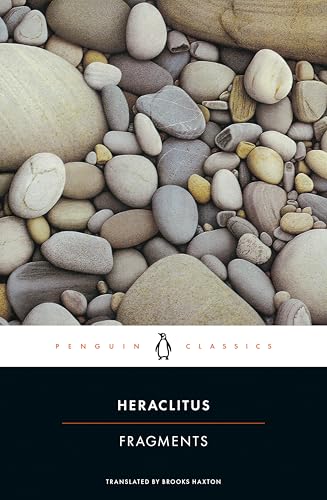
Get Fragments of Heraclitus on Amazon
As an Amazon Associate, Thalira earns from qualifying purchases.
Deepen Your Hermetic Practice
The Hermetic Synthesis Course guides you through all seven principles with structured daily practices.
Explore the CourseFrequently Asked Questions
Who was Heraclitus?
A pre-Socratic Greek philosopher (c. 535-475 BCE) from Ephesus. Called "The Obscure" for his paradoxical style. His work survives only in ~130 fragments.
What does "everything flows" mean?
Reality is fundamentally dynamic. "You cannot step into the same river twice." Change is the nature of things; stability is an illusion.
What is the Logos?
The rational principle governing the universe: hidden order within chaos. "Common to all" but perceived by few. Influenced Stoicism, Christianity (John 1:1), and Hegel.
What is the unity of opposites?
"The road up and the road down are one and the same." Opposites are aspects of a single reality. Day/night, life/death, health/disease define each other.
Why fire?
Fire symbolizes reality's dynamic, meaningful nature. "An ever-living fire, kindling in measures and being extinguished in measures." Always changing, always in process.
Why was he called "The Obscure"?
His paradoxical, compressed style resists simple interpretation. Deliberate: "Nature loves to hide." Truth reveals itself only to deep thinkers.
How does he relate to Eastern philosophy?
Parallels with Taoism (Logos/Tao), Buddhism (impermanence), Hinduism (Brahman). Whether from historical contact or independent discovery is debated.
What is "war as father"?
Conflict and opposition are creative forces. Without tension between opposites, nothing would exist. The bow and lyre generate power from opposition.
What about waking vs. sleeping?
"The waking have one common world; the sleeping turn aside each into a world of his own." Most people are "asleep," absorbed in private opinions rather than perceiving the Logos.
What is the best edition?
Robin Waterfield (Penguin, 2009) for accessibility. Charles Kahn (Cambridge, 1979) for scholarship. T.M. Robinson (Toronto, 1987) for bilingual text.
What are the Fragments of Heraclitus?
The Fragments are approximately 130 surviving quotations from Heraclitus's original work, preserved by later Greek and Roman authors who quoted him. The original work, possibly titled 'On Nature,' has been lost. The fragments are typically numbered according to the Diels-Kranz system (DK 1-130+). They range from single sentences to short paragraphs and are characterized by their aphoristic density, paradoxical logic, and resistance to simple interpretation.
What does 'everything flows' mean?
'Panta rhei' (everything flows) is the phrase most commonly associated with Heraclitus, though it may be a later summary rather than his exact words. His actual statement is: 'You cannot step into the same river twice, for other waters are continually flowing on.' The principle is that reality is fundamentally dynamic: nothing remains the same from one moment to the next. Change is not something that happens to things; change is the fundamental nature of things. Stability is an illusion created by the mind's tendency to see patterns in the flux.
What is the role of fire?
Fire is Heraclitus's primary symbol for the nature of reality. 'This cosmos was made by neither gods nor men, but was, is, and always will be: an ever-living fire, kindling in measures and being extinguished in measures' (DK 30). Fire represents constant transformation: it consumes fuel and produces heat, light, and ash in a continuous process of change. Reality is like fire: always changing, always in process, never static. Some scholars believe Heraclitus considered fire to be the actual substance of reality; others read it as a metaphor for the dynamic nature of existence.
Why was he called 'The Obscure'?
Ancient commentators called Heraclitus 'The Obscure' (ho Skoteinos) because of the difficulty of his aphoristic, paradoxical style. He wrote in compressed, enigmatic sentences that resist simple interpretation and often seem to contradict themselves. This obscurity was likely deliberate: Heraclitus believed that truth is hidden and that only those who make the effort to think deeply will understand. 'Nature loves to hide' (DK 123). His style forces the reader to engage actively with the text rather than passively receiving information.
How does Heraclitus relate to Eastern philosophy?
Scholars have noted striking parallels between Heraclitus and several Eastern traditions: the Taoist concept of the Tao (the way that governs all change), the Buddhist doctrine of impermanence (anicca), and the Hindu concept of Brahman as the underlying unity of all things. Whether these parallels reflect actual historical contact (Ephesus was connected to Eastern trade routes), common Indo-European philosophical roots, or independent discovery of universal truths remains debated.
What is the war of opposites?
'War is the father of all and the king of all' (DK 53). Heraclitus saw conflict, strife, and opposition as the fundamental creative forces of the universe. Without the tension between opposites, nothing would exist. Day requires night, life requires death, creation requires destruction. This is not a glorification of violence but a recognition that reality is generated by the dynamic tension between opposing forces. Remove the tension, and reality collapses into undifferentiated nothing.
What influenced Heraclitus?
The direct influences on Heraclitus are difficult to determine because he criticized all his predecessors. He explicitly rejected Hesiod, Pythagoras, Xenophanes, and Homer, claiming that 'Much learning does not teach understanding' (DK 40). His thinking may have been shaped by the Milesian tradition of natural philosophy, by exposure to Eastern ideas through Ephesus's position on trade routes, and by his own introspective observation of mental processes and natural phenomena.
What is the best edition of the fragments?
The Penguin Classics edition by Robin Waterfield (2009) provides an accessible translation with extensive commentary. Charles Kahn's The Art and Thought of Heraclitus (1979, Cambridge) is the standard scholarly edition. Dennis Sweet's bilingual edition gives Greek text and English translation side by side. T.M. Robinson's Heraclitus: Fragments (1987, Toronto) is another excellent scholarly edition. For a philosophical interpretation, Daniel Graham's Explaining the Cosmos (2006, Princeton) is recommended.
Sources and References
- Kahn, C. H. (1979). The Art and Thought of Heraclitus. Cambridge University Press.
- Waterfield, R. (trans.) (2009). The First Philosophers. Oxford World's Classics.
- Robinson, T. M. (1987). Heraclitus: Fragments. University of Toronto Press.
- Graham, D. W. (2006). Explaining the Cosmos. Princeton University Press.
- Kirk, G. S. (1954). Heraclitus: The Cosmic Fragments. Cambridge University Press.
- Hussey, E. (1972). The Presocratics. Duckworth.