
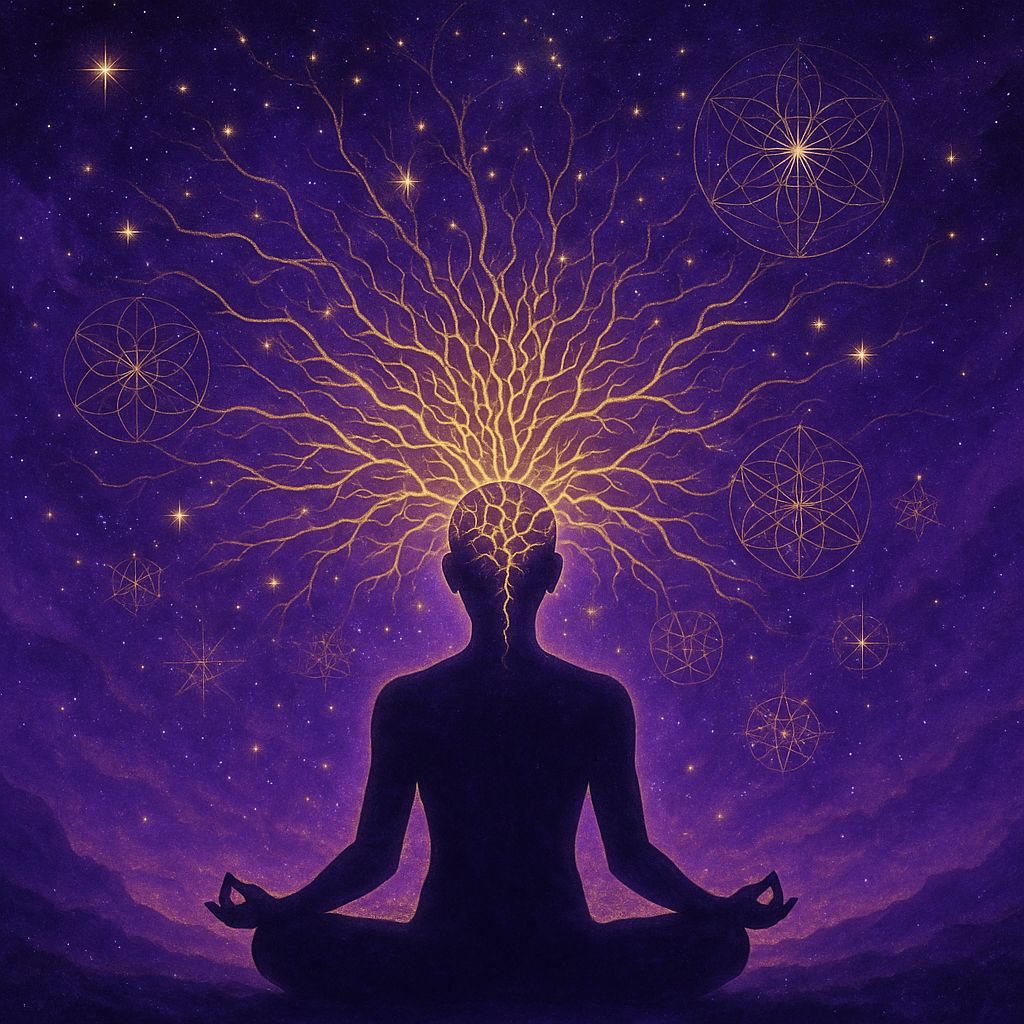
Rudolf Steiner argued that human thinking is not a private mental event but a participation in a world of ideas that has its own cosmic origin and history. The concepts we access when we think genuinely have their source in the same cosmic intelligence that produced the natural world. This is the "cosmic dimension" of thinking: our individual thought is a microcosmic echo of a macrocosmic wisdom that precedes and encompasses it.
Last updated: March 15, 2026
- The Logos tradition identifies cosmic intelligence or World Reason as the ground of both natural order and human thinking.
- Steiner held that concepts accessed through genuine thinking are not invented but encountered: they belong to a cosmic conceptual world that underlies both nature and mind.
- The spiritual hierarchies, in Steiner's account, are the beings whose cosmic thinking produced the natural world that human thinking can understand.
- Thought-forms, the spiritual residue of thinking activity, have real consequences in the spiritual world, not just in individual character.
- Steiner's philosophical claims about thinking can be engaged independently of his more speculative esoteric cosmology.
The Logos Tradition
The concept of the Logos, the cosmic Reason or World Word, is one of the oldest and most persistent ideas in Western philosophy and spirituality. It appears in Heraclitus's claim that a single rational order (Logos) governs the ceaseless flux of the world. It is central to Stoic cosmology, in which the Logos is both the divine reason immanent in nature and the rational principle in human beings that allows them to understand and participate in the cosmic order. It undergoes a decisive development in the Prologue of John's Gospel: "In the beginning was the Word (Logos), and the Word was with God, and the Word was God."
The Neoplatonist philosopher Plotinus (c.204-270 CE) developed the Logos as the second hypostasis of the One-Nous-Soul triad: the universal Intelligence that contains all the archetypal Forms and from which the material world emanates. The Logos, in Neoplatonism, is both the source of the world's intelligible structure and the medium through which individual minds can grasp that structure.
Rudolf Steiner worked within and beyond this tradition, making the Logos the centrepiece of his Christology and his philosophy of thinking. For Steiner, the Logos is not an abstract principle but a real spiritual being: the cosmic intelligence whose development through the stages of Earth evolution is the central event of human and cosmic history. The incarnation of the Logos in the historical Jesus represented the culmination of a long preparatory process and the beginning of a new phase in human consciousness development.
World Thoughts and Individual Thinking
One of Steiner's most distinctive contributions to the philosophy of mind is his account of the relationship between individual thinking and what he calls the "thought-content of the world." When a human being thinks a genuine thought, the thought is not being created from nothing in the private interior of the mind. The thought-content, the concept or idea being grasped, is being encountered rather than invented.
Mathematical truths are the clearest example. When you grasp that the sum of the angles of a plane triangle is 180 degrees, you are not inventing this relationship; you are discovering it. The relationship was true before you thought about it and would remain true if all human minds ceased to exist. It belongs, in some sense, to the structure of the conceptual world rather than to any individual mind.
Steiner extended this point beyond mathematics to all genuine thinking. The concept of justice, the idea of living organism, the nature of compassion, the principles of logical inference: all of these are encountered by thinking rather than invented by it. The sum of these concepts and their relationships constitutes what Steiner called the "thought-content of the world" or, in some contexts, the "cosmic thoughts" that underlie both nature and mind.
The implication is significant: when you think genuinely, you are not operating in a private mental space. You are participating in a shared conceptual reality that connects individual minds to one another and to the cosmic intelligence that originated these concepts. This gives thinking a fundamentally communal and cosmic character that purely subjectivist accounts of mind obscure.
The Spiritual Hierarchies
Steiner's cosmology includes a detailed account of the spiritual beings who, in his view, are responsible for the cosmos's conceptual structure. Derived in part from Dionysius the Areopagite's 5th-6th century hierarchical scheme (Seraphim, Cherubim, Thrones; Dominions, Virtues, Powers; Principalities, Archangels, Angels), Steiner's spiritual hierarchies are described as beings at different stages of cosmic development, each associated with different aspects of cosmic thinking.
The highest hierarchies (Seraphim, Cherubim, Thrones) are associated with the will, feeling, and thinking of the Trinity itself. The middle hierarchies (Dominions/Kyriotetes, Virtues/Dynamis, Powers/Exousiai) are associated with the cosmic intelligence that designed the macroscopic and microscopic structures of the physical world. The lower hierarchies (Archai, Archangels, Angels) are associated with the guidance of human cultural evolution, the inspiration of peoples and nations, and the relationship between individual humans and their spiritual guidance.
Steiner's claim is that the conceptual structure of the natural world, the mathematical laws, the organisational principles of living things, the pattern of cosmic history, is the result of the thinking activity of these hierarchical beings. When a human scientist discovers a law of nature, they are, in Steiner's framework, rediscovering a thought that was originally thought by a being at one of these hierarchical levels. Human thinking participates in cosmic thinking when it is genuine, but approaches it from below, as a younger and still-developing form of intelligence.
Cosmic Evolution and the Development of Thinking
Steiner's account of cosmic evolution, presented most fully in his book An Outline of Esoteric Science (1910), describes the solar system's development through four main stages, which he called Old Saturn, Old Sun, Old Moon, and Earth (with three future stages, Jupiter, Venus, and Vulcan, to follow). Each stage is characterised by a different quality of matter-consciousness and involves the development of different human sheaths and faculties.
The development of individual thinking, in Steiner's account, is specifically the task of the Earth stage. In earlier stages, consciousness was more dreamlike, collective, and clairvoyant: it had a participatory quality like the "original participation" that Owen Barfield also described. The development of the sharp, individual, self-conscious thinking that characterises modern humans is the specific contribution of Earth evolution, won at the cost of losing the earlier clairvoyant connection to spiritual reality.
Steiner's account of this development is not pessimistic. The loss of earlier participatory consciousness is understood as a necessary sacrifice to develop something new: the kind of individual freedom that requires genuine self-consciousness and self-directed thinking. Future evolutionary stages (the Jupiter epoch, in Steiner's terminology) will involve the recovery of spiritual perception but in a new form, consciously developed by individuals who have first passed through the phase of individual rational thinking. The cosmic dimension of thinking is thus not simply a given inheritance but a capacity that is being evolved through the joint work of cosmic intelligence and human freedom.
Thought-Forms and Their Consequences
In Steiner's spiritual cosmology, every act of thinking, feeling, and willing leaves a trace in the spiritual world. This is the concept of thought-forms: the idea that thinking activity produces real (though supersensible) effects that have their own duration, quality, and influence. Morally clear, loving, truth-oriented thoughts produce forms that contribute positively to the spiritual environment. Confused, malicious, or degraded thinking produces forms of corresponding quality.
This concept appears in modified form in the Theosophical tradition (Annie Besant and C.W. Leadbeater published Thought-Forms in 1901, claiming clairvoyant observation of the coloured forms produced by different emotional and mental states) and has parallels in the esoteric traditions of many cultures. The idea that thoughts are real and have real effects beyond the thinking individual is central to the moral significance of inner life in virtually all contemplative traditions.
Whether or not you accept the literal reality of thought-forms in Steiner's technical sense, the underlying point has practical force: the quality of your habitual thinking shapes your character, your relationships, and (across Steiner's cosmic framework) contributes to the spiritual environment of your time. Clear, loving, truth-seeking thinking is not merely personally beneficial; in Steiner's account, it contributes to the spiritual development of humanity as a whole in a way that cannot be reduced to its observable social effects.
The Akashic Record
The Akashic Record is a concept Steiner employed, which he shared with the broader Theosophical tradition, to describe a spiritual record of all events in cosmic and earthly history preserved in the etheric dimension of reality. The Sanskrit term akasha refers to the fifth element, the subtle field of space in which all phenomena are said to be inscribed.
Steiner claimed that his accounts of cosmic evolution and of specific historical events (including accounts of Atlantis and the details of ancient mystery schools) were based on his clairvoyant reading of this record. He distinguished this from imagination or speculation: the Akashic Record, in his account, is an objective spiritual reality that trained clairvoyance can access, not a personal vision.
These claims are not verifiable by ordinary empirical means, and mainstream historical and scientific scholarship does not accept them. They belong to Steiner's esoteric cosmology, which should be approached with the same critical engagement one brings to any large-scale metaphysical system: taking seriously the questions it raises, respecting the spiritual seriousness of its author, while maintaining appropriate uncertainty about its specific claims.
The concept of cosmic memory preserved in a non-physical record is not unique to Steiner or to Theosophy; variations appear in Indigenous traditions (the concept of living memory in the land), in Jungian psychology (the collective unconscious), and in certain interpretations of quantum field theory (the idea that information is never truly destroyed). Whether these converging intuitions point toward a shared reality or represent parallel myths about memory and continuity is an open question.
Intellect, Reason, and Intuition
Steiner's epistemology distinguishes three modes of cognitive activity that correspond, broadly, to the three stages of spiritual development he describes in his practical books.
The intellect (Verstand) is the everyday analytical mind: it divides, classifies, compares, and establishes logical connections. It is the faculty that ordinary scientific and academic thinking primarily employs. The intellect is precise and powerful within its domain, but it operates on a world already divided into concepts; it does not itself grasp the living unity from which the divisions are made.
Reason (Vernunft, in Kant's and Hegel's sense) is the faculty that grasps the relations between concepts, the systematic structure of a domain of knowledge, and the way different intellectual divisions relate to an underlying whole. It is the faculty of synthesis where the intellect is the faculty of analysis. The great systematisers of Western philosophy, Aristotle, Leibniz, Kant, Hegel, were exercising reason in this sense.
Intuition, in Steiner's technical vocabulary, is a further cognitive step beyond both: a direct spiritual perception in which the thinking subject and the thought-content are no longer separate. Ordinary intuition (the flash of understanding, the sudden recognition) is a shadow of this: a moment in which the gap between thinker and thought temporarily narrows. Full intuitive cognition, as Steiner describes it in How to Know Higher Worlds, is a stable capacity developed through long practice, in which the thinker can remain as clearly self-aware as in ordinary intellectual thinking while simultaneously perceiving the spiritual reality of what they are thinking about.
Steiner and Hegel on Cosmic Mind
The parallels between Steiner and Hegel on the question of cosmic thinking are striking and were not accidental. Steiner wrote extensively on Hegel in his early philosophical writings and acknowledged Hegel as the philosopher who came closest to grasping the cosmic dimension of thinking within the Western tradition.
Hegel's Phenomenology of Spirit (1807) describes the journey of consciousness from its most naive and immediate form (sense-certainty) through multiple stages of self-reflection, recognition, and alienation to Absolute Knowledge: the state in which consciousness recognises itself in everything it encounters, knowing that the world is not other than thought but is thought's own objectification. The Absolute Spirit thinks itself through the medium of human minds.
Steiner agreed that thinking participates in something beyond individual minds and that the development of thinking consciousness is the central drama of human history. Where he differed from Hegel was on the personal character of cosmic intelligence and on the status of the individual human being within it. Hegel's Absolute is impersonal and abstract; individual thinking is merely a phase of its self-realisation. For Steiner, cosmic intelligence consists of real persons (the spiritual hierarchies), and the human individual is not a dispensable phase of the Absolute's self-realisation but a genuinely new and irreplaceable spiritual being.
This difference is not merely academic. It determines whether the cultivation of individual thinking is something to be transcended in the service of a greater Whole or whether individual spiritual development is itself the cosmic goal. For Steiner, it is the latter: the evolution of free, morally responsible individuals who participate consciously in the life of the cosmos is the aim, not merely a means to it.
Humans as Co-Creators
The concept of humans as co-creators, participants in the ongoing development of the cosmos rather than merely its products, is central to Steiner's vision of human destiny. The spiritual hierarchies that originated human beings did so with the intention that humans would eventually become conscious co-workers in cosmic evolution, bringing a dimension of freedom and individuality that the higher hierarchies themselves could not produce by their own thinking, because their thinking, though incomparably greater than human thinking, operates from necessity rather than from freedom.
Human thinking, in Steiner's account, is the medium through which something genuinely new can be added to the cosmos. When a human being freely grasps a moral truth and acts from it, they are adding to the cosmos a fact that could not have existed without the free act of individual human consciousness. This is the cosmic significance of ethical life: not merely its social benefit, but its contribution to the development of a universe in which freedom, as well as intelligence, has become a real force.
This vision resonates with certain contemporary philosophical and theological accounts of human participation in creation: process theology's God who is enriched by human experience, Teilhard de Chardin's Omega Point as the convergence of cosmic consciousness, and the various participatory philosophies influenced by both Eastern and Western mystical traditions. Whether one accepts the specific metaphysical framework or not, the underlying intuition that human consciousness is not a passive mirror of an already-complete cosmos but an active participant in an ongoing creation is one of the most generous and motivating ideas in the spiritual heritage of humanity.
The Practice Implications
If Steiner's account of the cosmic dimension of thinking has even partial truth, several practical consequences follow for inner development.
First, the seriousness of thinking itself. If every genuine thought participates in the cosmic life of ideas, then intellectual carelessness, the acceptance of sloppy arguments, the repetition of received opinions without genuine engagement, has consequences beyond personal shortcoming. It represents a failure to participate in the cosmic dimension of thinking that is available to human beings. The cultivation of intellectual rigour and honesty is not separate from spiritual development but is one of its primary forms.
Second, the moral dimension of inner life. If thoughts have real consequences in the spiritual world through their quality and the thought-forms they produce, then the cultivation of the inner life is not merely a personal wellness practice. It is a contribution to the spiritual environment of one's time and community. Steiner emphasised the development of what he called "ethical individualism," the capacity to act from genuine moral insight, as both the product of developed thinking and its highest expression.
Third, the patience of spiritual development. Cosmic evolution operates on timescales that dwarf individual human lives. The individual's contribution to cosmic evolution through the development of their thinking and moral life is not visible in the ordinary temporal frame but participates in something whose significance unfolds over millennia. This gives spiritual practice a quality of unhurried seriousness that neither spiritual ambition (demanding rapid results) nor spiritual resignation (assuming nothing can be accomplished) captures.
Resources for working at the intersection of philosophical thinking and inner development are available in Thalira's consciousness research collection. For those drawn to the specific tradition of Steiner's work, the related articles on Steiner's Philosophy of Freedom and Is Thinking Really a Spiritual Activity? provide complementary perspectives.
Frequently Asked Questions
What does Steiner mean by the 'cosmic dimension' of thinking?
Steiner argued that when individual humans think genuine thoughts, they are not producing private mental events but participating in a world of concepts and ideas that exists independently of any individual mind. This world of ideas has a cosmic origin: in Steiner's account, the same conceptual life that human thinking participates in also underlies the structure and development of the natural world. Individual thinking is a microcosmic reflection of a macrocosmic intelligence.
What is the Logos in Steiner's teaching?
The Logos (Greek for 'word' or 'reason') in Steiner's Anthroposophy is the cosmic intelligence or World Word that is the spiritual ground of reality. Steiner associated the Logos with the Christ being in an esoteric rather than dogmatic sense: the cosmic Word that became incarnate in the physical world at the Turning Point of Time, bringing about a transformation of human consciousness. Individual thinking, for Steiner, participates in this Logos when it is genuine rather than merely mechanical.
What is Steiner's concept of cosmic evolution?
Steiner described a cosmic evolution of the solar system through four major stages: Saturn (heat/will), Sun (light/feeling), Moon (life/dreaming consciousness), and Earth (physical matter/waking consciousness). Human beings are described as having developed through all these stages, with the current Earth evolution focusing on the development of the physical body and individual, self-conscious thinking. Future cosmic stages would involve the development of higher faculties beyond current intellectual thinking.
How does Steiner relate individual thinking to cosmic intelligence?
Steiner held that the concepts and ideas accessed through individual thinking are not invented by the individual but are encountered as real structures in a conceptual world. This conceptual world is the product of cosmic intelligence, specifically of the hierarchical spiritual beings (Angels, Archangels, Archai, Exousiai, and others) whose thinking gave rise to the natural world. When a person thinks a genuine mathematical truth, they are accessing a thought that was first 'thought' by cosmic intelligence at a far earlier stage.
What are thought-forms in Steiner's cosmology?
In Steiner's clairvoyant account, every thought, emotion, and act of will produces a form in the spiritual world that has a certain duration and influence. Morally noble thoughts produce forms of beauty and light; destructive or degraded thoughts produce forms of corresponding quality. This concept appears in modified form in Theosophy (from Besant and Leadbeater's 'Thought-Forms' of 1901) and has parallels in various esoteric traditions. Steiner emphasised that the moral quality of thinking has real consequences in the spiritual world, not just in the individual's character.
What is the Akashic Record in Steiner's teaching?
The Akashic Record (from the Sanskrit 'akasha,' the subtle element of space) is described by Steiner as a spiritual record of all cosmic and earthly events, preserved in the etheric field of the Earth. In Steiner's clairvoyant investigations, he claimed to read this record for the basis of his accounts of cosmic evolution, Atlantis, and the evolution of humanity. Mainstream scholarship treats these claims as speculative spiritual cosmology rather than historical record, and they should be approached as such.
What is the difference between intellect and intuition in Steiner's framework?
In Steiner's epistemological hierarchy, the intellect (Verstand) operates analytically, dividing reality into concepts and establishing logical connections between them. Reason (Vernunft) operates synthetically, grasping the living unity that the intellect has divided. Intuition (Intuition, in the technical sense) is the highest cognitive mode: a direct spiritual perception in which the thinking being and the thought content become one without any mediation. Steiner saw the development from intellect through reason to intuition as the path of spiritual cognition.
How does Steiner's cosmic thinking relate to Hegel's Absolute Spirit?
Steiner was familiar with Hegel's philosophy and saw it as a significant but incomplete anticipation of his own position. Hegel's Absolute Spirit thinks itself into existence through the logical development of pure concepts. Steiner agreed that thinking participates in something beyond individual minds but disagreed with Hegel's impersonal Absolute. For Steiner, the cosmic intelligence behind thinking is personal: it consists of hierarchically ordered spiritual beings, not an abstract Absolute. The individual human being is not a moment in the Absolute's self-development but a genuinely new spiritual being who brings something to the cosmos that was not previously present.
What did Steiner mean when he said 'man is a thought of the Gods'?
Steiner used this formulation to express the idea that human beings are not accidental products of material evolution but beings who were conceived, intended, and developed by spiritual intelligences operating over cosmic timescales. The human form, capacities, and destiny were 'thought' by divine beings before they were physically realised. This does not mean humans are passive: the goal of cosmic evolution, in Steiner's account, is for humans to become free, self-conscious co-creators rather than dependents of the beings who originated them.
Does Steiner's cosmic philosophy of thinking require accepting his esoteric claims?
No. Steiner made two kinds of claims about thinking: philosophical claims (that thinking is self-transparent, that it accesses real conceptual content not of its own making, that it is the ground of freedom), and clairvoyant-investigative claims (about hierarchies, cosmic evolution, Akashic Records). The philosophical claims can be engaged with on their own terms, independently of the esoteric claims. Many readers find Steiner's philosophy of thinking deeply illuminating while remaining agnostic about his cosmological account.
How does cosmic thinking relate to the practice of meditation?
If thinking has a cosmic dimension, then the development of thinking through meditation is not merely a personal wellness practice but a contribution to cosmic evolution. Steiner held that the development of clear, loving, morally grounded thinking in individual humans gradually lifts the general level of thinking available in the human sphere. This gives meditative thinking practice a significance beyond personal benefit: it is part of the ongoing development of human consciousness as a whole.
What is the relationship between cosmic thinking and creativity?
In Steiner's account, genuine creativity, the production of something genuinely new that did not exist before, is possible for human beings precisely because they participate in the cosmic life of ideas. Mere recombination of existing elements is not creation; genuine creation brings something from the conceptual world into physical reality for the first time. This is the sense in which artists, scientists, and spiritual pioneers are described in esoteric tradition as co-creators with the divine: they are bringing cosmic potentials into actual existence through the medium of individual human thinking and action.
Sources
- Steiner, R. (1910/1972). An Outline of Esoteric Science. Anthroposophic Press.
- Steiner, R. (1904/1947). Theosophy: An Introduction to the Supersensible Knowledge of the World and the Destination of Man. Anthroposophic Press.
- Hegel, G.W.F. (1807/1977). Phenomenology of Spirit (A.V. Miller, Trans.). Oxford University Press.
- Besant, A., & Leadbeater, C.W. (1901). Thought-Forms. Theosophical Publishing Society.
- Barfield, O. (1957). Saving the Appearances: A Study in Idolatry. Faber and Faber.
- Wilber, K. (2000). Integral Psychology: Consciousness, Spirit, Psychology, Therapy. Shambhala.