
Quick Answer
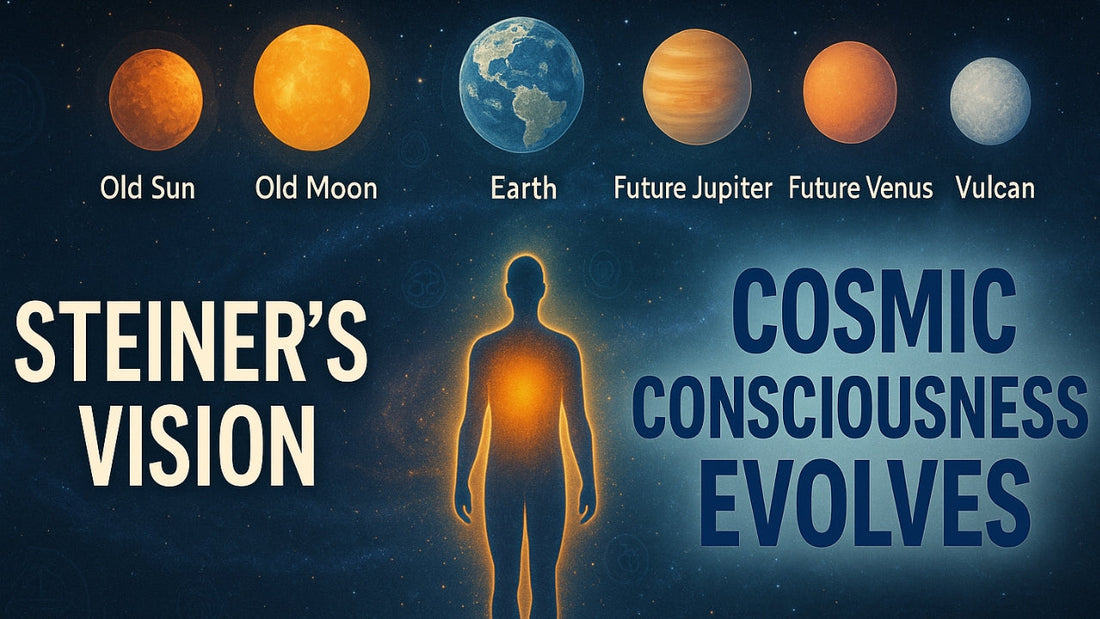
Rudolf Steiner described consciousness evolving through seven great cosmic periods (Old Saturn through Future Vulcan), with our current Earth stage containing seven epochs and seven cultural ages. We are in the fifth Post-Atlantean cultural age (1413-3573 AD), characterised by intellectual development and scientific thinking. A 2025 review of consciousness science found growing evidence that awareness may be far older and more widespread than traditionally believed, aligning with Steiner's view that consciousness, not just bodies, evolves through purposeful stages.
Table of Contents
- Steiner's Grand Perspective
- Beyond Darwin: Consciousness Evolution
- The Seven Planetary Stages
- Seven Epochs of Earth Evolution
- Post-Atlantean Cultural Ages
- Evolution of Human Faculties
- Our Current Evolutionary Moment
- The Christ Impulse
- What Research Does and Does Not Support
- Frequently Asked Questions
Key Takeaways
- Consciousness evolves, not just bodies: Steiner described a vast framework where consciousness itself develops through seven great cosmic periods, each developing new human capacities
- Seven planetary stages: Old Saturn (physical foundations), Old Sun (life forces), Old Moon (soul qualities), Earth (self-consciousness), Future Jupiter (imagination), Future Venus (inspiration), Future Vulcan (intuition)
- We are at a turning point: The fifth Post-Atlantean cultural age (1413-3573 AD) has developed intellectual freedom and scientific thinking, but is beginning to transition toward integrating spiritual perception with scientific clarity
- 2025 neuroscience aligns: Researchers increasingly argue that consciousness may be far older and more widespread than traditionally believed, with rudimentary awareness predating complex nervous systems
- Active participation possible: We are not passive products of evolution but can consciously develop capacities through meditation and inner development that foreshadow future evolutionary stages
Anthroposophy's View on The Cosmic Evolution of Consciousness: Rudolf Steiner's Grand Perspective
Ever wondered how human consciousness evolves according to Rudolf Steiner's spiritual science and why it seems to be developing so rapidly?
Or why ancient people experienced reality so differently than we do today?
These aren't random changes but part of a vast cosmic process.
Steiner's insights into Rudolf Steiner's remarkable insights into the evolution of consciousness through anthroposophy, and understanding spiritual science consciousness development offers a comprehensive framework for understanding human history and potential.
Beyond Darwin: Rudolf Steiner Evolution of Consciousness, Not Just Bodies
We're familiar with biological evolution – how physical forms develop over time.
But Steiner revealed something more profound: consciousness itself evolves.
This isn't just about getting smarter or more knowledgeable.
It's about fundamental shifts in how humans perceive, think, and experience reality.
Ancient peoples didn't just have different beliefs – they literally experienced the world differently than we do.
And future humans will experience reality in ways we can barely imagine.
This evolution isn't random but follows a meaningful pattern that Steiner mapped in extraordinary detail.
The Cosmic Timeframe: Spiritual Science Evolution Through Planetary Stages
Steiner described a vast cosmic timeframe for evolution that dwarfs conventional scientific timelines.
According to his spiritual research, our Earth and humanity have evolved through previous planetary stages:
• Old Saturn – The earliest stage where the foundations of physical existence were laid
• Old Sun – The development of life forces and etheric qualities
• Old Moon – The emergence of astral (soul) qualities
• Earth – Our current stage, developing individual self-consciousness
And will continue through future stages:
• Future Jupiter – The transformation of thinking into imagination
• Future Venus – The transformation of feeling into inspiration
• Future Vulcan – The transformation of willing into intuition
Each stage represents a complete cycle of development, with humanity evolving new capacities in each epoch.
This grand perspective places our current struggles and achievements within a meaningful cosmic context.
Anthroposophy Stages of Consciousness: The Seven Epochs of Earth Evolution
Within our current Earth stage, Steiner's anthroposophy describes seven major epochs of consciousness development, each characterized by different relationships between the etheric body, astral body, and physical body:
| Epoch | Spiritual Connection | Physical Embodiment | Self-Awareness | Emotional Development | Intellectual Capacity | Moral Development | Integration |
|---|---|---|---|---|---|---|---|
| Polarian | 9 | 1 | 1 | 2 | 1 | 3 | 2 |
| Hyperborean | 8 | 3 | 1 | 2 | 1 | 3 | 2 |
| Lemurian | 7 | 5 | 3 | 3 | 2 | 3 | 3 |
| Atlantean | 6 | 7 | 5 | 6 | 3 | 4 | 4 |
| Post-Atlantean (Current) | 3 | 9 | 8 | 7 | 9 | 6 | 5 |
| Future Epoch | 7 | 8 | 9 | 8 | 9 | 8 | 8 |
| Final Earth Epoch | 9 | 9 | 9 | 9 | 9 | 9 | 9 |
1. Polarian Epoch – Dreamlike consciousness connected to spiritual worlds
2. Hyperborean Epoch – Deepening connection to physical existence
3. Lemurian Epoch – Development of the first rudimentary self-awareness
4. Atlantean Epoch – Instinctive clairvoyance and connection to natural forces
5. Post-Atlantean Epoch – Our current epoch, developing intellectual consciousness
6. Future Epoch – Development of conscious spiritual perception
7. Final Earth Epoch – Integration of spiritual and physical existence
We're currently in the fifth (Post-Atlantean) epoch, which itself contains seven cultural ages.
This detailed mapping of consciousness evolution provides a framework for understanding both human history and our future potential.
The Post-Atlantean Cultural Ages in Anthroposophy
Our current Post-Atlantean epoch contains seven cultural ages, each developing specific aspects of consciousness and showing the difference between ancient and modern consciousness in anthroposophy:
1. Ancient Indian (7227-5067 BC) – Dreamlike spiritual consciousness
2. Ancient Persian (5067-2907 BC) – Recognition of the dual nature of existence
3. Egypto-Chaldean (2907-747 BC) – Development of star wisdom and earthly sciences
4. Greco-Roman (747 BC-1413 AD) – Development of logical thinking and individual identity
5. Anglo-Germanic (1413-3573 AD) – Our current age, developing intellectual freedom and scientific thinking
6. Russian-Slavonic (3573-5733 AD) – Future development of spiritual perception within physical consciousness
7. American (5733-7893 AD) – Future integration of spiritual and physical consciousness
Each age builds upon the achievements of previous ages while developing new capacities.
We're currently in the fifth cultural age, characterized by intellectual development, scientific thinking, and the emergence of freedom.
The Evolution of Human Faculties: Spiritual Perception vs Sense-Based Perception
Throughout these vast evolutionary cycles, specific human faculties have developed and transformed, showing the contrast between spiritual perception and sense-based perception:
• Consciousness – From dreamlike unity with spiritual worlds to clear self-awareness
• Perception – From instinctive clairvoyance to sense-based observation to future conscious spiritual perception
• Thinking – From picture-consciousness to logical thinking to future living thinking
• Social Organization – From tribal consciousness to individual freedom to future conscious community
Each faculty evolves through a process of separation and reintegration.
We temporarily lose connection with spiritual realities to develop independence, then consciously reconnect from a place of freedom.
This pattern of loss and conscious reconnection is the fundamental rhythm of consciousness evolution.
Our Current Evolutionary Moment in Consciousness Development
According to Steiner's clairvoyant research methods, we stand at a turning point in consciousness evolution, between material understanding and spiritual perception.
The materialistic worldview that has dominated recent centuries has served its purpose in developing clear thinking and scientific observation.
But it has reached its limits.
We're now beginning a gradual transition toward a new kind of consciousness that integrates spiritual perception with scientific clarity.
This transition isn't automatic but depends on human choice and development.
In lectures like "The Evolution of Consciousness," Steiner described how modern humans can consciously participate in this evolutionary process through specific practices and awareness.
We're not passive products of evolution but active participants in shaping its direction.
The Christ Impulse Evolution in Anthroposophy
Central to Steiner's understanding of consciousness evolution is what he called the "Christ Impulse evolution" - a cosmic force that transforms human consciousness.
This isn't merely a religious concept but a cosmic evolutionary force that provides the balance between spiritual and physical existence.
According to Steiner, the incarnation of Christ represented a moment in Earth evolution – the point where cosmic intelligence began to unite with human consciousness.
This impulse continues to work in evolution, regardless of whether one recognizes it through religious concepts.
It manifests as the capacity for selfless love, moral intuition, and the ability to find spiritual meaning within material existence.
In his lectures on "Cosmic Christianity," Steiner described how this impulse works to transform human consciousness from within.
Practical Implications: Waldorf Education Consciousness Evolution
Understanding consciousness evolution through anthroposophy isn't just theoretical – it has practical implications for how we live, most notably in Waldorf education consciousness evolution:
• Education – Recognizing that children recapitulate aspects of consciousness evolution in their development
• Health – Understanding the relationship between evolutionary forces and wellbeing
• Social Organization – Creating structures that support emerging consciousness capacities
• Personal Development – Consciously participating in the evolution of new capacities
• Cultural Creation – Producing art, science, and social forms that serve future evolution
Steiner's work in Waldorf education consciousness evolution, biodynamic agriculture, and social renewal all stemmed from this anthroposophical understanding of how consciousness develops through imagination, inspiration, and intuition.
By aligning our activities with evolutionary currents, we can participate consciously in humanity's development.
What Research Does and Does Not Support
Honest Assessment of the Evidence
What research supports: A 2025 review of consciousness science found growing evidence that awareness may be far older and more widespread than traditionally believed, with studies examining simple organisms and evolutionary pathways suggesting rudimentary forms of awareness could predate complex nervous systems (The Debrief, 2025). Historians Owen Barfield and Jean Gebser documented fundamental changes in human consciousness modes across historical periods. The 2025 Science of Consciousness conference in Barcelona presented research on meditation-neuroscience integration and neurophenomenological methods. Psychedelic research demonstrates that brain networks can rapidly reorganize, temporarily dissolving rigid patterns of thought.
What research does not support: Steiner's specific cosmic chronology (Old Saturn, Old Sun, Old Moon stages) is not empirically testable and is not accepted by mainstream science. The claimed dates for cultural ages are not supported by archaeology or historiography. The concept of "etheric bodies" and "astral bodies" remains outside scientific measurement. The claim that ancient peoples had "clairvoyant perception" cannot be verified through historical or neurological methods.
The honest position: Steiner's framework offers a comprehensive philosophical system for understanding consciousness development that resonates with certain aspects of modern consciousness research. The observation that human consciousness has changed across historical periods is well-supported. The specific spiritual interpretations and cosmic timeline should be understood as a philosophical framework rather than scientific theory. Its value lies in providing a meaningful context for personal development and a sophisticated language for discussing consciousness evolution.
You are a participant, not a spectator.
The evolution of consciousness provides a grand context for understanding both human history and your individual life. You are not an isolated being in a meaningless universe but a participant in a vast, purposeful process of development. By understanding this process, you can more consciously participate in shaping both your personal development and humanity's future.
An Outline of Occult Science: Unabridged and Illustrated Book by Rudolf Steiner by Steiner, Rudolf
View on AmazonAffiliate link, your purchase supports Thalira at no extra cost.
Frequently Asked Questions
How did human consciousness evolve according to Steiner?
According to Steiner, human consciousness evolved from dreamlike spiritual perception in ancient times through various stages toward our current intellectual consciousness. This evolution progresses through the sentient soul, intellectual soul, and consciousness soul. Steiner described seven great cosmic periods, seven epochs within our current Earth period, and seven cultural ages within our Post-Atlantean epoch.
Is there evidence for consciousness evolution beyond Steiner's spiritual research?
Historians like Owen Barfield and Jean Gebser documented how human consciousness has fundamentally changed throughout history. A 2025 review in neuroscience found growing evidence that consciousness may be far older and more widespread than traditionally believed. Archaeological evidence shows how human perception and thinking have evolved across cultures and epochs.
Does this mean modern consciousness is better than ancient consciousness?
Not better, but different. Each stage has its strengths and limitations. Ancient consciousness had direct spiritual perception that we have lost, while modern consciousness has analytical clarity and individual freedom that ancients lacked. The goal is not to return to earlier states but to move forward to a consciousness that integrates the best of all previous stages.
How does individual development relate to cosmic evolution?
According to Steiner, individual development recapitulates aspects of evolutionary development. Children pass through stages that mirror humanity's consciousness evolution. Through inner development practices, individuals can develop capacities that foreshadow future evolutionary stages, creating a dynamic relationship between individual and collective evolution.
What are imagination, inspiration, and intuition in Steiner's framework?
In anthroposophy, these represent three higher stages of cognition beyond ordinary intellectual thinking. Imagination is pictorial thinking that perceives etheric formative forces. Inspiration perceives the astral world and spiritual beings. Intuition allows direct communion with spiritual beings. These correspond to future evolutionary stages: Future Jupiter (Imagination), Future Venus (Inspiration), Future Vulcan (Intuition).
What are the seven planetary stages in Steiner's cosmology?
Old Saturn laid foundations of physical existence. Old Sun developed life forces and etheric qualities. Old Moon brought the emergence of soul qualities. Earth (our current stage) develops individual self-consciousness. Future Jupiter will transform thinking into imagination. Future Venus will transform feeling into inspiration. Future Vulcan will transform willing into intuition.
What is the Christ Impulse in Steiner's evolutionary framework?
The Christ Impulse is a cosmic evolutionary force, not merely a religious concept, that provides the balance between spiritual and physical existence. Steiner taught that the incarnation of Christ represented a turning point in Earth evolution where cosmic intelligence began to unite with human consciousness. It manifests as the capacity for selfless love, moral intuition, and finding spiritual meaning within material existence.
What cultural age are we currently in?
We are in the fifth cultural age of the Post-Atlantean epoch, called the Anglo-Germanic age (1413-3573 AD). This age is characterised by intellectual development, scientific thinking, and the emergence of individual freedom. It follows the Greco-Roman age and precedes the future Russian-Slavonic age.
How does Waldorf education connect to consciousness evolution?
Waldorf education is based on the understanding that children recapitulate aspects of consciousness evolution in their development. Different educational approaches are used at different ages to support the natural unfolding of capacities that mirror humanity's evolutionary journey, from imaginative picture-consciousness in early childhood to abstract thinking in adolescence.
Can we consciously participate in evolution?
According to Steiner, we are not passive products of evolution but active participants. Through specific meditative practices and developing what he called cosmic memory, individuals can develop capacities that provide insight into both past and future consciousness states. By aligning activities with evolutionary currents, we can consciously participate in shaping both personal development and humanity's future.
Sources and References
- Steiner, R. GA 13: An Outline of Esoteric Science (1910). Rudolf Steiner Press. Comprehensive description of cosmic evolution stages.
- Steiner, R. GA 9: Theosophy (1904). Introduction to supersensible knowledge and human constitutional members.
- Steiner, R. GA 103: The Gospel of St. John (1908). Lectures on the Christ Impulse in evolution.
- Barfield, O. (1957). Saving the Appearances: A Study in Idolatry. Historical documentation of consciousness evolution.
- Gebser, J. (1949). The Ever-Present Origin. Structures of consciousness across human history.
- The Debrief (2025). Science of Consciousness: The Most Intriguing Discoveries in 2025 Involving Neuroscience and the Mind.
- Conscious Chronicles (2024). A Year of Deepening the Frontiers of Consciousness Studies.
- Science of Consciousness Conference (2025). Barcelona. Proceedings on meditation, psychedelics, and consciousness theories.