
Quick Answer
In Rudolf Steiner's Anthroposophy, Ahriman represents the spiritual principle of materialistic binding, crystallisation, and unconscious repetition of the past. The Judas narrative can be read through this lens as a symbol of the Ahrimanic betrayal of living spiritual relationship for material transaction. Generational conditioning operates as an Ahrimanic pattern: crystallised family karma transmitted unconsciously through generations until brought into conscious recognition.
Table of Contents
- Ahriman in Rudolf Steiner's Anthroposophy
- The Lucifer-Ahriman Polarity and the Christ Balance
- The Judas Narrative: Steiner's Spiritual Interpretation
- The Thirty Pieces of Silver as Ahrimanic Symbol
- Generational Conditioning as Inherited Ahrimanic Pattern
- Ahrimanic Influence in Modern Culture
- Shadow Work and Recognising the Ahrimanic Self
- Steiner's Prediction of Ahriman's Physical Incarnation
- Practices for Countering Ahrimanic Patterns
- Family Systems and Generational Healing
- Frequently Asked Questions
Key Takeaways
- Ahriman as crystallisation principle: In Steiner's teaching, Ahriman represents the spiritual force that binds consciousness to past patterns, habit, and material explanation, operating opposite to Lucifer's principle of premature spiritualisation.
- Judas as cosmic symbol: Steiner's lectures interpret Judas not simply as a betrayer but as a karmic vehicle carrying a necessary role in the cosmic drama of the Passion, with the thirty pieces of silver symbolising the Ahrimanic reduction of living spirit to material transaction.
- Generational conditioning is Ahrimanic karma: Unconscious patterns transmitted through family lineages function as crystallised Ahrimanic habits: past consciousness operating in the present without awareness or freedom.
- Ahriman's predicted incarnation: Steiner's 1919 lectures predicted that Ahriman would incarnate in physical human form in the West during the third millennium, representing a cosmic event requiring conscious preparation by humanity.
- Counter-practices exist: Artistic activity, genuine contemplative thinking, biographical reflection, and the basic exercises in "How to Know Higher Worlds" specifically address Ahrimanic crystallisation.
Ahriman in Rudolf Steiner's Anthroposophy
Rudolf Steiner (1861-1925) developed a detailed cosmological and psychological framework in his Anthroposophy that describes two primary opposing spiritual beings whose influence on human development creates the conditions for genuine spiritual freedom. These beings, which he called Lucifer and Ahriman, are not equivalents of the Christian devil or medieval demons, though they share some symbolic territory with those figures.
Ahriman (whose name derives from the ancient Persian Angra Mainyu, the destructive spirit of Zoroastrian cosmology) represents in Steiner's framework the principle of hardening, materialisation, binding to the past, and the tendency to reduce living experience to mechanical explanation. Where Lucifer represents the temptation to premature spiritualisation, to inflation, escape from earthly reality, and a one-sided pursuit of inner experience at the expense of engagement with the physical world, Ahriman represents the opposite temptation: to become so identified with the material world, with logical systems, with the weight of the past and the comfort of the familiar, that the inner life of consciousness, meaning, and spiritual reality is denied or forgotten.
Steiner discussed Ahriman extensively across many lecture cycles. His 1919 lecture series "The Ahrimanic Deception" (Collected Works volume 191) provides one of his most systematic treatments. He also addresses the Lucifer-Ahriman polarity in his 1923 lecture "The Influences of Lucifer and Ahriman" and throughout his "Occult Science: An Outline" (1909). For Steiner, understanding these two opposing influences is not a theoretical matter but a practical necessity for anyone seeking genuine spiritual development in the modern age.
"The human being has to choose his path between Lucifer on the one side and Ahriman on the other. If he finds his way to Christ, he has a guiding star."
- Rudolf Steiner, "The Influences of Lucifer and Ahriman" (1919)
The Lucifer-Ahriman Polarity and the Christ Balance
Steiner's framework places human development between two opposing dangers rather than within a simple good-evil polarity. This is a more sophisticated picture of the moral and psychological landscape than conventional religious dualism provides, and it maps remarkably well onto what contemporary psychology recognises as the two major directions of developmental distortion.
Lucifer, in Steiner's system, entered human experience during the ancient Lemurian epoch, tempting humanity toward premature independence from the divine world. The Luciferically-influenced human being is driven toward inner experiences without earthly grounding, toward pride and inflation of the spiritual ego, toward aesthetic and creative experience that remains self-referential rather than genuinely connected to other beings or to earthly responsibility. The Luciferic temptation is always toward the beautiful and the elevated, toward transcendence that avoids the harder work of earthly incarnation.
Ahriman, who Steiner dates as entering human experience more prominently after the Mystery of Golgotha (the Christ event), represents the force that binds human beings excessively to the material world, to mechanical thinking, to the past and its habits, and to the denial of anything that cannot be weighed, measured, and explained in material terms. Ahrimanic culture denies the reality of inner experience, reduces meaning to neurochemistry, reduces love to evolutionary biology, and replaces living thinking with logical algorithms. Modern consumer culture, algorithmic social media, and the reduction of education to measurable outputs all carry Ahrimanic signatures.
Christ, in Steiner's cosmic picture, represents the balancing principle: the divine being who chose to incarnate fully into earthly conditions while maintaining the full reality of spiritual consciousness, demonstrating the possibility of a human life that is neither inflated (Luciferic) nor deadened (Ahrimanic) but genuinely alive in both dimensions simultaneously. The Christ event is, for Steiner, the central turning point of Earth evolution, the moment when the cosmic balance principle entered human experience from within rather than from without.
The Judas Narrative: Steiner's Spiritual Interpretation
The conventional reading of Judas Iscariot frames him as a simple betrayer motivated by greed. Steiner offers a more complex spiritual interpretation in lectures including those published in Collected Works volume 148 (November 1913). Rather than reducing Judas to moral failure, Steiner sees him as carrying a specific karmic necessity within the cosmic drama of the Passion.
Steiner observes that the Gospels themselves present Judas's role as necessary rather than merely contingent. The events of the Passion could not have unfolded as they did without the betrayal. From the perspective of ordinary human freedom, Judas chose his action. From the perspective of cosmic karma and the overall design of the Christ event's unfolding in earthly time, the betrayal was necessary for the Mystery of Golgotha to occur in the specific historical and geographical circumstances that gave it its universal significance.
This does not absolve Judas of personal responsibility in Steiner's framework; it means that his karmic burden was extraordinarily heavy. The karma of bearing the role of betrayer in the central cosmic event of Earth evolution is not something a random person receives. Steiner suggests that Judas bore a level of consciousness about his own role that most people cannot access, and that his suicide represents not cowardice but a particular form of the consciousness of his deed overwhelming him.
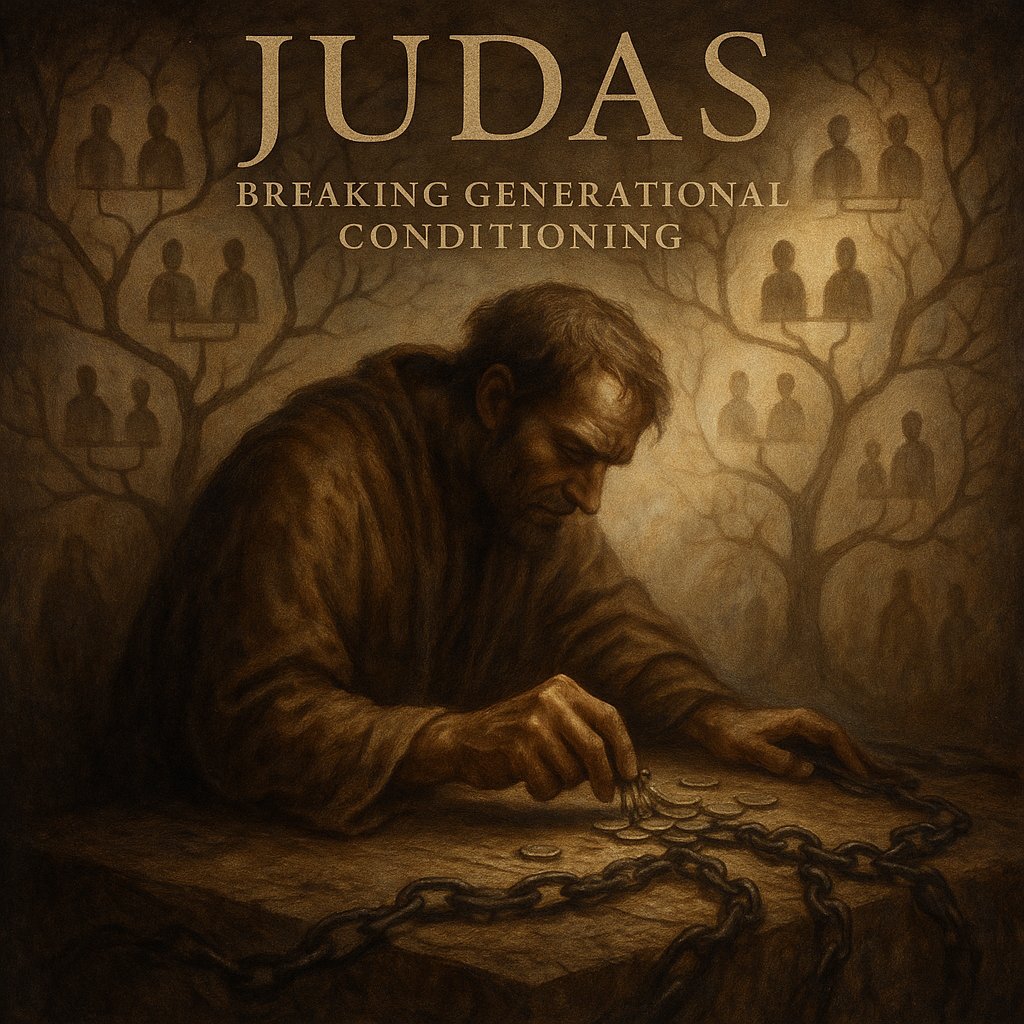
The Ahrimanic dimension of the Judas narrative lies in what he did with his role: he reduced the living spiritual relationship between student and teacher to a material transaction. He answered the question "what will you give me?" (Matthew 26:15) - the Ahrimanic question that evaluates everything in terms of material exchange rather than living relationship. The thirty pieces of silver are not merely a historical detail; they are a symbol of the specifically Ahrimanic form of betrayal: the reduction of spirit to matter, of love to transaction, of living relationship to commodity.
The Thirty Pieces of Silver as Ahrimanic Symbol
In Steiner's interpretation, the thirty pieces of silver represent the Ahrimanic principle at work in human moral life: the tendency to convert every living relationship into a transaction, to measure everything according to material equivalence, and to subordinate spiritual loyalty to material gain.
This is not a small or ancient pathology. Contemporary culture is saturated with it. The commodification of human relationships through digital platforms, the monetisation of every form of human attention and expression, the reduction of education to employability metrics, and the transformation of healthcare into an insurance transaction all express the same Ahrimanic principle that Judas embodied in microcosm. Steiner noted in his 1919 lectures that Ahriman's approach in modern times is precisely through the development of economic systems that infiltrate and reinterpret all human relationships in terms of material exchange value.
The prophetic accuracy of Steiner's analysis of Ahrimanic tendencies in modern culture is striking. Writing in 1919, he described the dominance of economic thinking over all other human domains (what we would now call neoliberalism), the substitution of algorithms and statistical thinking for genuine individual insight (what we would now call data science and machine learning), and the denial of any human experience that cannot be quantified as unscientific (what we would now call scientism), as the specific expressions of Ahrimanic consciousness that humanity needed to recognise and balance.
Generational Conditioning as Inherited Ahrimanic Pattern
Generational conditioning refers to the unconscious transmission of psychological patterns, beliefs, relationship templates, and behavioural tendencies from parents and grandparents to children through both direct modelling and through subtler epigenetic and systemic mechanisms that science is only beginning to understand.
From an Anthroposophical perspective, these transmitted patterns are Ahrimanic in character: they represent past consciousness operating in the present without awareness. A child raised in a family where emotional expression was dangerous learns to suppress emotion as a survival strategy. This suppression becomes automatic, unconscious, and eventually experienced as personality: "I am just not an emotional person." The original conditioning (an appropriate response to a specific childhood environment) has crystallised into a rigid habit that now operates independently of environmental necessity.
This is precisely Ahriman's mechanism: taking what was once a living, appropriate response to a specific situation and hardening it into a mechanical repetition that operates regardless of context. The living wisdom of "be careful here" becomes the dead habit of "always be guarded everywhere." The useful past becomes a binding on the present.
The biblical statement that God "visits the iniquity of the fathers upon the children unto the third and fourth generation" (Exodus 20:5) is, from this perspective, not a statement about divine punishment but an observation about the mechanism of generational transmission. Unresolved psychological patterns in one generation do not vanish; they are transmitted through the family system as unconscious templates that the next generation inherits and is shaped by before they have the awareness to choose differently.
Epigenetic research has recently provided partial biological grounding for this ancient observation. Studies including Michael Meaney's research at McGill University on rat maternal behaviour, published from the 1990s onward, demonstrated that the quality of maternal care alters gene expression patterns in offspring in ways that persist and can be transmitted to subsequent generations. This epigenetic transmission mechanism represents a biological substrate for what Steiner described at the level of karmic pattern transmission.
Ahrimanic Influence in Modern Culture
Steiner's diagnosis of Ahrimanic influence in modern culture is remarkable for its prescience. Writing in 1919, he identified the following tendencies as specifically Ahrimanic expressions that humanity needed to recognise and balance:
The dominance of abstract logical thinking divorced from living experience. Steiner distinguished between "dead" thinking (logical analysis that dissects but does not understand living reality) and "living" thinking (the capacity to think in the same way that nature creates: from within, participating in the creative process rather than observing it from outside). Modern academic education excels at dead thinking and often actively suppresses the development of living thinking.
The development of technology that replaces human relationship with mechanical mediation. Steiner's prediction that "machines" would increasingly substitute for direct human presence and relationship is fulfilled with striking literalness in digital communication platforms, artificial intelligence, and the substitution of algorithmic curation for genuine human editorial judgment.
The reduction of economic life to a purely materialistic framework that eliminates consideration of human dignity, ecological reality, and spiritual necessity. Steiner developed his "Social Threefolding" as an explicit counter to Ahrimanic economic thinking: a framework that insists on the independence of cultural-spiritual life from economic domination.
Recognising Ahrimanic Patterns in Yourself
Common personal Ahrimanic manifestations include: explaining away meaningful coincidences as random; reducing your own or others' emotional experiences to neurochemistry or childhood conditioning without engaging with their meaning; preferring the familiar and predictable even when you know it no longer serves you; compulsive repetition of relationship patterns despite conscious intention to change; and intellectual cynicism that uses sophisticated analysis to avoid genuine engagement with difficult questions. Recognising these patterns is the first step toward addressing them, as Steiner emphasised throughout his pedagogical work.
Shadow Work and Recognising the Ahrimanic Self
C.G. Jung's concept of the shadow, the unconscious dimension of the personality that contains everything the ego has rejected, denied, or failed to develop, offers a complementary framework for understanding Ahrimanic patterns at the personal level. Jung's shadow work (described most accessibly in "The Shadow" chapter of his collected writings and in Marie-Louise von Franz's "Shadow and Evil in Fairy Tales") involves bringing into conscious recognition the rejected aspects of oneself that operate below awareness as autonomous complexes.
Where Steiner describes Ahrimanic patterns as crystallised past conditioning that operates mechanically in the present, Jung describes the shadow as unconscious complexes that possess the personality from within, causing the person to act in ways that contradict their conscious values and intentions. These are, from different angles, descriptions of the same phenomenon: the compulsive repetition of past patterns in the present, operating beneath the threshold of freedom.
Shadow work applied to family systems reveals the generational dimension of personal unconscious patterns. The patterns that feel most definitively "me" are often the most thoroughly inherited, the crystallised condensation of several generations of family survival strategies. Recognising this does not dissolve the pattern automatically, but it shifts the relationship to it: from identification ("this is who I am") to observation ("this is a pattern I inherited, and I can choose to perpetuate it or to work with it differently").
Steiner's Prediction of Ahriman's Physical Incarnation
In his 1919 lecture series "The Ahrimanic Deception" (GA 191), Rudolf Steiner made a specific prediction: that Ahriman would take on physical human incarnation in the Western hemisphere at some point during the third millennium. He described this as a spiritual event of cosmic significance comparable to the Christ incarnation at the turning point of time.
Steiner emphasised that this predicted incarnation was not something to be feared or resisted but something to be understood and consciously met. The danger, he said, lies in humanity being caught unprepared and therefore being taken over by Ahrimanic influence without recognising what is happening. Foreknowledge and the development of genuine spiritual understanding were, in his view, the most effective preparation.
He described specific cultural symptoms of approaching Ahrimanic influence: the spread of materialistic thinking into all domains of life, the development of technologies that create an artificial "world of the spirit" (he specifically described something resembling the internet, an information environment that mimics spiritual interconnection while lacking genuine spiritual content), and the increase of dogmatic scientism that denies the legitimacy of inner experience and spiritual investigation.
Whether one interprets this prediction literally (an actual individual embodying Ahrimanic consciousness) or symbolically (the full cultural manifestation of Ahrimanic tendencies in institutional form), its descriptive accuracy regarding contemporary culture is striking enough to reward serious consideration.
Practices for Countering Ahrimanic Patterns
Basic Anthroposophical Exercises for Ahrimanic Patterns
- Daily review (Ruckschau): Each evening, review the day's events in reverse chronological order, observing yourself as an impartial witness. This builds the capacity for consciousness to observe its own patterns rather than being swept along by them.
- Living thinking: Spend 10 minutes daily taking a natural concept (a plant, a cloud, a simple biological process) and thinking it from the inside, following its own logic rather than imposing categories from outside. This counters the Ahrimanic tendency to reduce living reality to abstract schema.
- Artistic activity: Engage regularly with an art form (painting, movement, music, poetry) that requires bringing living inner experience into form. Steiner particularly recommends eurythmy (movement art based on sound) as a specifically counter-Ahrimanic practice.
- Biographical reflection: At regular intervals (monthly or seasonally), examine your life biography for repeating patterns, particularly where you have repeated a dynamic despite conscious intention not to. What pattern is visible? Where in your family history does this pattern originate?
- The six basic exercises from "How to Know Higher Worlds": Control of thought, initiative in action, composure, positivity, open-mindedness, and their synthesis are Steiner's basic inner development exercises, specifically designed to build the inner organs of perception that Ahrimanic thinking actively suppresses.
Family Systems and Generational Healing
Bert Hellinger's Family Constellation therapy, developed beginning in the 1980s and now practiced internationally, works with generational patterns in family systems by making unconscious loyalties and systemic forces visible through structured group representations. From an Anthroposophical perspective, constellation work can be understood as making the Ahrimanic (past-binding) forces within family karma visible enough to be consciously recognised and addressed.
When a family member is excluded from the family system's acknowledged history (perhaps a relative who died in disgrace, committed a serious crime, or was considered a source of shame), the systemic forces of loyalty and belonging mean that later generations unconsciously identify with or repeat the excluded member's experience without knowing why. Constellation work makes this systemic dynamic visible, allowing conscious acknowledgment and release.
The spiritual dimension of this work, which Hellinger himself approached with increasing openness in his later years, is precisely the domain that Steiner addressed in his treatment of karma and reincarnation. The family karma that constellation therapy makes visible in a single session corresponds to the karmic patterns that Steiner describes as carried across multiple incarnations and worked with over evolutionary time.
Combining Anthroposophical inner development work with family systems awareness provides a powerful approach to generational pattern recognition. The inner exercises build the consciousness needed to observe patterns without identification; the family systems perspective provides the framework for understanding where specific patterns originate and why they are so tenacious.
Explore Rudolf Steiner's complete framework for understanding Ahriman, Lucifer, and the Christ principle in our Hermetic Synthesis Course, which provides systematic engagement with Anthroposophical spiritual science alongside other esoteric traditions.
Steiner on Karma, Repetition, and the Ahrimanic Principle
Rudolf Steiner's framework for understanding generational conditioning cannot be separated from his broader teaching on karma and reincarnation, which he developed most systematically in the lecture series compiled as Karmic Relationships (GA 235-240, 1924) and in his earlier work Reincarnation and Karma (1903). For Steiner, karma is not simply the accumulation of individual actions across lifetimes but the complex web of relational obligations, unresolved spiritual questions, and constitutional tendencies that the ego carries from life to life in search of resolution and development.
The Ahrimanic principle enters this karmic framework as the specific force that tends to crystallize karma into unconscious repetition rather than allowing it to become conscious and therefore potentially transformative. Steiner describes Ahriman's essential character in the 1919 lectures as the desire to bind human consciousness to the past, to make the past so real and so heavy that the future becomes merely a repetition of what has already occurred. Ahrimanic conditioning, in this framework, is precisely what most people call "just the way things are" in their family or culture: the patterns they have so thoroughly absorbed that questioning them does not occur as a possibility.
The Judas narrative becomes relevant here because Judas, in Steiner's reading, represents the spiritual principle of consciousness bound to the material world. The thirty pieces of silver are not simply a betrayal motive but a symbol: they represent the soul that has allowed the evaluation of all things in terms of material worth to become its organizing principle. This is not a judgment of the historical Judas as an individual but an identification of a principle, an Ahrimanic tendency, that can operate within any soul that has lost contact with the spiritual dimension of existence and replaced it with a purely material accounting system for value.
Steiner's point, often missed by readers who encounter his Judas lectures only through summaries, is that the Judas principle is present in every person and in every age as a latent possibility. The betrayal is not of Christ by one man but of the spiritual in the human being by the forces of materialistic consciousness that Ahriman represents. This makes the Judas narrative not a historical curiosity but a living psychological and spiritual diagnostic: where in your life are you unconsciously operating from purely material values in an area that deserves spiritual assessment?
Breaking Ahrimanic Patterns: The Path of Conscious Freedom
Steiner's fundamental teaching about Ahriman, articulated most clearly in "The Ahrimanic Deception" (GA 191, 1919) and in the sculptural group he created for the Goetheanum building (depicting the human being holding the balance between Lucifer above and Ahriman below), is that Ahrimanic forces are not simply evil in the sense of something to be destroyed. They are necessary elements of the cosmic drama of consciousness development. Without Ahriman's hardening principle, consciousness could not crystallize into the clear, precise, logical thinking that modern scientific knowledge requires. The problem is not that Ahriman exists but that human beings can be captured by the Ahrimanic one-sidedly, becoming so thoroughly materialized in their consciousness that they lose contact with the spiritual dimensions of existence.
The path out of Ahrimanic captivity, in Steiner's framework, is not the opposite extreme (the Luciferic tendency toward uncritical spiritual enthusiasm and disconnection from earthly responsibility) but the middle path of developing what he calls the "consciousness soul," the capacity to be genuinely present to both the spiritual and the material, to think clearly and precisely while remaining open to supersensory reality. This is not an easy balance. It requires ongoing inner work of the kind Steiner systematically describes in How to Know Higher Worlds (1904): the development of concentration, equanimity, unprejudiced openness, and positivity through disciplined daily practice.
Applied to generational conditioning specifically, breaking Ahrimanic patterns means bringing them into conscious awareness (the first step, corresponding to shadow work in Jungian terms), developing the inner freedom to observe them without immediate identification (the second step, requiring the equanimity and inner stillness Steiner describes as prerequisites for higher development), and gradually building new capacities in the areas where the crystallized patterns have operated. This is not a single act of insight but a sustained process of inner development, which is precisely why Steiner emphasizes that genuine Anthroposophical practice requires patience and commitment over years and decades rather than the immediate results promised by the many forms of spiritual consumerism that Ahriman inspires.
Practice: Identifying Ahrimanic Patterns in Family Systems
- Take three generations of your family (your parents and at least one set of grandparents) and identify one recurring pattern in each area: relationship to money, relationship to authority, relationship to creative or spiritual aspiration, and physical health.
- For each pattern, ask: does this pattern serve the people in whom it appears, or does it operate automatically regardless of whether it serves them? Ahrimanic patterns characteristically continue regardless of whether they produce good outcomes.
- Identify which of these patterns you recognize in your own life. Note where you have questioned or changed the pattern and where you have continued it without examination.
- Sit quietly for ten minutes and bring the most significant identified pattern into clear mental focus. Don't try to change it; simply observe it with as much neutrality and clarity as you can sustain. Steiner called this kind of concentrated, equanimous attention "exact clairvoyance of the heart": not passive acceptance but clear, unprejudiced seeing.
- Write a short reflection on what freedom in relation to this pattern would look and feel like. Not the absence of the pattern (which often simply inverts it) but genuine inner freedom to respond differently when the pattern's habitual trigger arises.
- Repeat this exercise weekly, rotating through the identified patterns. Steiner's curriculum requires sustained attention over time rather than single transformative insights.
The Biblical Dimension: Exodus and the Third and Fourth Generation
The biblical observation about "visiting the iniquity of the fathers upon the children unto the third and fourth generation" (Exodus 20:5) is one of the most striking anticipations of modern family systems theory in ancient literature. Contemporary practitioners working in epigenetics, family constellation therapy (developed by Bert Hellinger, drawing on Boszormenyi-Nagy's contextual therapy), and intergenerational trauma research have documented the mechanisms through which psychological and even physiological patterns transmit across generations in ways that biblical writers could not have explained but clearly observed.
Steiner's Anthroposophy provides a philosophical framework for understanding this transmission that sits between the purely biological (epigenetic transmission of stress responses and physiological predispositions) and the purely spiritual (karmic debt carried by the soul). In his teaching, the hereditary stream, what we inherit biologically and psychologically from our family lineage, is one of the two primary factors shaping individual constitution; the other is the soul's own karmic content from previous lives. The interaction between these two streams produces the specific individual, with their unique combination of inherited tendencies and individually developed qualities.
Ahrimanic generational patterns are particularly likely to persist across generations because they operate through the hereditary stream: they are not conscious choices that each generation deliberately makes but structural dispositions embedded in family culture, in unconscious communication patterns, in what is valued and what is not spoken of. The family that has never allowed grief to be expressed produces children who cannot grieve; the family that treats all emotional expression as weakness produces adults who manage their own emotional life through the same suppression. These patterns are not karma in the individual sense but they shape the conditions within which individual karma must work itself out.
Integration: Steiner, Jung, and Family Systems in Dialogue
The most productive contemporary approach to Ahrimanic generational patterns draws on three intersecting frameworks: Steiner's Anthroposophical diagnosis of the materializing forces that bind consciousness to unconscious repetition, Jung's shadow work as the method of bringing unconscious content into conscious awareness without judgment, and family systems theory (Hellinger, Bowen, Boszormenyi-Nagy) as the practical framework for mapping how specific patterns transmit through family structures. None of these frameworks is sufficient alone. Steiner provides the philosophical depth and the understanding of supersensory dimensions that Jung's framework lacks; Jung provides the psychological precision and clinical grounding that Steiner's lectures presuppose but do not systematically teach; family systems theory provides the relational mapping without which individual inner work can miss the structural dimensions of inherited patterns. Together they constitute a comprehensive approach to the kind of inner freedom that Steiner consistently identified as the central task of the present stage of human spiritual development.
Deepen Your Understanding of Anthroposophy and Inner Development
The Hermetic Synthesis Course includes dedicated modules on Steiner's inner development path, the Lucifer-Ahriman polarity, and their connections to Western esoteric and philosophical traditions.
Explore the CourseFrequently Asked Questions
Who is Ahriman in Rudolf Steiner's teaching?
In Anthroposophy, Ahriman represents the spiritual principle of hardening, materialisation, and binding to the past, the tendency to crystallise experience into rigid unconscious habit rather than allowing conscious renewal. Steiner discussed Ahriman extensively in his 1919 lecture series "The Ahrimanic Deception" (GA 191) and in his 1923 lecture "The Influences of Lucifer and Ahriman."
What is the Anthroposophical interpretation of Judas?
Steiner in his GA 148 lectures (November 1913) interprets Judas as carrying a specific karmic necessity within the cosmic drama of the Passion rather than as a simple betrayer. The thirty pieces of silver symbolise the Ahrimanic reduction of living spiritual relationship to material transaction.
What is generational conditioning in a spiritual context?
Generational conditioning is the unconscious transmission of psychological patterns and behavioural templates from ancestors through family systems. In Steiner's framework, these are Ahrimanic patterns: crystallised past consciousness operating in the present without awareness or freedom.
What did Rudolf Steiner say about Ahriman's incarnation?
In his 1919 lecture series "The Ahrimanic Deception" (GA 191), Steiner predicted that Ahriman would incarnate in physical human form in the Western hemisphere during the third millennium. He described foreknowledge and genuine spiritual development as the most effective preparation for humanity.
How does shadow work relate to Ahrimanic patterns?
Jung's shadow work addresses unconscious contents that operate as autonomous complexes possessing the personality from within. Ahrimanic patterns operate similarly: crystallised past habits that cause compulsive repetition below the threshold of freedom. Shadow work applied to family systems reveals generational Ahrimanic patterns by bringing them into conscious recognition.
What is the Lucifer-Ahriman polarity in Anthroposophy?
Lucifer represents premature spiritualisation, inflation, and disconnection from earthly reality. Ahriman represents excessive materialisation, crystallisation, and binding to the past. Christ represents the balancing principle. All one-sided tendencies in human psychology can be understood as tilting too far toward one or the other pole.
How do Ahrimanic patterns manifest in daily life?
Ahrimanic patterns manifest as compulsive repetition of unrewarding behaviour, unconscious repetition of parental relationship dynamics, intellectual cynicism that denies the reality of inner experience, excessive attachment to security at the expense of growth, and the tendency to explain away meaningful experience in purely material terms.
What spiritual practices help address Ahrimanic patterns?
Steiner recommends: artistic activity (especially eurythmy), cultivation of living thinking that follows natural processes, biographical reflection bringing unconscious patterns to consciousness, daily review meditation, and the six basic exercises from "How to Know Higher Worlds" (1904): thought control, initiative in action, composure, positivity, open-mindedness, and their integration.
What is the connection between Judas and the thirty pieces of silver?
Steiner interprets the thirty pieces of silver as a spiritual symbol of the Ahrimanic principle: reducing living relationship to material transaction. This represents the betrayal of spirit for material security, the specific Ahrimanic form of betrayal that Judas embodied in the cosmic drama of the Passion.
How does family constellation therapy relate to these ideas?
Family constellation therapy, developed by Bert Hellinger from the 1980s, makes generational systemic patterns visible through structured group representations. From an Anthroposophical perspective, this renders Ahrimanic (past-binding) forces within family karma visible enough for conscious recognition and transformation rather than unconscious repetition.
How does Steiner's teaching on karma relate to generational conditioning?
Steiner's karma teaching (developed in Karmic Relationships, GA 235-240, 1924) distinguishes between the soul's individual karmic content carried across lifetimes and the hereditary stream of family patterns inherited through biological and cultural transmission. Ahrimanic generational patterns operate primarily through the hereditary stream, crystallizing as unconscious habits and family culture that each generation absorbs before developing the consciousness to examine them. Bringing these patterns into conscious awareness is a karmic task as much as a psychological one.
What is the biblical connection to generational conditioning that Steiner draws on?
Steiner connects generational conditioning to the Exodus 20:5 reference to "visiting the iniquity of the fathers upon the children unto the third and fourth generation," reading this not as divine punishment but as an accurate observation of how unconscious patterns transmit across family lineages. Modern family systems therapy, epigenetic research, and intergenerational trauma studies have documented mechanisms for exactly this kind of transmission, providing contemporary scientific context for what biblical writers observed and what Steiner interpreted philosophically.
How do Jung's shadow work and Steiner's Anthroposophy relate to each other?
Jung and Steiner were contemporaries who never directly engaged each other's work, but their systems are complementary. Jung's shadow work provides the psychological methodology for bringing unconscious content into conscious awareness, which is a prerequisite for the inner freedom Steiner describes as the goal of Anthroposophical development. Steiner's framework provides the philosophical and spiritual depth, including the understanding of Ahrimanic forces, that Jung's system lacks. Together with family systems theory, they constitute a comprehensive approach to working with inherited unconscious patterns.
Sources and References
- Steiner, R. (1919). The Ahrimanic Deception (GA 191). Rudolf Steiner Press.
- Steiner, R. (1923). The Influences of Lucifer and Ahriman. Published in Lucifer and Ahriman. Anthroposophic Press (1993).
- Steiner, R. (1909). Occult Science: An Outline. Anthroposophic Press.
- Steiner, R. (1904). How to Know Higher Worlds. Anthroposophic Press.
- Jung, C. G. (1951). Aion: Researches into the Phenomenology of the Self. Princeton University Press.
- Hellinger, B. (2001). Loves Hidden Symmetry: What Makes Love Work in Relationships. Zeig, Tucker and Co.
- Meaney, M. J. (2001). Maternal care, gene expression, and the transmission of individual differences in stress reactivity across generations. Annual Review of Neuroscience, 24, 1161-1192.