
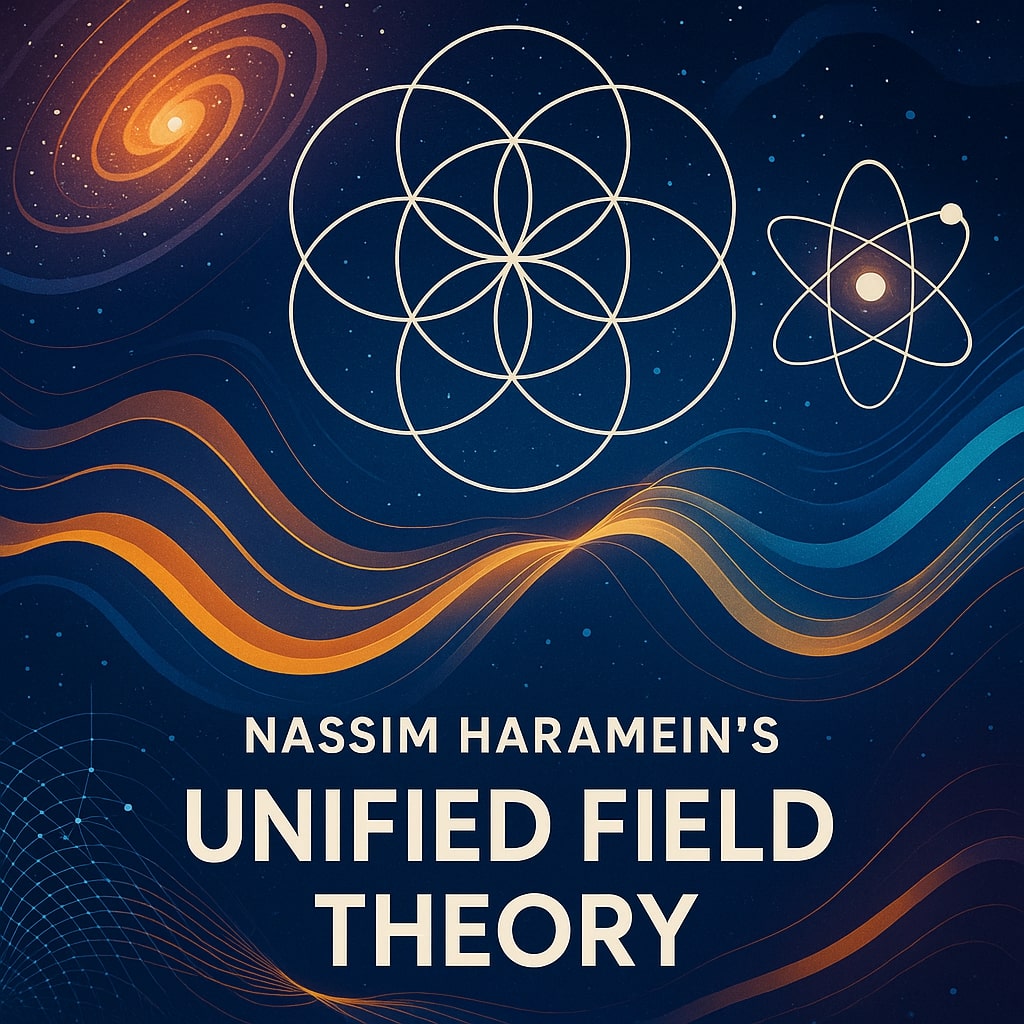
Haramein's Unified Field Theory: The Core Ideas
Nassim Haramein is an independent researcher who proposes that the geometry of space (specifically the 64-tetrahedron grid based on the Vector Equilibrium and Flower of Life) is the fundamental structure of reality at all scales, from subatomic particles to galaxies. His Schwarzschild proton model treats protons as miniature black holes. His Connected Universe framework proposes that all matter is connected through the holographic information structure of the vacuum. His work is widely influential in esoteric and consciousness communities but has not been accepted by mainstream physics, which has raised specific technical objections to his published papers.
Key Takeaways
- Nassim Haramein proposes that the 64-tetrahedron grid, based on the Vector Equilibrium, is the fundamental geometric structure underlying physical reality at all scales.
- His Schwarzschild proton model treats protons as miniature black holes, a claim that mainstream physicists have critiqued on empirical grounds.
- The Connected Universe framework proposes all matter is linked through the holographic information structure of the quantum vacuum.
- Haramein connects his geometric physics to ancient sacred geometry traditions, positioning the Flower of Life and related forms as early intuitions of cosmological structure.
- His work is influential in esoteric and consciousness communities but occupies speculative territory outside mainstream physics; engaging with it requires holding both its conceptual richness and its empirical limitations clearly.
Who Is Nassim Haramein?
Nassim Haramein was born in Geneva, Switzerland, in 1962. He has described spending his childhood asking fundamental questions about the nature of space and coming to early intuitions about the geometric structure of the universe. He is largely self-taught in physics, which is both the source of his independence from institutional constraints and of the technical criticisms that physicists direct at his work.
Haramein founded the Resonance Project (later renamed the Resonance Science Foundation) in 2004. He has lectured extensively around the world, reaching large audiences through YouTube, documentary films, and conference appearances. His 2003 presentation "Crossing the Event Horizon" became widely circulated in alternative science communities. His 2010 paper "The Schwarzschild Proton" won an award at an alternative physics conference in Monaco, though this award has no standing in mainstream academic physics.
Haramein currently divides his time between the Resonance Science Foundation's operations and an active public speaking and online education practice. He is married to the musician and artist Dobrica Deageli, and the couple have been based in Hawaii. His work continues to generate significant interest and controversy in equal measure.
The Core Geometric Framework
The foundation of Haramein's entire theoretical system is geometric. He proposes that the structure of spacetime itself, at the Planck scale (the smallest meaningful unit of length, approximately 1.6 x 10^-35 metres), takes the form of a specific geometric lattice: the 64-tetrahedron grid.
The Vector Equilibrium
The Vector Equilibrium (VE), identified by the architect and systems theorist Buckminster Fuller, is a geometric form also known as the cuboctahedron: a shape with 8 triangular faces and 6 square faces. Its defining property is that all vectors from its centre to its vertices, and all vectors along its edges, are equal in length. Fuller described this as the most fundamental geometric state of equilibrium, the condition of perfect balance from which all other forms emerge through departure from that equilibrium.
Haramein identifies the Vector Equilibrium as the basic unit of space. He proposes that space at the Planck scale consists of closely-packed Vector Equilibria, creating the 64-tetrahedron grid (formed when you compound the VE with its dual forms). This grid, he argues, is the zero-point or ground state of the vacuum: the condition of the universe before any perturbation creates the structures we observe as matter and energy.
The 64-Tetrahedron Grid and the Flower of Life
The 64-tetrahedron grid consists of 64 tetrahedra (triangular pyramids) arranged in specific geometric relationships. Haramein connects this directly to the Flower of Life sacred geometry pattern, a series of overlapping circles that generates, in its interior structure, the forms of the Vector Equilibrium and other key geometries. He argues that ancient cultures that used the Flower of Life pattern in sacred art and architecture were encoding knowledge of this fundamental geometric structure of the vacuum.
This connection is central to why Haramein's work resonates so strongly in the sacred geometry community. He is not simply using sacred geometry as metaphor but making the stronger claim that sacred geometry traditions preserved accurate cosmological knowledge that his physics framework now provides a mathematical basis for.
Scale Invariance and Fractal Structure
A consistent theme in Haramein's framework is that the same geometric and dynamic principles apply at all scales: from the Planck scale through the atomic, molecular, biological, planetary, stellar, and galactic. He presents examples of toroidal flow patterns appearing in galaxies (the double lobed jets of active galactic nuclei), in the Earth's magnetic field, in the electromagnetic fields of the human heart, and in the seed geometry of plants. This scale invariance is not unique to Haramein's ideas ; it resonates with fractal geometry, the holographic principle in quantum gravity, and various systems-theory frameworks. What is specific to his framework is the claim that this scale invariance is explained by the fundamental geometry of the vacuum lattice.
The Schwarzschild Proton Model
The most technically detailed and most technically criticized part of Haramein's work is his Schwarzschild proton model, first presented formally in his 2010 paper.
The Basic Claim
The Schwarzschild radius equation from general relativity gives the radius at which any mass would become a black hole if compressed to that density. Haramein applies this equation to the proton, calculating what the Schwarzschild radius would be for an object with the proton's known size and a mass density consistent with the Planck density (the density of spacetime at the Planck scale). He concludes that the proton behaves as a miniature black hole, with the vacuum energy within the proton's volume generating the mass associated with it.
This model, if correct, would unify general relativity (gravity) with quantum mechanics (the strong nuclear force) at the proton scale. It would explain why the proton is stable, predict the proton charge radius, and potentially resolve the longstanding problem of quantum gravity.
The Holographic Mass Solution
In 2013, Haramein published what he calls the Holographic Mass Solution, an update to the Schwarzschild proton model. This paper attempts to calculate the proton mass from the ratio of Planck spherical units on the surface of the proton to those in its volume, using a holographic principle approach. He claimed this calculation predicted the proton charge radius to close agreement with experimental values available at the time.
In 2019, the CODATA (Committee on Data for Science and Technology) revised the accepted value of the proton charge radius downward slightly (from approximately 0.8775 fm to 0.8414 fm), following improved measurements using muonic hydrogen. Haramein and his colleagues argued this revised value aligns more closely with his model than the previous value did.
The Technical Criticism
Mainstream physics has raised specific objections to Haramein's Schwarzschild proton model. The most significant, detailed in a critique by physicist Bob Eisele, concerns the proton mass. Haramein's Schwarzschild proton model predicts a proton mass on the order of 10^14 grams, approximately 38 orders of magnitude larger than the measured proton mass of approximately 1.67 x 10^-24 grams. An error of 38 orders of magnitude is not a small discrepancy to be resolved by refinement; it represents a fundamental disagreement with observed reality.
Haramein's response to this criticism is that the apparent mass discrepancy is explained by the ratio of surface-to-volume information in his holographic framework, with most of the proton's vacuum energy not contributing to the measured inertial mass. Whether this response adequately addresses the empirical discrepancy is a matter of ongoing debate in the communities that follow his work.
The Connected Universe
The Connected Universe is Haramein's broader cosmological framework, extending his geometric and proton black hole ideas into a comprehensive theory of the relationship between matter, consciousness, and space.
The Holographic Vacuum
Drawing on the holographic principle from quantum gravity research (particularly 't Hooft and Susskind's work on black hole information), Haramein proposes that the information contained in any volume of space is encoded on its surrounding surface. At the Planck scale, this means that the vacuum is not empty but is instead filled with an enormous density of information: every point in space contains the information of the whole, in the manner of a hologram.
This holographic vacuum is what Haramein means when he speaks of the connectivity of all things. Every proton, because it is a Schwarzschild radius entity in his model, has an event horizon surface that encodes the information of the entire universe. Consciousness, in his framework, arises from or is an aspect of this informational connectivity: each individual awareness is a localized expression of the universal information field.
Implications for Consciousness
Haramein explicitly connects his physical framework to questions of consciousness, identity, and the nature of self. In his model, the sense of separation between self and world is an artifact of the localization of awareness within a particular physical structure, while the underlying reality is total informational connectivity. This framework positions meditation, spiritual practice, and states of expanded consciousness as experiences of the actual underlying physics: moments when the local contraction of awareness relaxes and the more fundamental connectivity becomes perceptible.
This is the bridge that makes Haramein's work so significant to consciousness practitioners. He offers not just a metaphor for interconnectedness but a purported physical mechanism: the holographic vacuum information structure of the Planck lattice.
The Double Torus
The torus (a donut-shaped surface) and the double torus (a system of two tori sharing a central point, with flow spiralling outward in one torus and returning through the other) are central to Haramein's dynamic model of how energy organizes itself in space.
He presents toroidal energy flow as the universal pattern of dynamic organization: the way that any self-sustaining energy system maintains itself by continuously cycling between expansion and contraction, outward radiation and inward absorption. He shows examples of this pattern across scales: the torus-shaped electromagnetic field of the Earth, the spiral arms of galaxies above a galactic centre, the apical-basal growth pattern of plants, and the toroidal electromagnetic field generated by the beating human heart (which has been confirmed by research at the HeartMath Institute).
The double torus is also central to his model of atomic structure and of the vacuum itself. In his framework, the Vector Equilibrium transitions into a toroidal flow pattern as energy begins to move, creating the spin that is the fundamental property of quantum particles. The proton and the electron, in his model, are specific configurations of this toroidal vacuum flow.
Sacred Geometry and Ancient Knowledge
One of the most consistently developed themes in Haramein's presentations is the claim that ancient cultures around the world encoded knowledge of the fundamental geometry of spacetime in their sacred art, architecture, and symbol systems.
The Flower of Life, found inscribed in the Temple of Osiris at Abydos, Egypt, in the Forbidden City in Beijing, in ancient Assyrian bas-reliefs, and in numerous other sites across the ancient world, is in Haramein's analysis a precise representation of the 64-tetrahedron grid of the vacuum lattice. The Sri Yantra, the central diagram of Hindu Tantric cosmology, encodes the same geometric relationships from a different visual perspective. The Islamic geometric tradition, with its rigorous use of circles, hexagons, and specific angular relationships, reflects the same underlying geometry. The architecture of ancient temples and stone circles, Haramein argues, was designed with this cosmological geometry as its organizing principle.
Whether or not one accepts the physical claims in Haramein's physics, this interpretive framework gives contemporary sacred geometry practitioners a new way of understanding their tradition: not as decorative aesthetics or symbolic convention but as a body of cosmological knowledge preserved in visual and architectural form across thousands of years and many independent cultures. The consistency of the Flower of Life's appearance across geographically separate ancient cultures is itself a phenomenon that requires some explanation, and Haramein's interpretation is one of several that take this consistency seriously.
Scientific Reception: An Honest Assessment
A fair engagement with Haramein's work requires being honest about both its strengths and its limitations as physics.
Within mainstream physics, Haramein is not considered a serious contributor to the field. His papers have not been published in peer-reviewed physics journals of standing. The specific technical objections raised by physicists, particularly the proton mass discrepancy of 38 orders of magnitude in the Schwarzschild proton model, have not been resolved to the satisfaction of the physics community. His use of legitimate physics concepts (holographic principle, Planck units, Schwarzschild radius) in contexts and combinations that do not follow from the mathematical frameworks those concepts belong to is a persistent source of criticism.
At the same time, the questions Haramein raises are genuine and important ones. The unification of quantum mechanics and general relativity is one of the central unsolved problems in physics. The relationship between the structure of the vacuum and the properties of matter is an active area of research. The possibility that holographic principles apply at the scale of the proton is not absurd in principle, even if Haramein's specific version of this idea has problems. The observation that toroidal patterns appear across many scales in nature is real, even if the explanation for why this is so requires more than Haramein provides.
For those engaging with Haramein's work from a spiritual or philosophical perspective, the honest position is probably this: his framework offers a rich, geometrically sophisticated cosmological vision that resonates with perennial wisdom traditions and provides a vocabulary for discussing the unity of matter, energy, consciousness, and geometry. Whether it is valid physics in the technical sense matters less for this purpose than whether it is a useful framework for understanding the universe at the level of meaning and pattern.
Why Spiritual Communities Find This Work Compelling
Haramein's popularity in esoteric and spiritual communities is not accidental or naive. There are genuine reasons why his framework resonates with practitioners who would not describe themselves as interested in physics for its own sake.
First, he offers physics-language support for the fundamental intuition of interconnectedness that is central to most spiritual traditions. "All is one" is a spiritual axiom; a holographic vacuum in which every point encodes the whole gives this axiom a geometric and physical basis. Second, he rehabilitates sacred geometry as cosmological knowledge rather than superstition. Third, he provides a framework in which consciousness is not an embarrassing add-on to a fundamentally material universe but is woven into the informational structure of space itself. Fourth, his scale-invariant model (the same geometry from Planck to cosmic scales) supports the Hermetic axiom "as above, so below" as something more than metaphor. Fifth, he presents his ideas in accessible, visually rich presentations that give non-physicists a genuine sense of understanding rather than mere deference to expertise.
These are real strengths of his work at the level of meaning-making, and they explain why his influence has grown rather than faded despite the physics community's rejection of his technical claims.
The Resonance Science Foundation
The Resonance Science Foundation (RSF) is the organization through which Haramein conducts his public educational and research activities. Based in Kauai, Hawaii, the RSF produces online courses, public lectures, and community events centered around Haramein's unified field framework.
The RSF's Delegate Programme is a structured online curriculum covering Haramein's physics framework in depth, drawing connections to biology, cosmology, consciousness studies, and practical self-development. Thousands of people have completed this programme, creating an international community of practitioners who apply Haramein's geometric cosmology as a framework for understanding both physics and personal transformation.
The RSF has also produced several documentary films: "The Black Whole" (2011), which presents the core physics of the Schwarzschild proton and connected universe; and "The Connected Universe" (2016), which contextualizes Haramein's ideas within the broader landscape of consciousness research, ancient traditions, and alternative cosmology. Both have been widely circulated in alternative science and spirituality communities.
Engaging With Haramein's Work Thoughtfully
If you are drawn to Haramein's framework, a few principles for thoughtful engagement are worth considering.
First, read the criticism. Understanding why physicists criticize his work helps you engage with his ideas at a more sophisticated level and protects you from overinvesting in specific empirical claims that may not hold up. Second, separate the geometric and philosophical framework from the specific technical claims. The idea that toroidal patterns organize energy at multiple scales, that sacred geometry encodes cosmological principles, and that consciousness may be an aspect of the informational structure of space are interesting and generative ideas regardless of whether the Schwarzschild proton model is technically correct. Third, treat this as a starting point, not an endpoint. Haramein's work, whatever its technical limitations, points toward real questions: quantum gravity, the structure of the vacuum, the nature of consciousness, the relationship of ancient knowledge to modern science. Follow those questions where they lead, including into the mainstream scientific literature on quantum field theory, holographic principles, and consciousness studies.
The Holographic Universe: The Revolutionary Theory of Reality by Talbot, Michael
View on AmazonAffiliate link — your purchase supports Thalira at no extra cost.
Frequently Asked Questions
Who is Nassim Haramein and what does he claim to have discovered?
Nassim Haramein is a Swiss-American independent researcher and public speaker who proposes a unified field framework he calls the Resonance Project or the Connected Universe theory. His central claims are that the geometry of space itself (based on the 64-tetrahedron grid and the Vector Equilibrium) is the foundation of physical structure from the quantum to cosmic scales, and that protons behave as black holes whose mass can be calculated using Schwarzschild radius equations.
What is Haramein's Schwarzschild proton model?
Haramein's Schwarzschild proton model proposes that the proton can be modelled as a mini black hole, with its mass calculated using the Schwarzschild radius equation from general relativity. He published a paper in 2010 making this claim. Mainstream physicists have criticized this model: the predicted proton mass differs from the measured value by approximately 38 orders of magnitude, and the model does not appear to make testable predictions that distinguish it from existing models in nuclear physics.
What is the connected universe theory?
The Connected Universe is a broader framework proposed by Haramein in which the Planck-scale structure of space itself connects all matter across all scales. In this view, every proton is connected to every other point in the universe through the holographic information structure of the vacuum. Haramein uses this framework to propose that consciousness, information, and matter are unified aspects of a single geometric field. This framework is not accepted within mainstream physics but has significant influence in esoteric and consciousness studies communities.
What is the double torus in Haramein's theory?
The double torus is a geometric form central to Haramein's unified field model. He proposes that energy flows through the universe at every scale in a toroidal pattern: spiralling outward from a central point, arcing around the surface, and returning through the centre. This pattern appears in galaxies, hurricanes, plants, electromagnetic fields, and atoms. The torus appears in both physics research (plasma physics, electromagnetic field modelling) and sacred geometry traditions.
Has Haramein's work been accepted by mainstream science?
No. Haramein's papers have been largely rejected by mainstream physics journals and his work has been specifically criticized by physicists. A technical critique by physicist Bob Eisele pointed out that Haramein's Schwarzschild proton paper predicts a proton mass approximately 10^38 times larger than the measured value. Haramein holds no academic physics position and his papers have been published in non-peer-reviewed or alternative physics venues. His work is more accurately categorized as speculative theoretical physics or metaphysics with physics language.
Why do spiritual communities find Haramein's ideas compelling?
Haramein speaks to themes that matter deeply in esoteric and spiritual communities: the fundamental interconnectedness of all things, the significance of sacred geometry as a structural principle of the cosmos, the possibility that consciousness is woven into the fabric of physics, and the idea that the ancients understood geometric cosmological principles that modern science is only now approaching. These ideas resonate with perennial philosophical traditions, and his accessible presentation style makes complex physics language approachable.
What is the Vector Equilibrium in Haramein's framework?
The Vector Equilibrium (also called the cuboctahedron) is a geometric form identified by Buckminster Fuller in which all vectors from the centre to the vertices and along the edges are equal in length. Haramein considers this the most fundamental geometric form in the universe, the state of perfect balance from which all other geometric structures emerge. He connects it to the 64-tetrahedron grid, which he identifies with the matrix of the Flower of Life sacred geometry pattern.
What is Haramein's connection to sacred geometry?
Haramein argues that ancient sacred geometry traditions, including the Flower of Life, Metatron's Cube, and the geometric grids encoded in ancient monuments, represent an intuitive or direct perception of the fundamental geometric structure of spacetime. He presents his unified field geometry as the mathematical basis for what the ancients encoded symbolically, positioning sacred geometry as ancient cosmological knowledge rather than decoration.
How does Haramein relate to quantum physics?
Haramein draws extensively on the language and concepts of quantum physics, particularly quantum vacuum energy (zero-point energy), holographic principles from quantum gravity research, and the role of the Planck scale. His use of these concepts has been criticized by physicists as selective and imprecise. His relationship to quantum physics is best understood as analogical and metaphorical rather than technical and predictive.
What is the Resonance Science Foundation?
The Resonance Science Foundation (formerly the Resonance Project) is Haramein's non-profit organization based in Kauai, Hawaii. It produces educational content, online courses, and conferences oriented around his unified field framework. The foundation hosts the Delegate Programme, an online curriculum training people in Haramein's cosmological model, and has produced documentary films including "The Black Whole" and "The Connected Universe."
Sources and Further Reading
- Haramein, N. (2010). The Schwarzschild proton. AIP Conference Proceedings, 1303.
- Haramein, N., & Val Baker, A.K.F. (2019). Resolving the vacuum catastrophe: A generalized holographic approach. Journal of High Energy Physics, Gravitation and Cosmology, 5(2).
- Eisele, B. (2011). Analysis of Nassim Haramein's "The Schwarzschild Proton." Available: Skeptical community analysis, physics forums.
- Fuller, R.B. (1975). Synergetics: Explorations in the Geometry of Thinking. Macmillan.
- 't Hooft, G. (1993). Dimensional reduction in quantum gravity. arXiv:gr-qc/9310026.
- Susskind, L. (1995). The world as a hologram. Journal of Mathematical Physics, 36(11), 6377-6396.